

November 16, 2026 – The Federal Reserve will raise payment prices 1.4% on average next year. Check processing bears the brunt, while FedACH and FedNow get no new changes.
In Summary
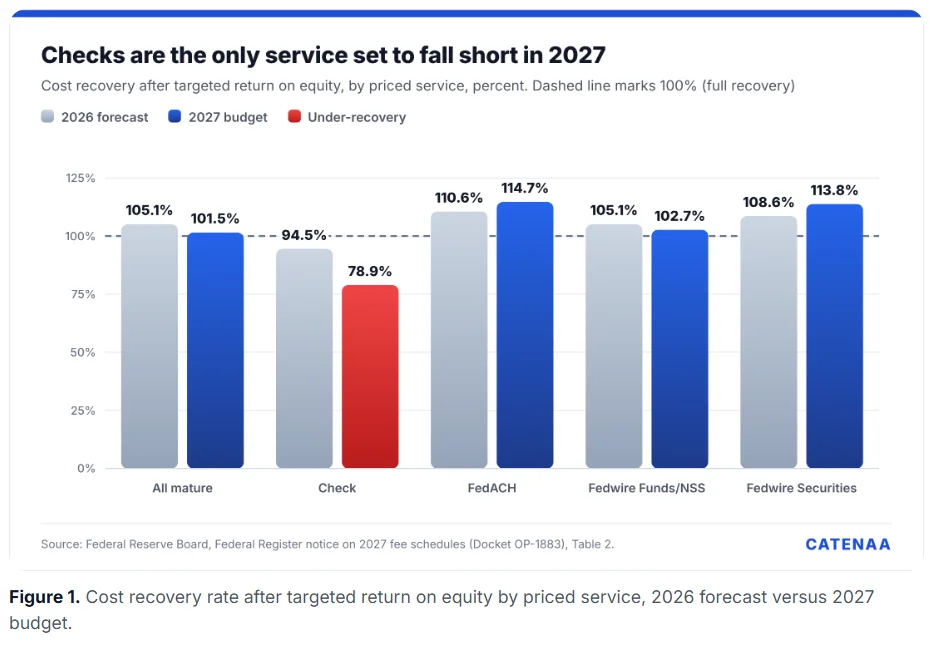
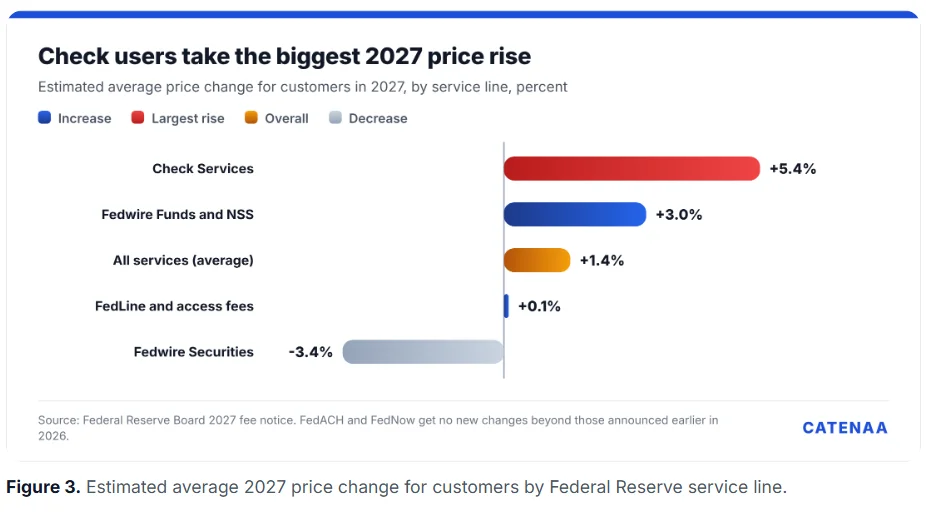
The Fed expects to recover 101.5% of its costs in 2027, with an average 1.4% price rise.
Check Services face a 5.4% average increase, and FedReceipt item fees triple.
FedACH fees stay unchanged, and FedNow gets no new changes beyond those announced earlier in 2026.
A new FRFS Access Fee of $300 a month per parent institution replaces several FedLine charges.

The Federal Reserve has set its Fed fees for 2027, and the bill lands unevenly. Banks that clear large check volumes will pay noticeably more. By contrast, ACH-heavy banks and their fintech partners see little direct change.
What the Board approved
The Board announced the 2027 schedules on November 12, effective January 1. It expects to recover 101.5% of actual and imputed costs. Prices for established services will rise 1.4% on average.
The law shapes these numbers. The Monetary Control Act of 1980 requires the Fed to recover costs over time. That includes an imputed private-sector profit. From 2016 through 2025, it recovered 103.7% of costs for mature services.
The 2027 target is down from a 105.1% forecast for 2026, according to the Federal Register notice. Budgeted 2027 revenue of $550.5 million would exceed total expense of $531.5 million by $19.0 million.
Why Fed fees rise most for checks
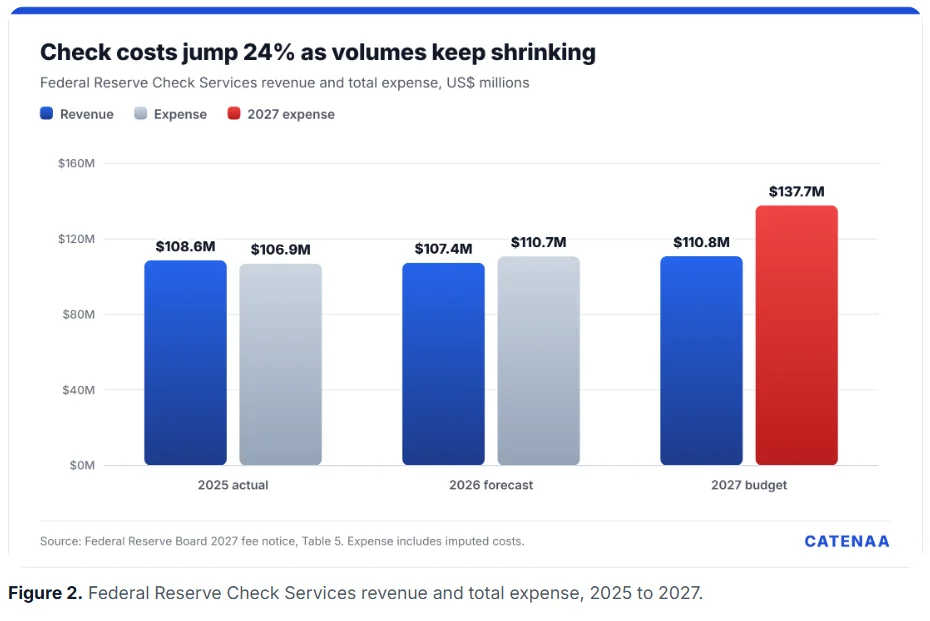
Check Services expect to recover only 78.9% of costs in 2027. Expenses jump 24.3% to $137.7 million as the Reserve Banks invest in aging systems. Meanwhile, revenue rises just 3.2% to $110.8 million.
To narrow the gap, FedReceipt item fees will triple, from $0.0005 to $0.0015. Reject repair, premium delivery, FedImage and return reclear fees climb about 20%. Overall, check customers face a 5.4% average increase.
Volumes keep shrinking, too. Through August 2026, commercial forward check volume ran 8.7% below a year earlier. Americans wrote about 9 billion checks in 2024, down from roughly 40 billion in 2000, according to the Payments Study.
Furthermore, from May 2027 check processing will open five hours later on Sundays. It will also close 18 hours earlier on Saturdays.
ACH and instant payments hold steady
FedACH fees stay unchanged in 2027. Even so, FedACH should recover 114.7% of costs, and the Fed expects commercial receipt volume to grow 6.2% this year.
The FedNow Service also gets no new changes beyond those announced earlier in 2026. However, those earlier moves matter for low-volume users. The free tier for the first 2,500 transactions a month ends, and an incentive program starts on January 1.
FedNow handled about 12.0 million transactions from January through August. Its forecast 2026 operating costs reach $236.1 million.
Who pays more, and who pays less
Fedwire Funds transfer fees edge up, with the Tier 1 price rising from $0.970 to $0.980. Those customers face a 3.0% average increase, partly to fund longer operating hours and resilience work. In contrast, Fedwire Securities fees fall about 3.4%.
The new FRFS Access Fee costs $300 a month per parent institution and $270 for each additional active routing number. Payment processors acting for banks pay $10 per routing number. In return, FedLine Web and FedLine Advantage become free, and most other connection fees fall. The Fed expects these access changes to be revenue neutral, according to the staff memo.
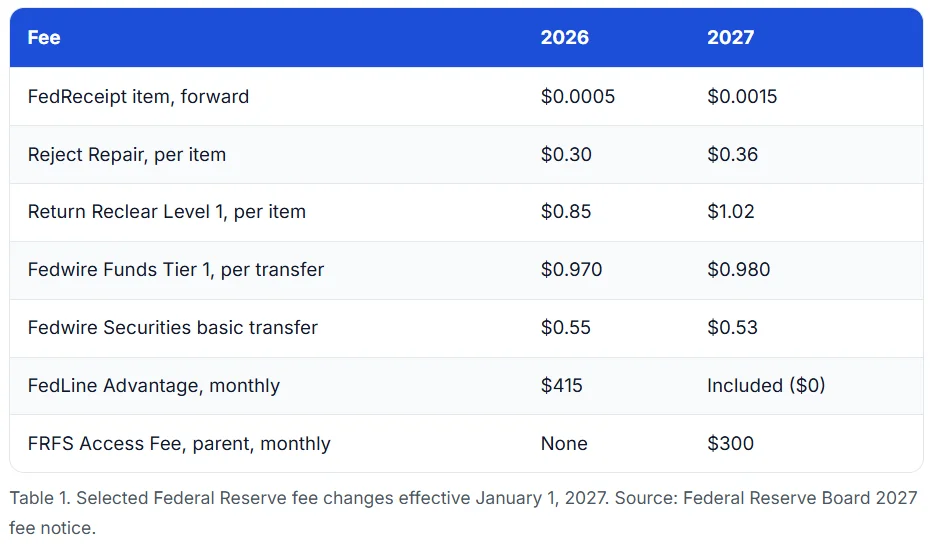
Consider a bank group with three active routing numbers. Its access fees would total $840 a month before any 25% discount. Yet free FedLine Advantage, which cost $415 a month in 2026, offsets part of that bill. Full schedules sit on the Financial Services site.
For fintechs, Fed fees matter mainly through their sponsor banks. Those banks may pass the new access charge on to program partners. Still, flat ACH pricing keeps the core cost of moving money predictable in 2027.
The broader message is clear. The Fed will keep checks running. Yet it plans regular fee increases to move the service back toward full cost recovery.