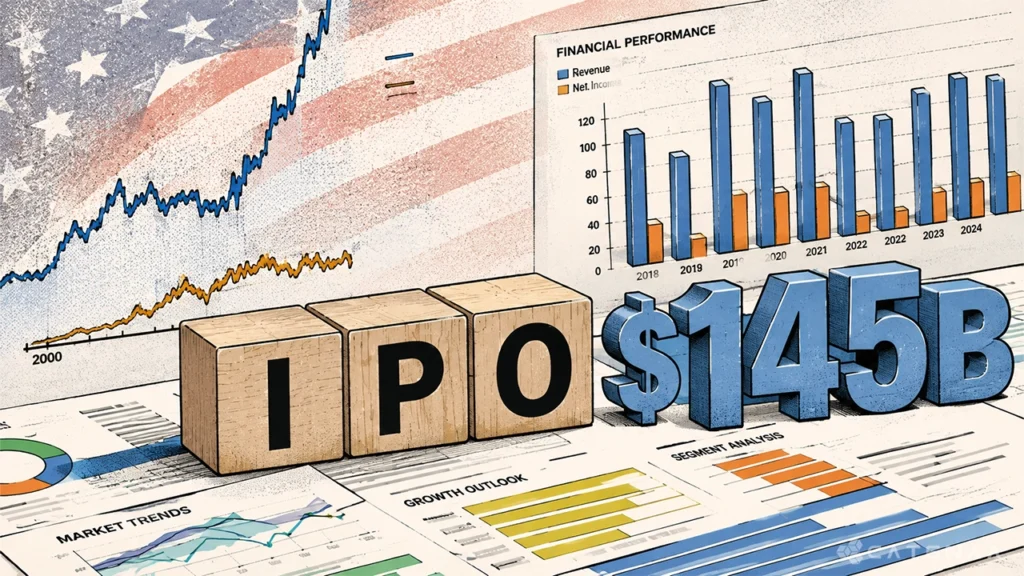


August 19, 2026 – Fewer companies have listed this year than last. Even so, three giant deals have already pushed proceeds past the 2021 peak.
In Summary
US listings have raised $145.5bn in 2026, beating the 2021 record of $142.4bn.
Only 102 deals have been priced, a fall of 25.5% from last year.
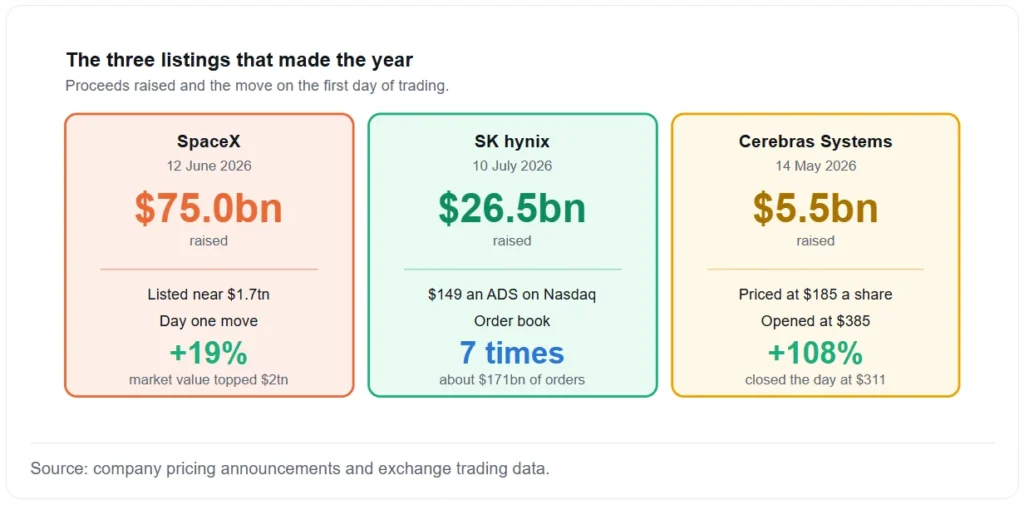
SpaceX raised $75bn in June, more than half the annual total.
SK hynix took $26.5bn in the largest US listing ever by a foreign company.
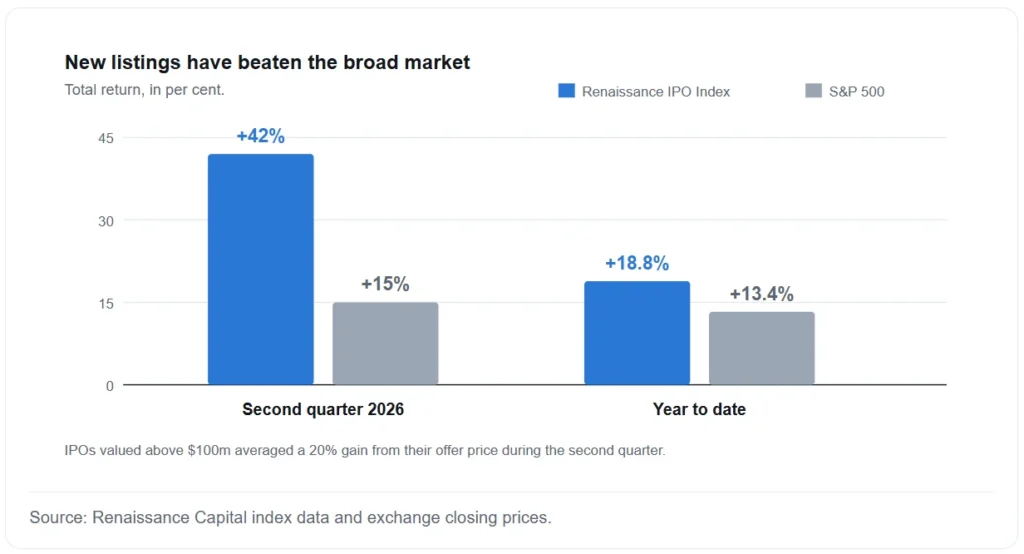
The Renaissance IPO Index has gained 18.8% this year against 13.4% for the S&P 500.
Anthropic and OpenAI have both filed confidentially, so the pipeline stays heavy.
A record broken in seven months
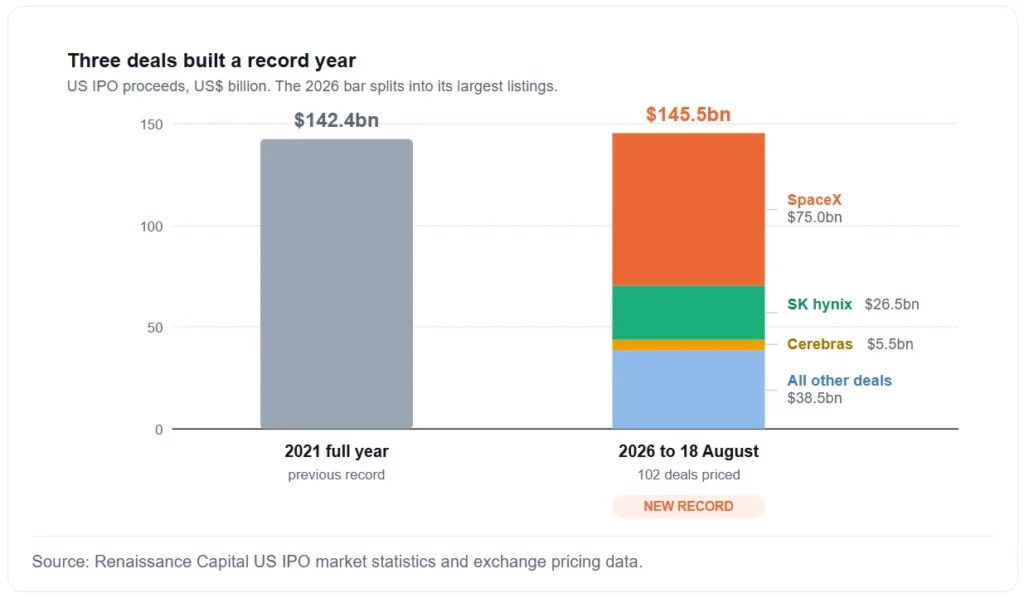
The US IPO market has already set a new high. Companies priced 102 deals and raised $145.5bn by mid-August. That total passed the previous record of $142.4bn, set across the whole of 2021.
Deal counts tell a different story. Pricing is down 25.5% against the same point last year. Proceeds, by contrast, have risen more than sixfold. In short, the market has fewer, far larger listings.
The second quarter carried most of the load. Bankers priced 48 IPOs worth $104.8bn between April and June. Nine deals besides SpaceX each raised at least $1bn.
Three deals did the heavy lifting
Concentration defines this record. SpaceX alone raised $75bn, or 52% of the annual total. SK hynix added $26.5bn and Cerebras Systems $5.5bn. Everything else priced this year comes to about $38.5bn.
Strip the top three out, and 2026 looks ordinary. The remaining 99 deals would rank well below 2021. Therefore, the headline number says more about scale than about breadth.
One launch company rewrote the scale
SpaceX listed on 12 June and raised $75bn. Shares rose 19% on the first session. Market value then pushed above $2tn, having listed near $1.7tn.
That single offering exceeded all US IPO activity from the previous two calendar years combined. Few bankers expected a private company to absorb so much demand at once. Above all, the deal proved that public markets could still price a trillion-dollar debut.
SK hynix set a foreign listing record
South Korea’s memory chipmaker followed on 10 July. SK hynix sold 177.9m American depositary shares at $149 each, raising $26.5bn on Nasdaq. Investors placed about $171bn of orders, so the book covered the deal seven times over.
No foreign company had ever raised more in a US listing. The previous mark belonged to Alibaba, which took $25bn in 2014. Demand for advanced memory used in AI servers drove the interest.
A chipmaker reopened the tech window
Cerebras Systems started the run in May. The AI chipmaker priced 30m shares at $185, well above an initial range of $115 to $125. Bankers had already lifted that range once, to $150 to $160.
Trading was wild. Shares opened at $385, up 108% on the offer. They closed the session at $311, valuing the company near $66bn. Consequently, other technology issuers began preparing their own filings.
August belongs to biotech
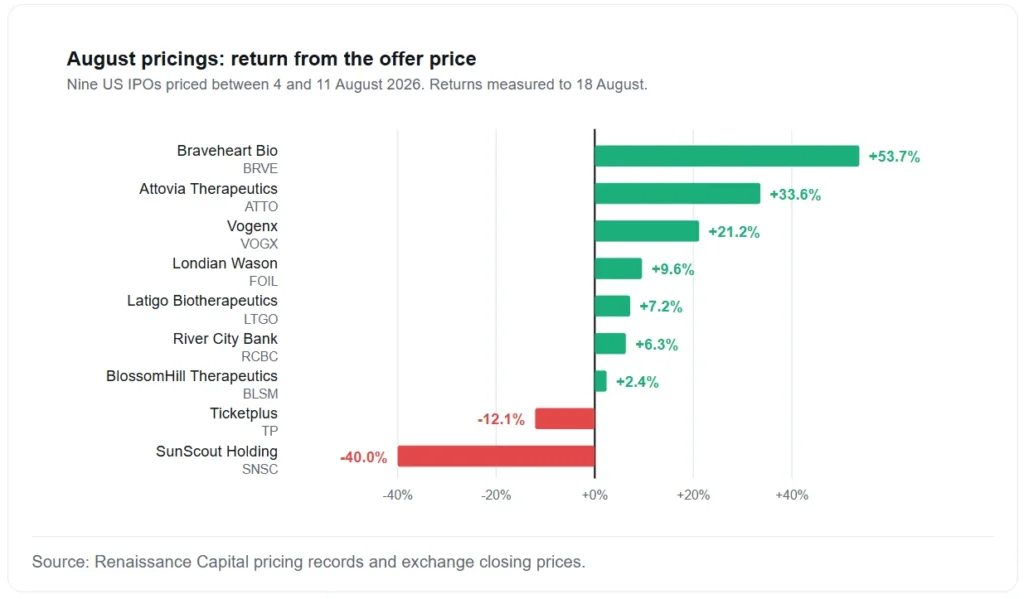
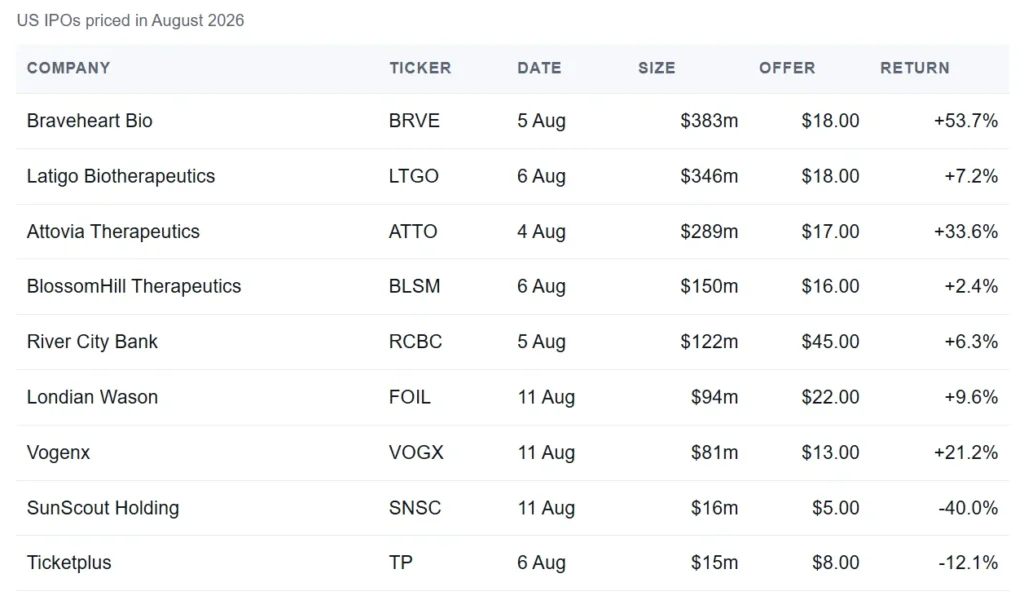
Summer brought a change of character. Nine companies priced between 4 and 11 August, and most were drug developers. Braveheart Bio led with $383m and now trades 53.7% above its offer price.
Attovia Therapeutics raised $289m and sits 33.6% higher. Latigo Biotherapeutics took $346m for a 7.2% gain. Meanwhile, BlossomHill Therapeutics has barely moved after its $150m deal.
Smaller offerings fared worse. SunScout Holding trades 40% below its $5 offer. Ticketplus, which priced 43% under its midpoint, has lost a further 12.1%.
Traditional issuers also appeared. River City Bank raised $122m at $45 a share and trades 6.3% higher. In addition, five blank cheque vehicles raised $605m during the first week of the month.
Returns have beaten the market
Buyers of new issues have done well this year. The Renaissance IPO Index gained 42% during the second quarter. Over the same three months, the S&P 500 added 15%.
Year to date, the gap has narrowed but held. New listings are up 18.8% against 13.4% for the benchmark. Deals valued above $100m averaged a 20% gain from their offer price in the second quarter.
Those numbers explain the rush to file. Issuers see a receptive market, and investors see a working trade. Nevertheless, August’s smaller deals show the bid does not reach everywhere.
The pipeline runs through AI
New filings hit their highest quarterly level since 2021. Anthropic and OpenAI have each filed confidentially, which points to further mega deals. OpenAI submitted its paperwork in June, shortly after its rival.
Older sectors are joining too. Jersey Mike’s and Tailored Brands have both filed. So the window is not limited to technology or biotech.
Two deals sit on the near-term calendar. Lyntris plans to sell 24m shares on the New York Stock Exchange at $19 to $22, raising up to $492m. MetaOptics follows on Nasdaq with a smaller $18m offering.
A boom that stops at the border
Global figures look far less exciting. Companies worldwide have raised about $201bn from listings in 2026. The 2021 comparison stands at $394bn, so the wider market remains subdued.
American exchanges are therefore taking share. Foreign issuers want dollar liquidity and index inclusion. SK hynix chose Nasdaq for exactly those reasons.
What could break the run
Risks sit close to the surface. Venture-backed technology stayed largely absent from the second quarter, despite the headline totals. Most proceeds came from mature businesses with real revenue.
Rates present the second threat. Long-dated yields have climbed, which raises the discount applied to future profits. Should Jackson Hole shift expectations next week, pricing talks could stall quickly.
Finally, performance has to hold. A run of broken deals like SunScout would cool sentiment fast. For now, the record stands, and the fourth-quarter calendar looks unusually crowded.