


November 15, 2026 – Sixty new bankers will chase firms with $50 million to $1 billion in sales. The prize is sticky deposits and fee income.

In Summary
U.S. Bank plans to add 60 middle-market banking roles, including hires in Texas, Florida and California.
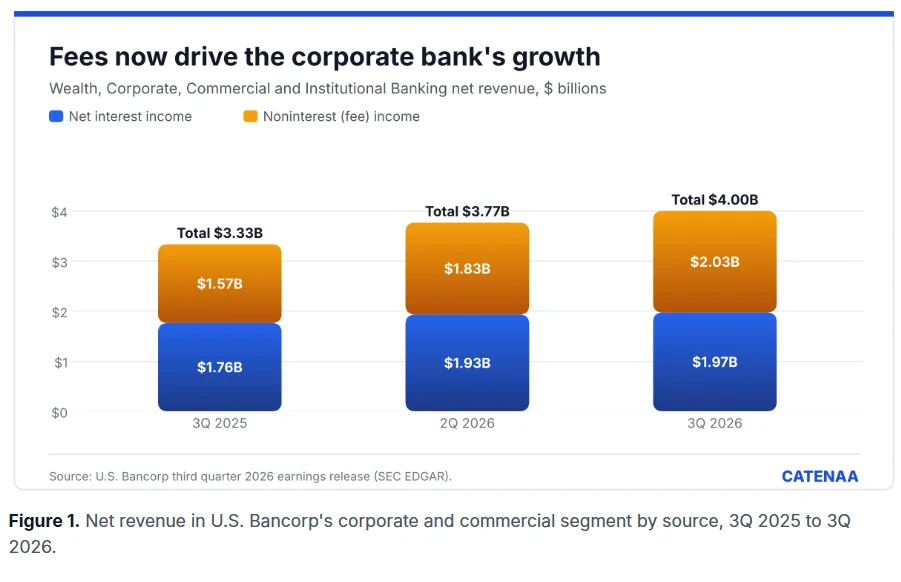
Its corporate and commercial segment grew net revenue 19.9% from a year earlier, to nearly $4.0 billion.
Fee income in that segment jumped 28.9%, ahead of 11.9% growth in net interest income.
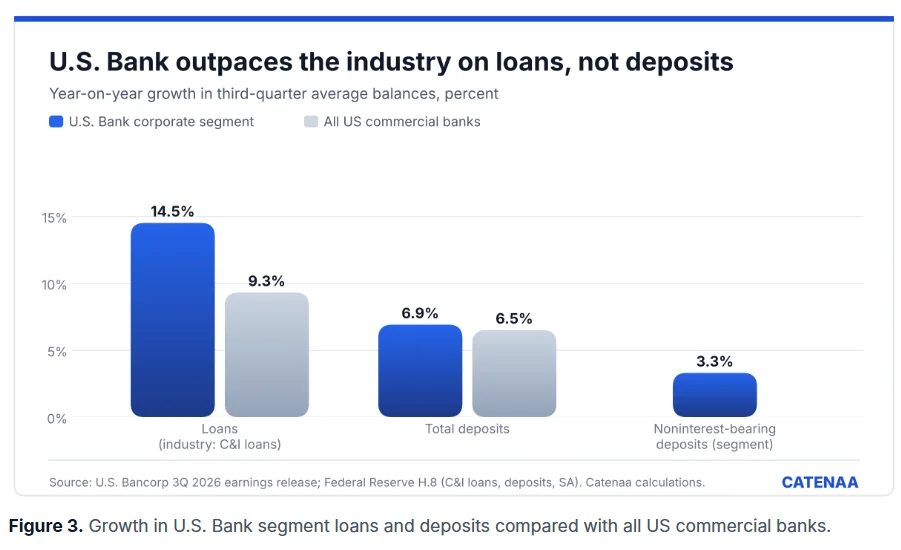
Segment deposits grew 6.9%, close to the 6.5% gain across all US banks, per Catenaa calculations.
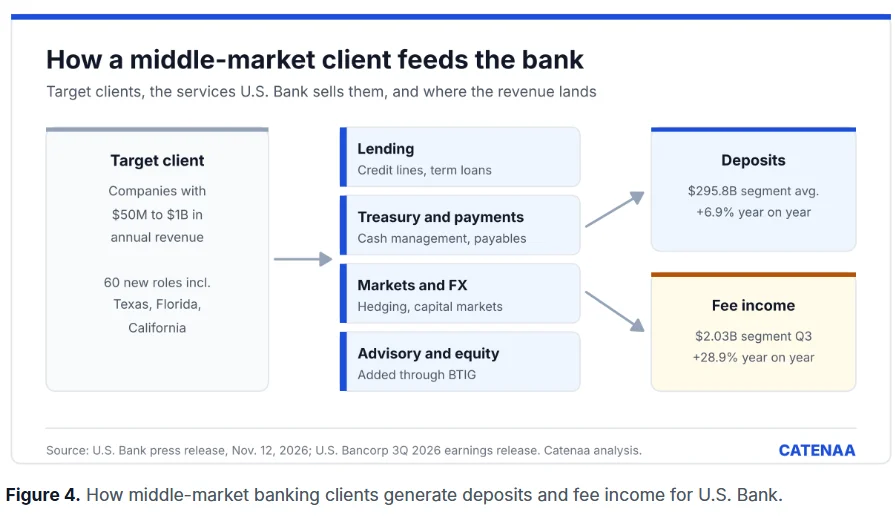
U.S. Bank wants a bigger share of America’s mid-sized companies. The lender said on Nov. 12 it will add 60 roles to its middle-market banking team in the coming months. Hiring will include Texas, Florida and California. The team serves firms with annual revenue between $50 million and $1 billion.
The move is about more than loans. Mid-sized firms hold operating cash, make payments and trade currencies. Each of those needs can produce deposits and fees. The bank says its offer spans lending, treasury management, payments, capital markets, foreign exchange, advisory and equity. Its recent purchase of BTIG expands the last two.
The market is large. The bank cites an estimate of about 200,000 middle-market firms in the US. Together, they account for roughly a third of private-sector GDP. U.S. Bank, which calls itself the fifth-largest US commercial bank, wants more of that wallet.
Why middle-market banking matters
In fact, the bank already leans on this business. Its Wealth, Corporate, Commercial and Institutional Banking segment earned $1.6 billion in the third quarter, per its earnings release. That was about 73% of group net income of $2.2 billion, by Catenaa’s math.
Segment revenue reached $4.0 billion, up 19.9% from a year earlier. Net interest income rose 11.9%. Meanwhile, fee income climbed 28.9%. Costs grew too, with segment expenses up 17.3%. Even so, revenue grew faster than costs, so the unit still gained operating leverage.
Fees are growing faster than lending
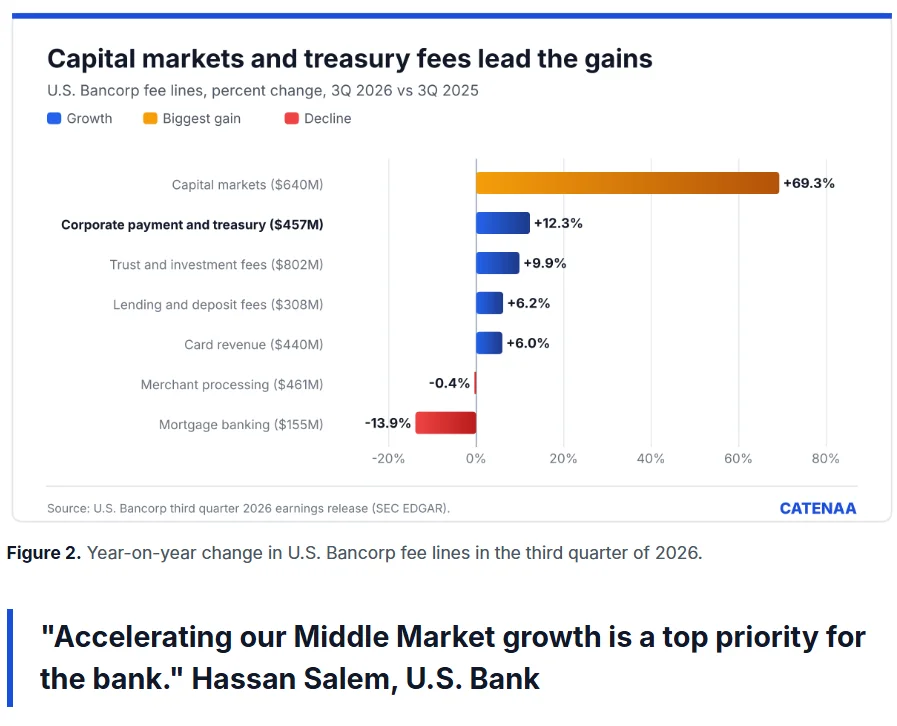
Capital markets revenue drove much of the fee surge. It rose 69.3% across the group, helped by the BTIG deal. Corporate payment and treasury management revenue also rose 12.3%, to $457 million. In addition, trust and investment fees grew 9.9%. Across the group, total fee revenue rose 14.9% to $3.5 billion.
That second line matters most for a cash push. Treasury services tie a client’s daily cash flows to the bank. As a result, those ties can make client links harder to move.
Hassan Salem leads Middle Market in the bank’s Institutional Client Group. “Accelerating our Middle Market growth is a top priority for the bank,” he said in the release.
The battle for deposits
Deposits are the real prize. The segment held $295.8 billion in average deposits in the third quarter, up 6.9% from a year earlier. Of that, $57.9 billion paid no interest, a gain of 3.3%.
For context, deposits at all US commercial banks rose about 6.5% over the same period. Catenaa based that figure on Federal Reserve H.8 data. Business loans across the industry grew about 9.3%. By comparison, the segment’s average loans jumped 14.5%.
The segment’s loan book is broader than business loans, so the comparison is only a guide. Still, U.S. Bank is growing loans faster than the market. Deposit growth, however, is only keeping pace. That gap may help explain the hiring push.
Margins and what to watch
The bank’s net interest margin rose to 2.84% from 2.75% a year earlier. Average total deposits grew 2.9% across the group. Group net income rose 10.0% to $2.2 billion. Moreover, the common equity tier 1 capital ratio stood at 10.8%. Its quarterly report gives the full segment detail.
Next, watch whether new bankers lift low-cost deposits, not just loans. The next quarterly results on the bank’s investor site will offer a first test of middle-market banking momentum.