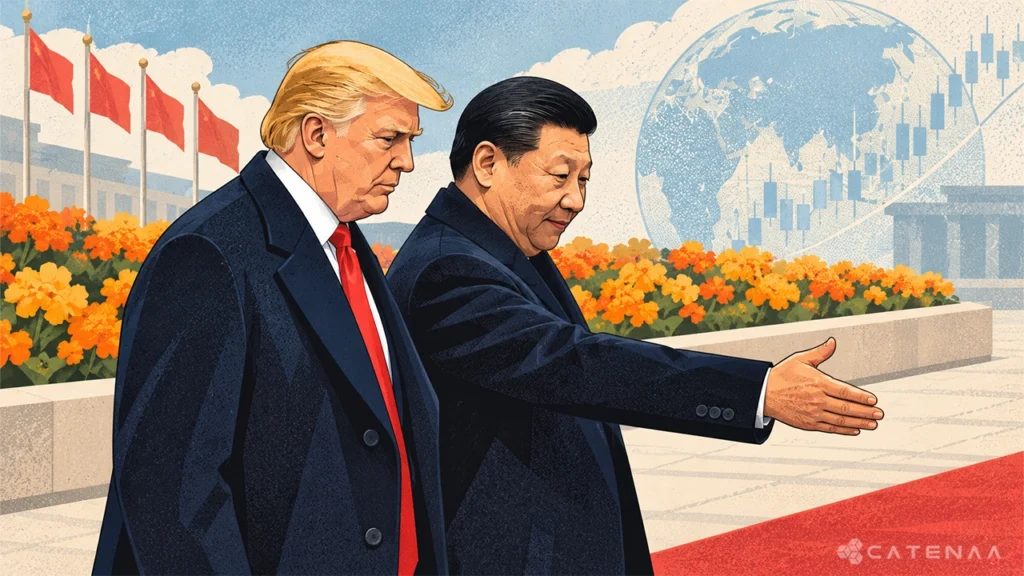


September 22, 2026 – Xi Jinping’s first White House visit in more than a decade comes as U.S. imports from China recover, Chinese Treasury holdings fall and the yuan hits a four-year high.

In Summary
Xi Jinping begins a state visit to Washington on 23 September, his first White House visit in more than a decade.
May’s Beijing deals included $17 billion a year in U.S. farm purchases and an initial 200 Boeing aircraft.
The U.S. goods deficit with China fell to $202.7 billion in 2025, the smallest since 2005.
Imports from China fell 19.4% in January to July but rebounded to $27.1 billion in July.
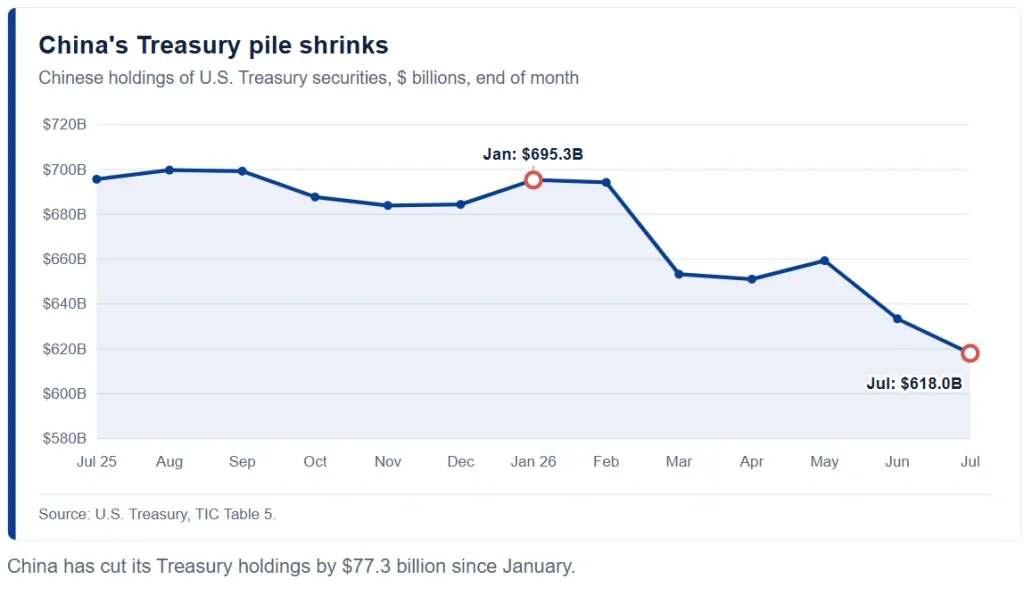
China’s Treasury holdings dropped 11.1% since January to $618.0 billion, while the yuan hit its strongest since July 2022.
Chinese President Xi Jinping lands in Washington on Wednesday for a three-day state visit. The Trump-Xi summit marks his first White House visit in more than a decade, the White House said. For markets, it arrives at a delicate moment for trade, bonds and currencies.
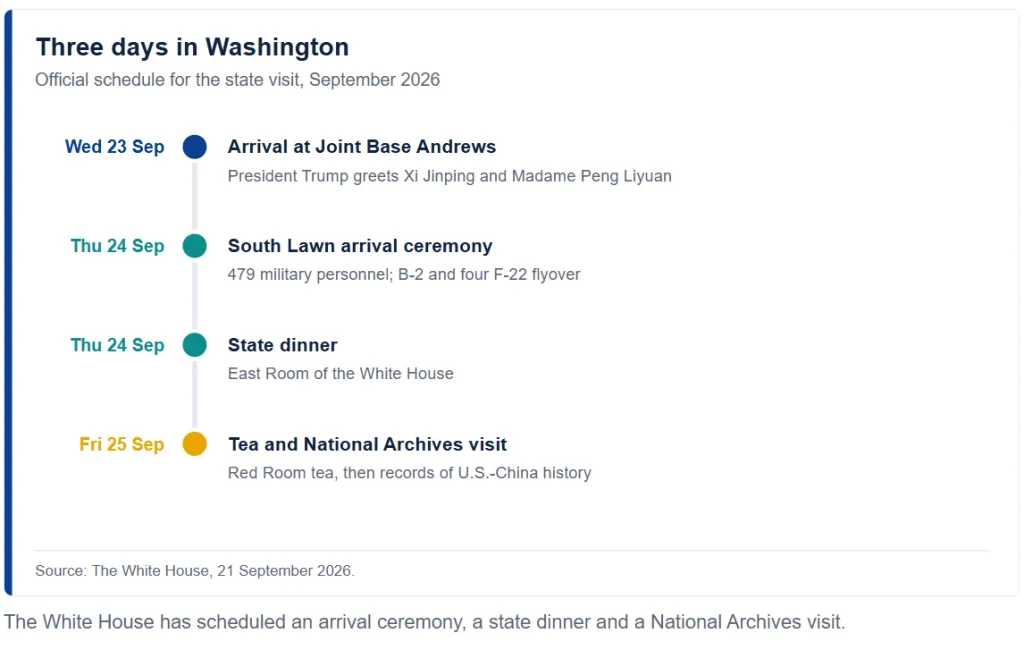
President Trump will greet Xi and Madame Peng Liyuan at Joint Base Andrews on 23 September. The formal welcome follows on Thursday. A South Lawn ceremony will feature 479 military personnel. A B-2 bomber and four F-22 jets will fly overhead. An East Room state dinner closes the day.
On Friday, the leaders take tea in the Red Room. They then visit the National Archives to view records on U.S.-China history.
Building on the May Beijing Deals
The visit follows Trump’s trip to Beijing in May. At that time, the White House listed a set of commitments from China. Beijing agreed to buy at least $17 billion a year of U.S. farm goods in 2026, 2027 and 2028. It also approved an initial purchase of 200 Boeing aircraft.
Rare earths featured as well. China pledged to address supply concerns over yttrium, scandium, neodymium and indium. Furthermore, the two sides created a U.S.-China Board of Trade and a Board of Investment.
Still, the fact sheet left key gaps. It set no tariff levels and no dates for most steps. So this week offers a chance to turn broad pledges into firm numbers and timelines.
Trade Deficit Shrinks, Imports Recover
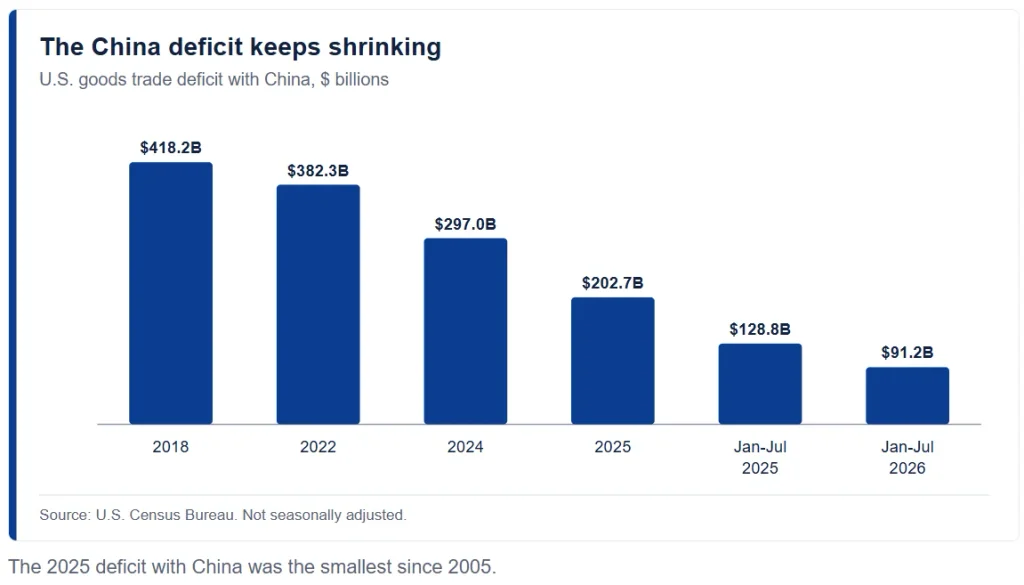
The trade data show how far the relationship has shifted. The U.S. goods deficit with China fell to $202.7 billion in 2025, Census Bureau data show. That was the smallest since 2005. It compares with $297.0 billion in 2024 and a peak of $418.2 billion in 2018.
The squeeze continued this year. From January to July, imports from China fell 19.4% to $156.4 billion. Exports, by contrast, held flat at $65.2 billion. As a result, the seven-month deficit narrowed to $91.2 billion from $128.8 billion.
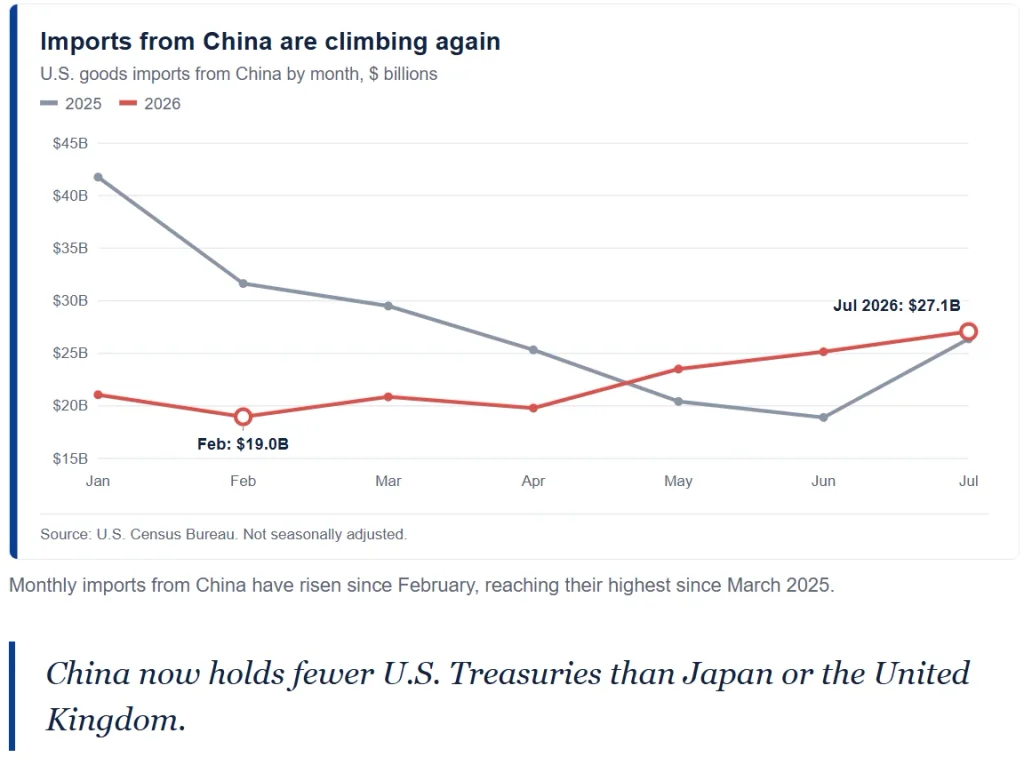
However, the trend has started to turn. Monthly imports climbed from $19.0 billion in February to $27.1 billion in July. That July figure was the highest since March 2025. In other words, Chinese goods have flowed back since the May deals.
U.S. sales to China, however, have moved more slowly. Exports reached $9.7 billion in July, up 4.4% from a year earlier. So far, the data show no clear lift from the farm and aircraft pledges. As a result, Washington will want evidence that the promised purchases are starting to land.
China Sells Treasuries Ahead of the Trump-Xi Summit
Bond investors have a separate worry. China held $618.0 billion of U.S. Treasuries at the end of July, Treasury data show. That was down $77.3 billion, or 11.1%, since January.
China now ranks third among foreign holders. Japan leads with $1,103.9 billion, while the United Kingdom holds $998.3 billion. Notably, China’s share of all foreign holdings has slipped to about 6.7%.
The contrast with other holders is striking. Over the year to July, China cut its holdings by 11.2%. Japan trimmed its stake by 4.5%. The United Kingdom, meanwhile, added 11.4%. So the selling looks specific to Beijing rather than a broad retreat from U.S. debt.
Timing makes the drop sensitive. The Federal Reserve raised rates on 16 September, and the 10-year yield closed at 5.01% on 18 September. A steady seller of Treasuries adds pressure at the margin. Therefore, any signal on Chinese reserve policy will draw close attention.
A Stronger Yuan Sets the Tone
Currency markets tell a calmer story. The yuan traded at 6.6975 per dollar on 18 September, Federal Reserve data show. That was its strongest level since July 2022.
A year earlier, the rate stood at 7.1125. That means the yuan has gained about 6.2% against the dollar. Since the end of 2025, it has risen about 4.4%. A firmer yuan makes Chinese exports slightly more expensive in dollar terms. It also eases one long-running U.S. complaint about currency policy.
What Investors Should Watch
Three outcomes matter most. First, markets want proof that the farm and Boeing deals are moving. Soybean prices and aircraft orders would reflect any progress quickly.
Second, investors will watch for tariff relief or new technology rules. Either could move chipmakers, carmakers and battery stocks. Third, bond traders will look for any hint on China’s Treasury holdings.
Finally, tone matters as much as terms. A warm Trump-Xi summit could support the yuan and Asian equities. A cold one, however, could revive fears of a fresh trade war.