


October 25, 2026 – A chip-led selloff pushed investors into bonds on Thursday. The 10-year yield posted its biggest one-day drop since 2024.

In Summary
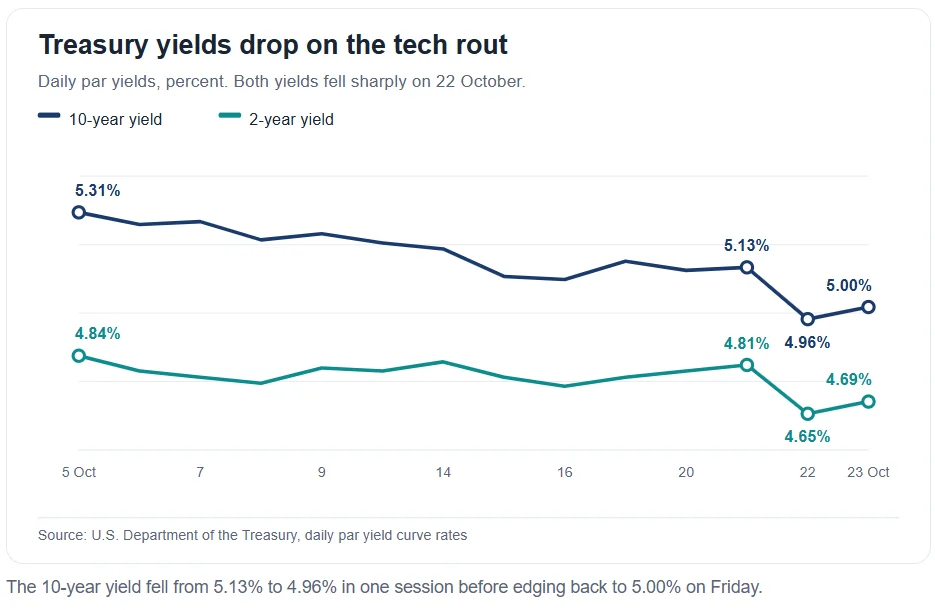
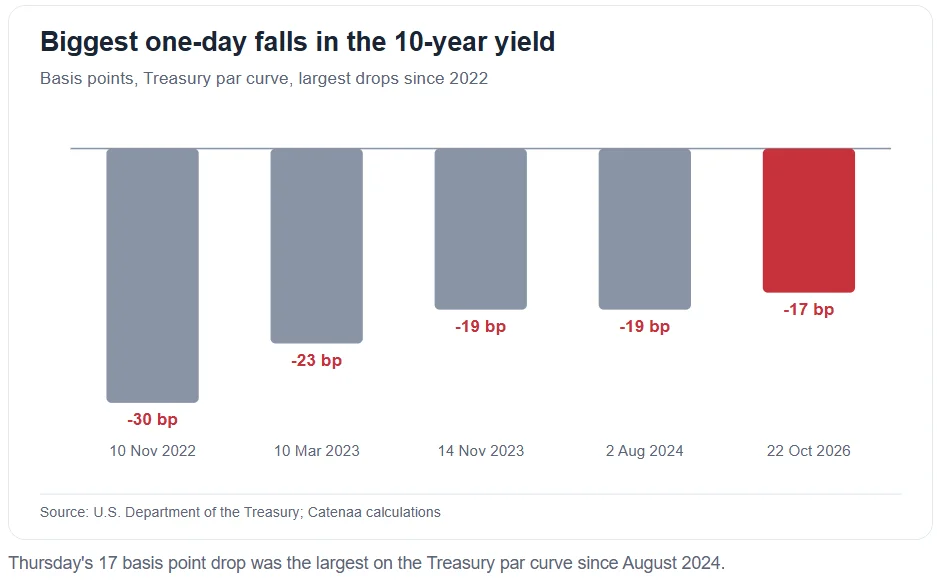
The 10-year yield fell 17 basis points to 4.96% on 22 October, according to Treasury data.
That was its biggest one-day drop on the Treasury par curve since August 2024.
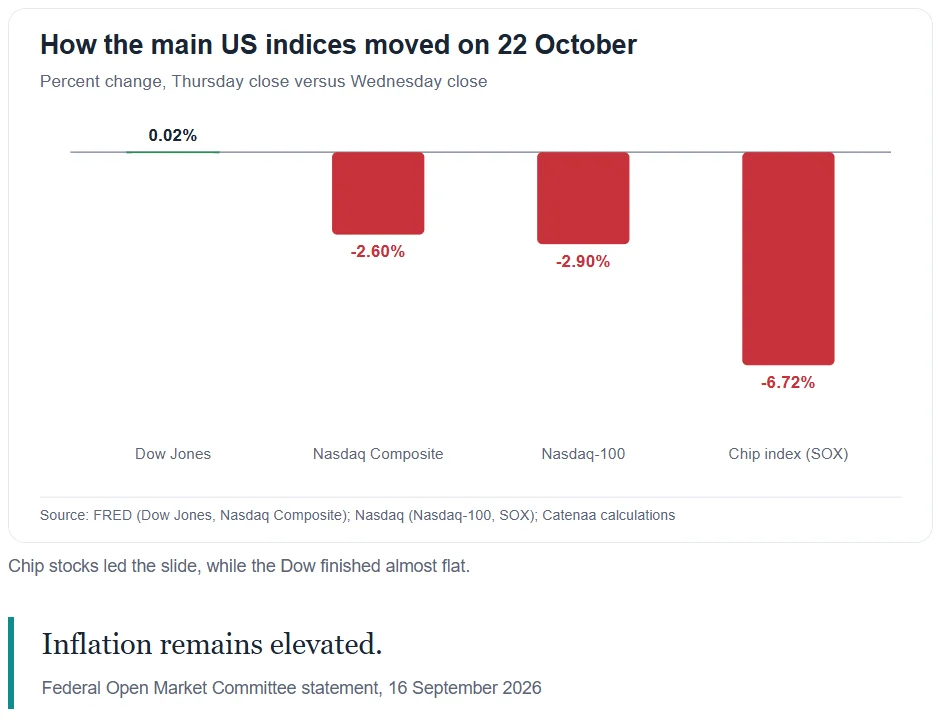
The Nasdaq Composite lost 2.60%, while the chip index sank 6.72%.
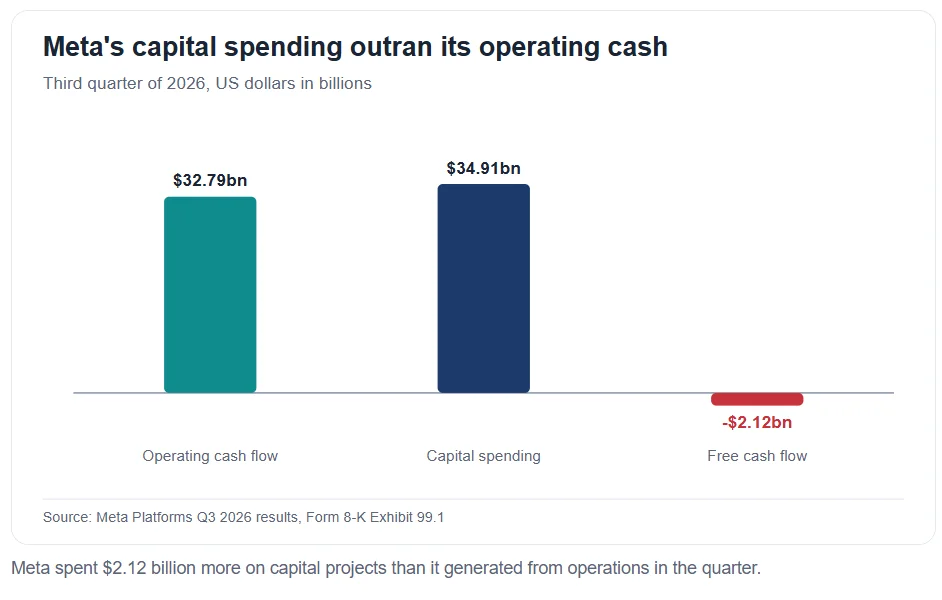
Meta posted negative free cash flow of $2.12 billion as AI spending climbed.
Yields edged back to 5.00% on Friday, ahead of the Fed meeting on 27 and 28 October.
Treasury yields fell sharply on Thursday as a tech rout sent investors into government bonds. The 10-year yield dropped 17 basis points to 4.96%, according to Treasury par yield data. That marked its biggest one-day fall since 2 August 2024. Meanwhile, the two-year yield slid 16 basis points to 4.65%.
Why Treasury yields fell so fast
The trigger came from stocks. The Nasdaq Composite dropped 2.60% to 26,008.86, based on index data from FRED. Chip shares fared far worse. The chip index lost 6.72% in a single session, Nasdaq data show. As a result, money rushed toward safety, and bond prices rose.
Doubts about the cost of AI added to the strain. Meta, for example, released third-quarter results on 21 October. Revenue rose 26% to $64.60 billion. However, capital spending hit $34.91 billion, above its $32.79 billion of operating cash flow. That left free cash flow at negative $2.12 billion. Its shares then fell 6.98% on Thursday.
Rate hike bets cool
The bond rally also shifted the rate outlook. The Federal Reserve raised its target range by a quarter point in September, to 3.75% to 4.00%. Its statement warned that “inflation remains elevated.” Two-year yields tend to track where traders expect Fed policy to go. So their 16 basis point slide points to less tightening ahead.
The shape of the curve barely changed. The gap between 10-year and two-year Treasury yields stood at 31 basis points on Thursday, against 32 a day earlier. In other words, both ends fell almost equally. That pattern looks more like a broad flight to safety than a sudden shift in growth views.
Chip stocks bear the brunt
The selling did not hit every sector equally. The Nasdaq-100 fell 2.90%, while the Dow Jones Industrial Average edged up 0.02%. In other words, investors dumped growth shares but kept the rest. The chip index closed at 10,731.98, down from 11,505.56 a day earlier.
Thursday’s fall also deepened a longer slide. On 13 October, the chip index closed at 12,208.79, so it has lost 12.1% in seven sessions. It now sits 26.7% below its 22 June high of 14,634.72. Even after Friday’s small bounce to 10,779.46, the index ended the week close to those lows. Chip investors, it seems, want proof that heavy AI budgets will pay off.
Friday brings a partial rebound
Calm returned on Friday, but only in part. The 10-year yield rose to 5.00%, and the two-year yield climbed to 4.69%. Elsewhere, the Nasdaq Composite slipped another 0.21% to 25,955.34. By contrast, the chip index gained 0.44%. Even so, Treasury yields at the long end remain well below early October levels. The 10-year yield still sits 31 basis points under its 5 October reading.
What comes next for Treasury yields
The Fed meets on 27 and 28 October. Several large tech firms also report earnings next week. Their spending plans will matter for both stocks and bonds. If budgets keep rising, worries about returns could flare again and push Treasury yields lower once more. On the other hand, strong profits could ease the pressure. For now, the 5% mark on the 10-year yield is the line to watch.