


September 27, 2026 – The government sold $183bn of notes in three days. Demand thinned beyond two years, and long-dated yields climbed to levels last seen before the financial crisis.

In Summary
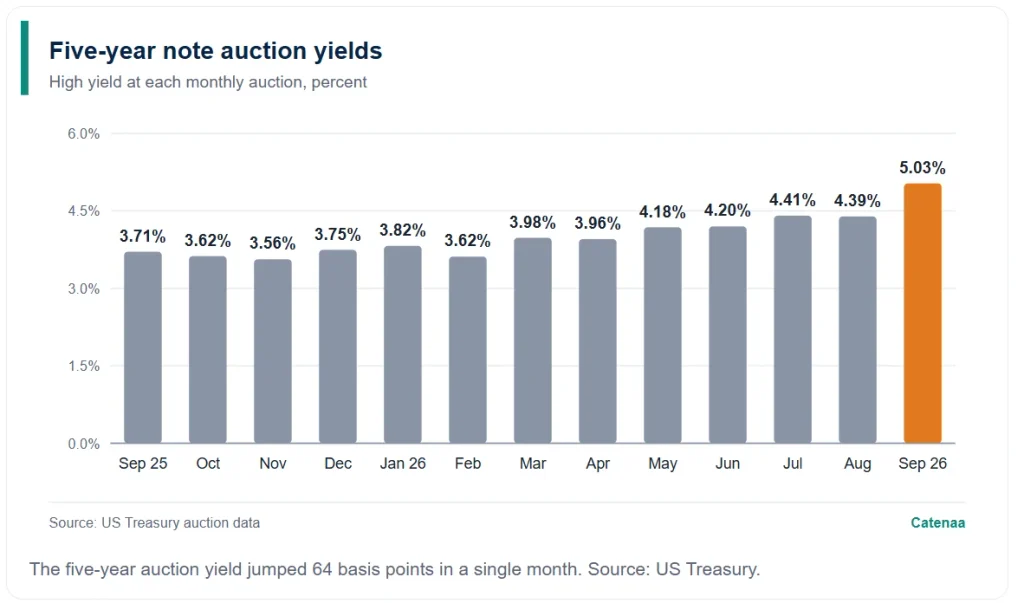
The $70bn five-year sale cleared at 5.033%, the highest auction yield since June 2006.
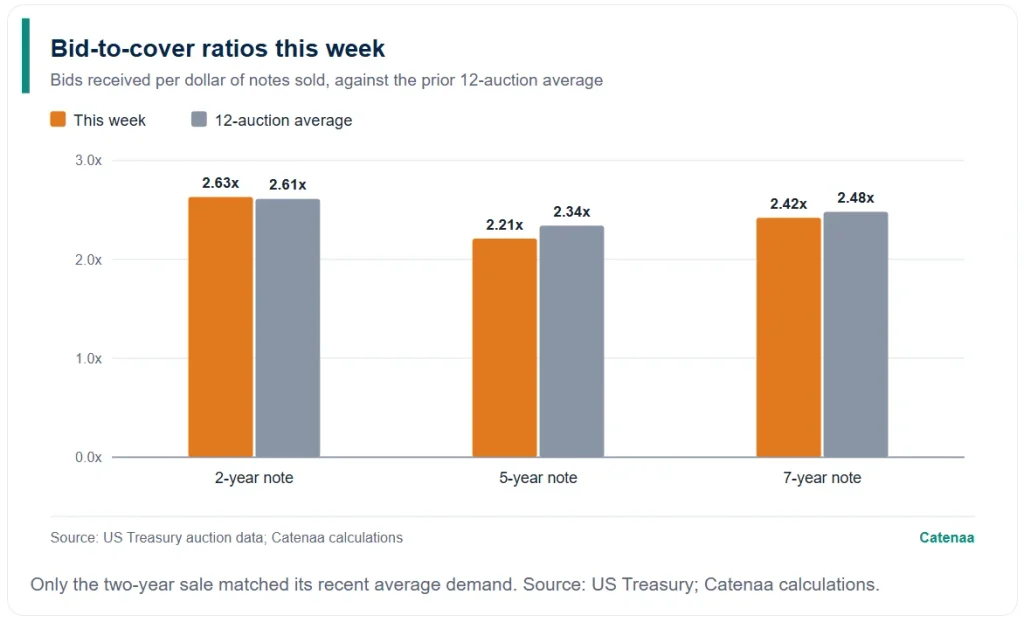
Bids covered the five-year offer just 2.21 times, and dealers took 13.6% against a 10.7% average.
The 10-year yield closed at 5.18% on 24 September, its highest level since July 2007.
The 30-year yield reached 5.49% on Friday, matching its June 2004 level.
Treasury auctions hit turbulence this week as yields climbed to levels last seen before the 2008 financial crisis. The government sold $183bn of two-, five- and seven-year notes between 22 and 24 September. Demand held up at the short end but faded further out.
The weakest sale came on Wednesday. Treasury auction data show the $70bn five-year note cleared at 5.033%, the highest auction yield since June 2006. Moreover, bidders offered just 2.21 times the amount on sale, the lowest ratio since December 2018.
Treasury auctions show softer demand
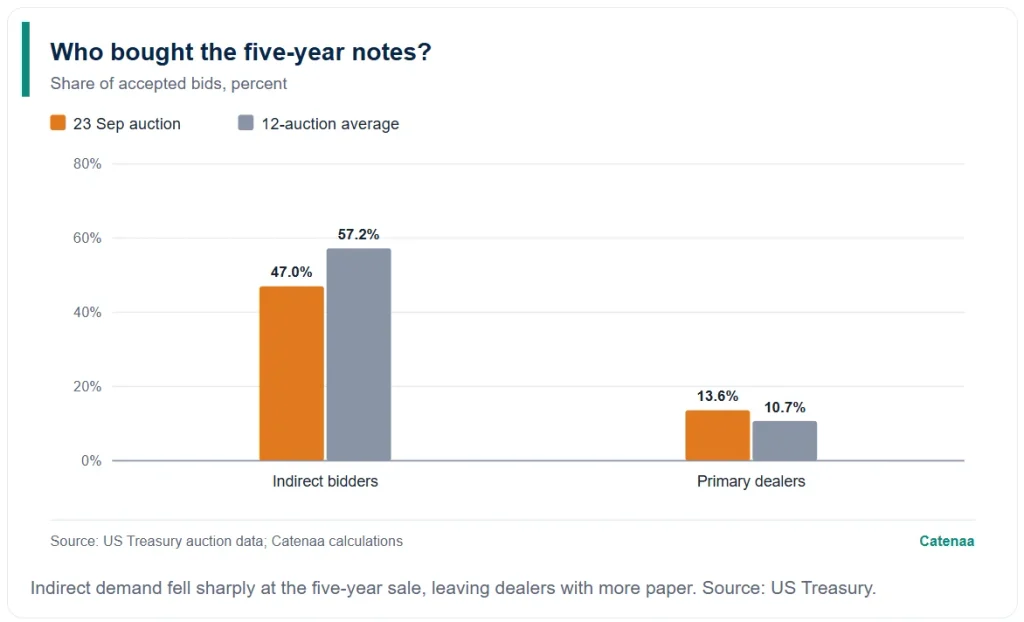
Several signals point to thinner appetite. Indirect bidders, a group that includes foreign official buyers and funds bidding through dealers, took 47.0% of the five-year sale. That compares with an average of 57.2% over the prior 12 auctions.
As a result, primary dealers absorbed 13.6% of the notes, above their 10.7% average. Dealers must bid at every auction, so a bigger dealer share usually signals softer end demand. When end investors step back, dealers end up holding more of the new supply on their balance sheets.
The seven-year sale fared slightly better. It drew a 2.42 bid-to-cover ratio, just under its 2.48 average, yet still priced at 5.085%. That is the highest seven-year auction yield since Treasury revived the note in 2009.
By contrast, the two-year auction went smoothly. It drew a 2.63 ratio, in line with its recent average, at a 4.787% yield.
Taken together, this week’s Treasury auctions show a split market. Buyers still want short-dated paper, which tracks Fed policy closely. However, they demand a higher price for tying up money for five years or more.
Yields reach multi-decade highs
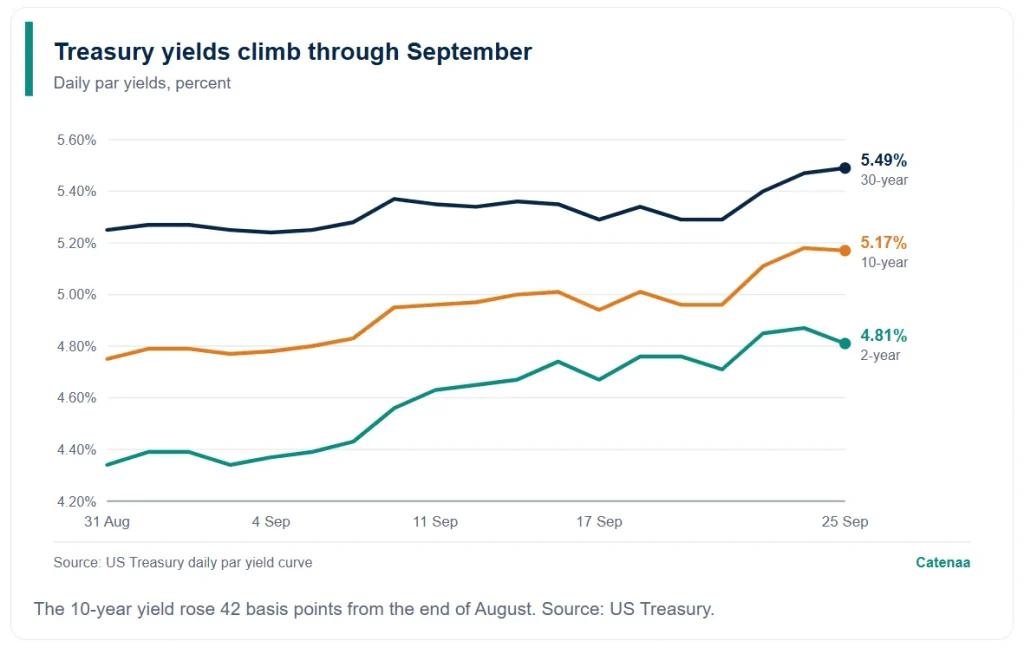
The auctions landed in a market already under pressure. Treasury’s daily par yield curve put the 10-year yield at 5.18% on 24 September. Long-run Federal Reserve data show that it was the highest close since July 2007.
The 30-year yield then rose to 5.49% on Friday, matching its June 2004 level. Meanwhile, the 10-year eased to 5.17%, still 16 basis points higher on the week.
The move in auction yields has been sharp too. The five-year note sold at 4.393% in August, so its auction yield jumped 64 basis points in one month. Similarly, the seven-year yield rose from 4.512% to 5.085%.
Longer maturities led the move. The two-year yield rose just five basis points over the week, to 4.81%. Therefore, the gap between two- and 10-year yields widened to 36 basis points from 25 a week earlier. That steeper curve signals that investors want more pay for holding long-dated debt.
Fed hike and heavy supply add pressure
Monetary policy also plays a part. The Federal Reserve lifted its target range by a quarter point on 16 September. The new range of 3.75% to 4% appears in its policy statement.
Its statement said inflation remains elevated. Higher policy rates pull short yields up first, yet this week the long end moved most. That pattern points to supply and risk premiums rather than the Fed alone.
Supply is the other weight. Treasury’s Debt to the Penny data put total public debt at $40.07trn on 24 September. That is $2.61trn, or 7.0%, higher than a year earlier.
Heavy issuance also weighs on interest costs. Debt held by the public stood at $32.36trn on the same date. Each one-point rise in yields on that stock would eventually add about $324bn a year in interest, on Catenaa calculations.
Strong activity data added fuel as well. Catenaa reported a five-year high in the US flash PMI on 23 September. That same day, the 10-year yield jumped 15 basis points.
What weak Treasury auctions mean for investors
Higher auction yields raise borrowing costs across the economy, from mortgages to company loans. They also lift the government’s own interest bill as older debt rolls over at higher rates.
Mortgage rates and company borrowing costs usually follow the 10-year yield, so households and firms will feel the move. Meanwhile, rate-sensitive stocks such as homebuilders and utilities may face more pressure if yields keep rising.
For bond buyers, the picture cuts both ways. New notes now pay the richest coupons in almost two decades. However, softer auctions show that buyers want still higher yields before they commit.
The next round of two-, five- and seven-year sales should follow in late October, in line with Treasury’s monthly pattern. Until then, Treasury auctions will serve as a live gauge of global appetite for US debt.