

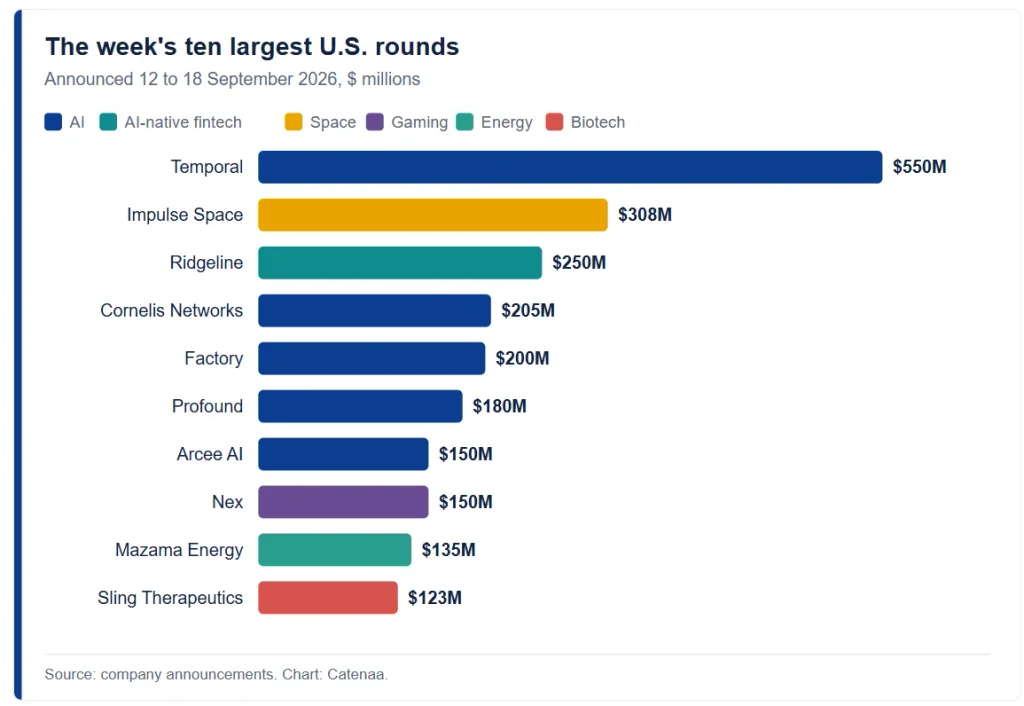
September 20, 2026 – Temporal’s $550 million Series E topped the week’s ten largest U.S. rounds. AI-focused firms took about two-thirds of the $2.25 billion raised.

In Summary
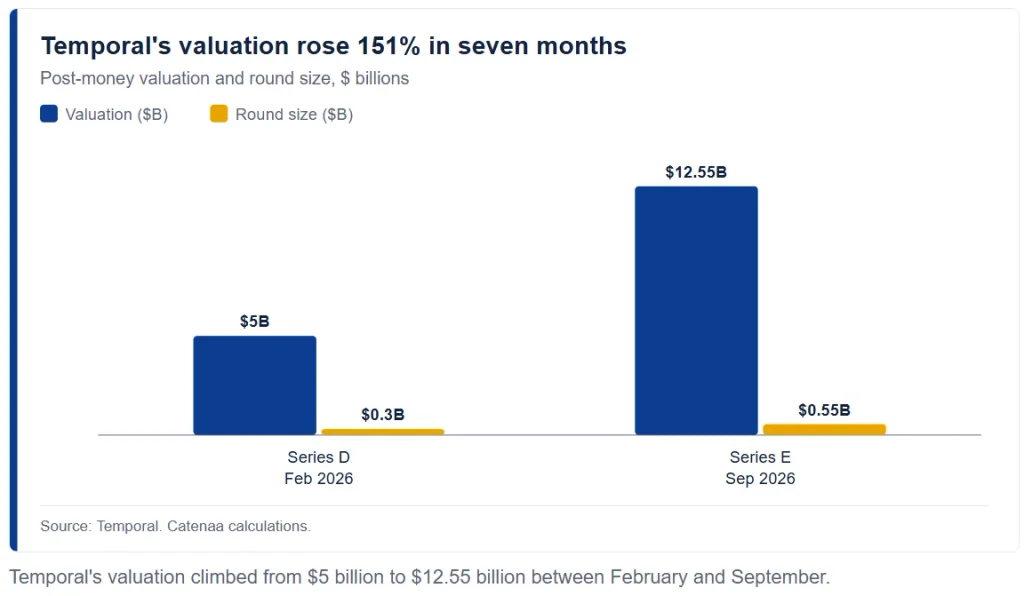
Temporal raised $550 million at a $12.55 billion valuation, 2.5 times its February price.
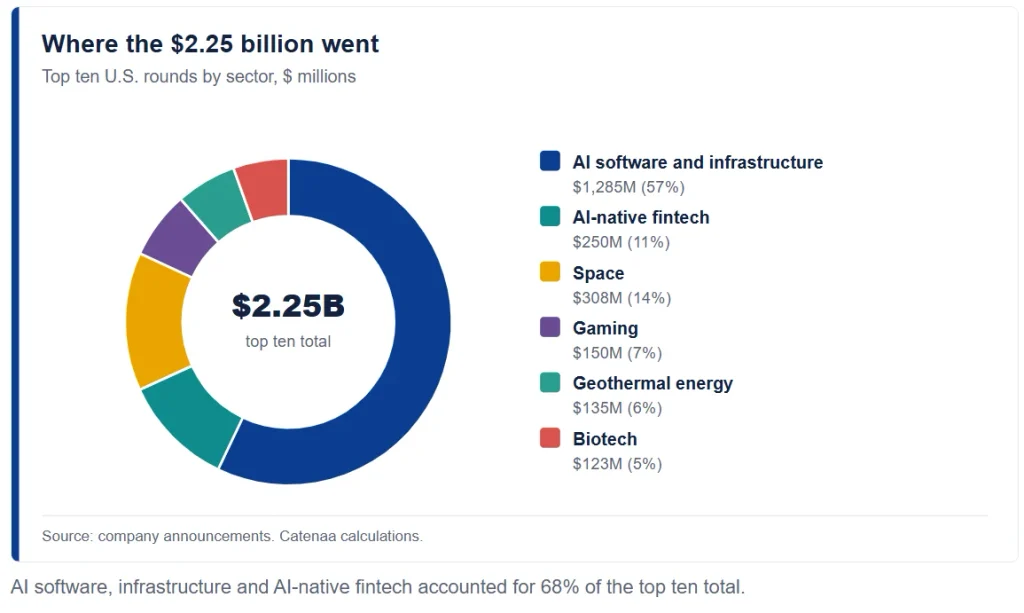
The ten largest U.S. rounds announced from 12 to 18 September totalled about $2.25 billion.
AI-focused firms, including AI-native fintech Ridgeline, took roughly $1.54 billion, or 68%.
Ridgeline’s own release puts its valuation at $1.425 billion, not the $1.45 billion some reports cited.
Impulse Space lifted its Series D to $808 million, the week’s biggest non-AI raise.
Startup funding got smaller last week, but its focus stayed sharp. The ten largest U.S. rounds announced from 12 to 18 September totalled about $2.25 billion. That figure comes from a Catenaa tally of company releases. None of them reached $1 billion. Even so, artificial intelligence claimed most of the money.
At the top sat Temporal Technologies. The company raised $550 million in Series E funding at a $12.55 billion valuation. Lightspeed, Wellington Management, Tiger Global and the growth equity arm of Goldman Sachs Alternatives led the deal.
Temporal Rides the AI Agent Boom
Temporal builds open source software that keeps long programs running when servers fail. That job matters more now, because AI agents often run for hours across many steps. If one step breaks, the whole task can collapse.
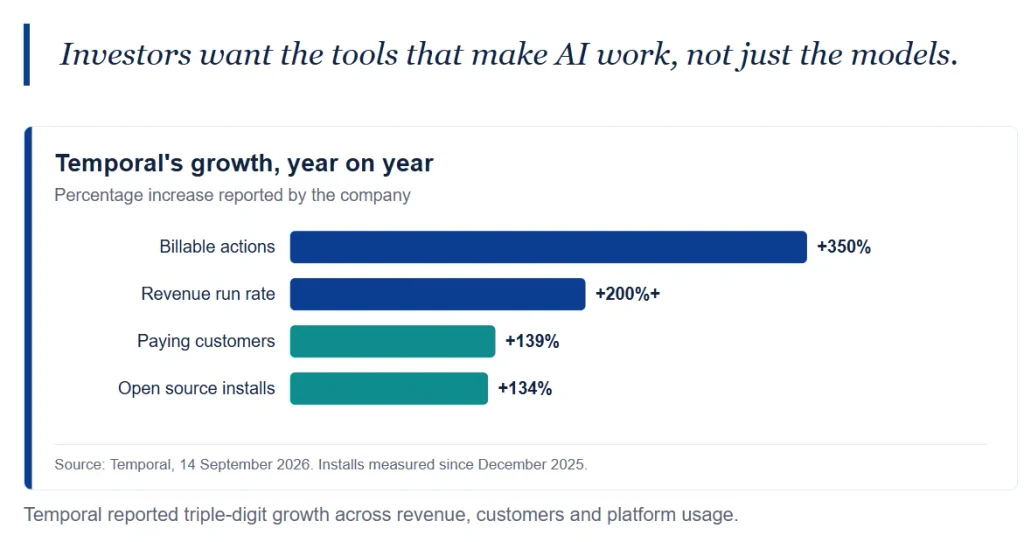
The growth numbers explain the rush. Temporal says its revenue run rate grew more than 200% in a year. Paying customers rose 139% to over 4,300. Meanwhile, billable actions on its cloud hit 1.9 trillion in August, up 350%.
The price jump is just as striking. In February, Temporal raised $300 million at a $5 billion valuation. Seven months later, investors paid 2.5 times that figure. Notably, the company says OpenAI’s use of Temporal grew 60-fold in under a year. Also, Temporal’s team doubled to 570 people. Snap alone runs 414 million Stories a day through the platform.
Space and Fintech Break the Pattern
Not every big cheque went to AI. Impulse Space, a maker of vehicles that move payloads between orbits, closed a $308 million Series D extension. That lifts its full Series D to $808 million. The firm also counts a $28 million Space Systems Command contract extension.
Fintech made the list as well. Ridgeline, which sells cloud software to investment managers, raised $250 million in Series E funding. Founder and chairman Dave Duffield led the round himself. The release sets the post-money valuation at $1.425 billion. Some early reports rounded that to $1.45 billion, which overstates it by $25 million.
Ridgeline says clients have committed more than $750 billion in assets to its platform. Its pitch is simple. The software replaces six to nine older systems at a typical firm. For asset managers under fee pressure, that cost case lands well.
AI Still Takes the Largest Share
Beyond Temporal, AI names filled the middle of the table. Factory, a developer of AI coding agents, raised $200 million at a $5 billion valuation. Blackstone, Khosla Ventures and Sequoia Capital were among its backers. Its users include Nvidia, Adobe and Royal Bank of Canada. In total, Factory has now raised more than $400 million since its founding in 2023.
Next came Profound, which helps brands appear in AI search answers. It raised $180 million at a $1.8 billion valuation, led by Sequoia and Kleiner Perkins. Its previous round, a $96 million Series C, closed only seven months earlier. Profound now works with more than 1,000 enterprise brands, including 16% of the Fortune 500.
Arcee AI, a builder of open-weight models, raised $150 million. Cornelis Networks added $205 million for AI networking gear. Together with Ridgeline, which calls itself AI-native, these firms took about $1.54 billion. That equals 68% of the top ten total.
Why Growth Investors Keep Paying Up
The pattern points to one theme. Investors want the tools that make AI work, not just the models. Temporal sells reliability. By contrast, Factory sells coding output, and Profound sells visibility in AI answers.
However, valuations are climbing fast. Temporal’s price rose 151% in seven months. Profound’s new round is almost twice the size of its last one. That leaves little room for error if growth slows.
Additionally, the investor mix is shifting. Wellington and T. Rowe Price, two large asset managers, joined Temporal’s round. Blackstone, meanwhile, backed Factory. Returning backers, including Sequoia, Index Ventures and GIC, also added to Temporal’s round. Buyers of this size often wait for a public listing, so their early entry hints at future IPOs.
What the Rest of the Startup Funding List Shows
Energy and health rounded out the top ten. Mazama Energy raised $135 million for superhot rock geothermal power. Sling Therapeutics closed $123 million for a thyroid eye disease drug. Nex raised $150 million in equity and debt for motion-based family games.
For now, last week’s message is clear. Startup funding has become more selective, yet AI remains the default bet. The next test comes when these companies report revenue that justifies their new prices.