


October 07, 2026 – Europe’s most valuable fintech now serves more than 80 million customers. Its loan book, however, remains tiny next to the deposits it holds.

In Summary
Revolut’s reported $115 billion valuation equals about 19 times its 2025 revenue of $6.0 billion.
Profit before tax rose 57% to $2.3 billion in 2025, against 13% growth at Barclays.
Loans equal just 6.2% of Revolut’s customer deposits, versus 73% at Barclays.
Only £151 million of £974 million in interest income came from customer loans.
Conditional OCC approval keeps a planned 2027 US bank launch on track.
The Revolut valuation has reached a reported $115 billion, cementing its place as Europe’s most valuable private technology company. Yet the London fintech still lends out only a sliver of the cash its customers hold. That gap, more than customer growth, may decide whether the price holds.
How the Revolut Valuation Got Here
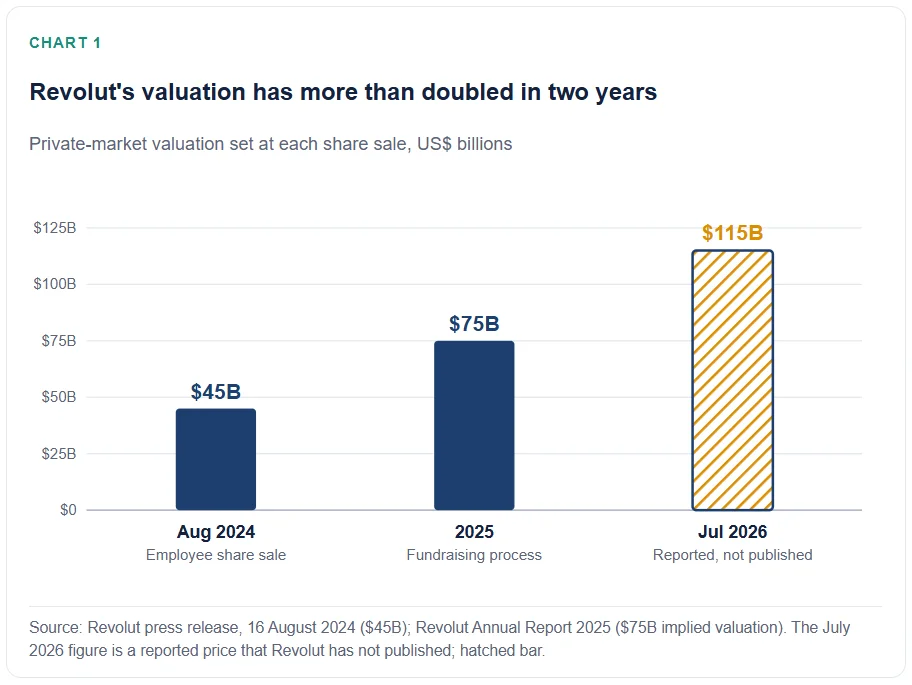
Revolut has not published a price for its latest secondary share sale. However, investors in that deal reportedly valued the company at $115 billion. Before that, a fundraising process set an implied value of $75 billion, according to its 2025 annual report. Back in August 2024, an employee share sale put the figure at $45 billion.
Notably, the price has tracked revenue closely. The $45 billion mark equalled about 20 times 2023 revenue of $2.2 billion. By comparison, $115 billion is roughly 19 times 2025 revenue. In other words, investors are paying for growth rather than a richer multiple. On a per-customer basis, buyers are paying roughly $1,400 for each of its more than 80 million customers.
Profit Is Real and Rising Fast
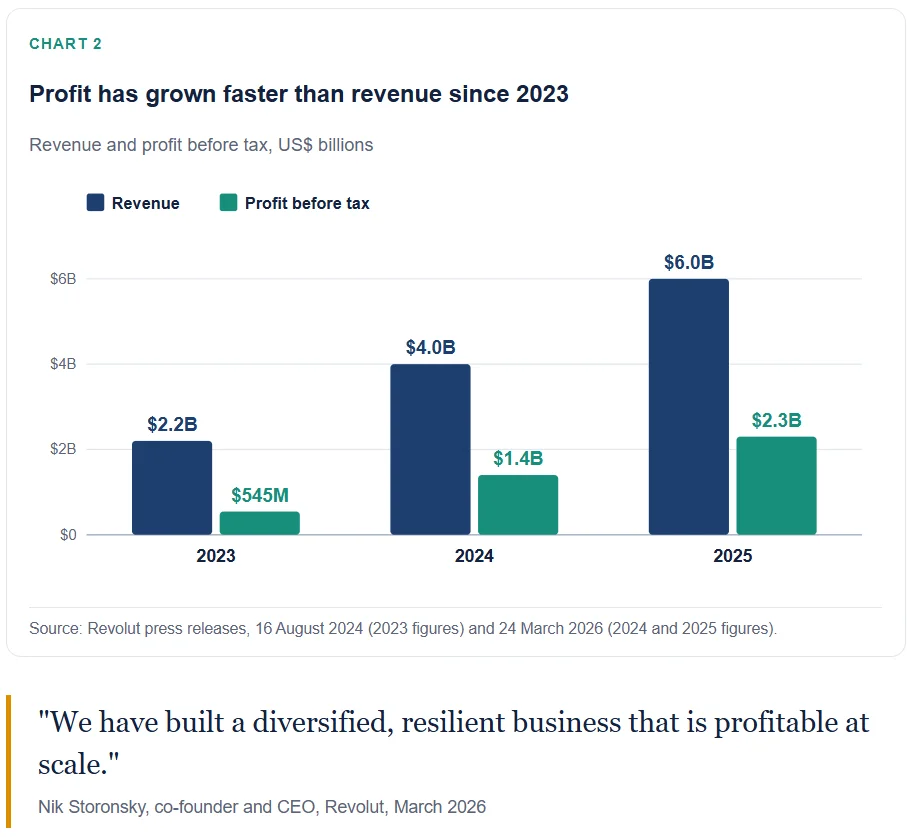
Revolut’s 2025 results show revenue of $6.0 billion, up 46%. Profit before tax jumped 57% to $2.3 billion, a 38% margin. Net profit reached $1.7 billion, its fifth straight year in the black.
Activity also surged. Transaction volumes climbed 65% to $1.7 trillion, and paid plan adoption grew 42%. Finance chief Victor Stinga said 11 product lines now each earn more than £100 million a year.
For scale, Barclays earned £9.1 billion before tax in 2025, its annual results show. Revolut’s £1.7 billion is less than a fifth of that. Still, Barclays grew pretax profit by 13%, so Revolut grew more than four times as fast.
Fees Pay the Bills, Not Loans
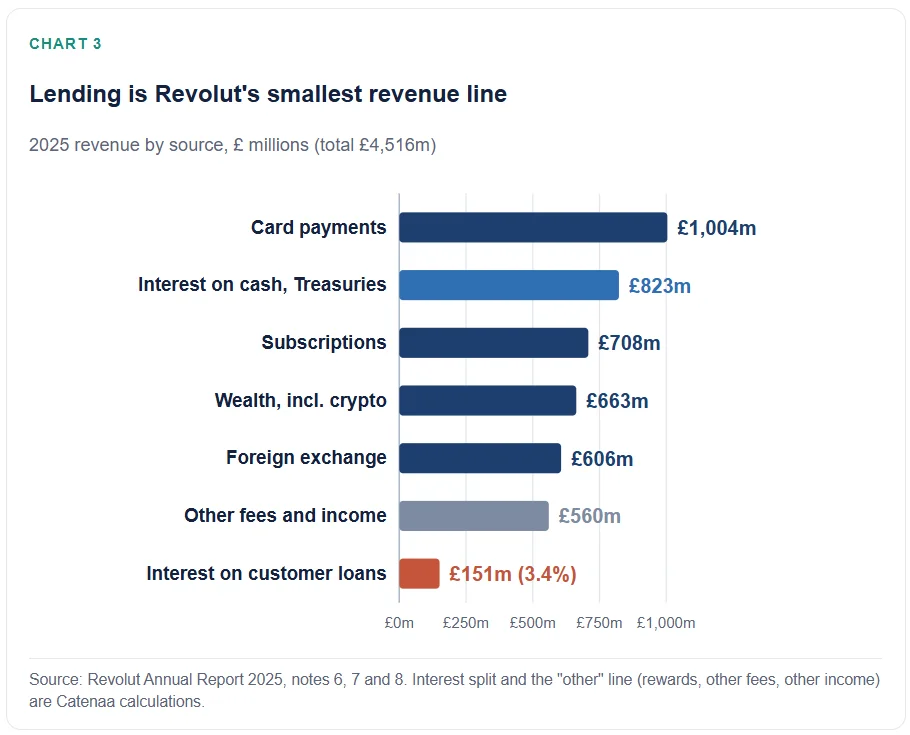
The revenue engine runs on fees. Card payments brought in £1.0 billion last year, while subscriptions added £708 million. Wealth products, which include crypto trading, contributed £663 million. Foreign exchange, the original hook, added £606 million.
Interest income totalled £974 million. However, only £151 million came from loans to customers. Most of the rest came from cash and Treasury holdings, so it tracks interest rates more than lending skill.
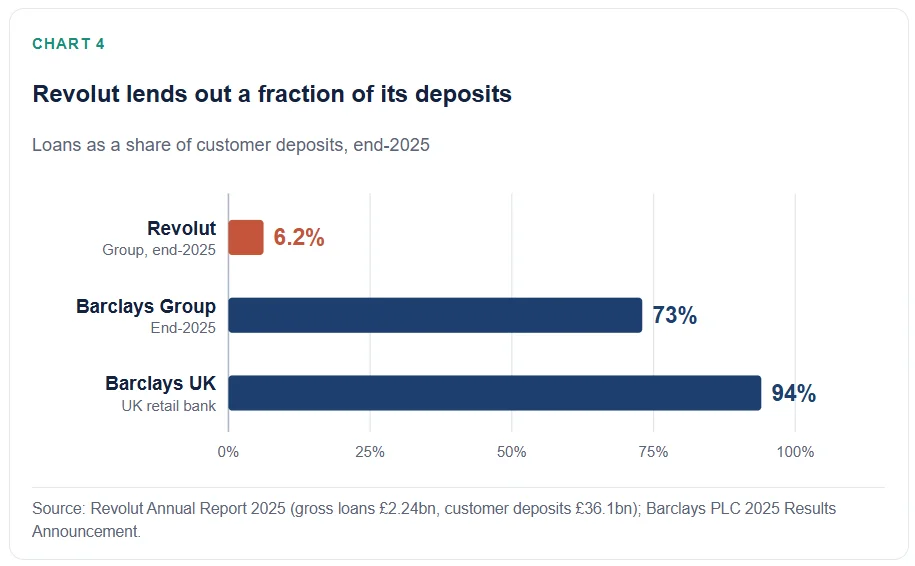
The balance sheet tells the same story. Customer deposits reached £36.1 billion at the end of 2025, while gross loans stood at £2.2 billion. Revolut puts its loan-to-deposit ratio at 6.2%. By contrast, Barclays reported 73% across its group.
Lending is growing, but from a low base. The loan book more than doubled in 2025, and loans, cards and buy-now-pay-later now run in 13 countries. Meanwhile, Revolut kept 90% of its assets in cash, cash equivalents and Treasury investments.
Growth Still Leans on Europe
Customer numbers keep climbing. Retail customers rose 30% to 68.3 million in 2025, and the firm now cites more than 80 million. Its stated goal is 100 million by mid-2027. Total customer balances, including funds at partner banks, rose 66% to £50.2 billion.
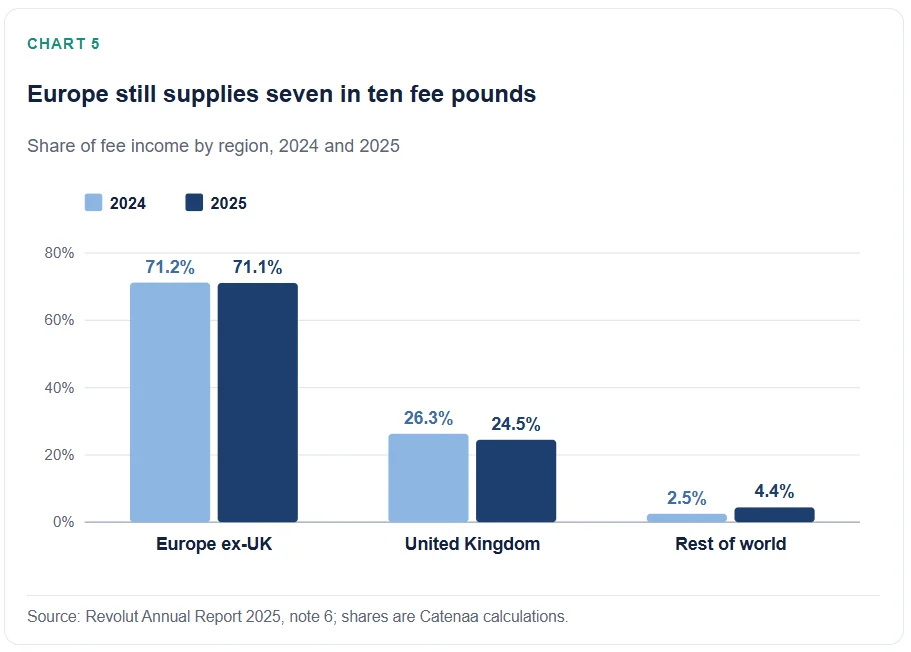
Even so, the money remains concentrated. Europe outside Britain generated 71% of 2025 fee income, while Britain supplied about a quarter. The rest of the world contributed just 4.4%, up from 2.5% a year earlier.
The US Charter Is the Next Test
On September 3, Revolut said it had won conditional approval from the Office of the Comptroller of the Currency. The planned US national bank still needs sign-off from the FDIC, the Federal Reserve and the OCC itself. Revolut plans a 2027 launch offering loans, credit cards, insured deposits, stablecoins and crypto.
That product mix matters for the valuation. A US bank would let Revolut lend against its own deposits at scale. At the same time, it would add credit risk the company has so far kept small.
Elsewhere, the licence map keeps widening. Revolut operated as a licensed bank in 30 countries at the end of 2025. This year it has added bank licences in France and Australia. In March, Britain’s Prudential Regulation Authority also lifted restrictions on its UK banking licence.
Primary accounts are the other gauge to watch. Revolut said customers choosing it as their main bank rose 45% in 2025. Meanwhile, it has not disclosed the absolute number.
What It Means for Investors
For now, the numbers support the growth story. Revenue, profit, and customers all rose sharply in 2025. The harder part comes next: turning deposits into loans without denting a 38% margin. Until then, the Revolut valuation rests on fees, cards and subscriptions rather than credit.