

November 15, 2026 – The chipmaker raised $4 billion across five maturities. Its borrowing spreads are 28 basis points wider than in May 2025.

In Summary
Qualcomm sold $4 billion of notes due 2028 to 2036, with coupons from 5.000% to 5.800%.
Catenaa estimates a weighted average yield of about 5.40% and a weighted spread of about 72 basis points.
Spreads on comparable maturities are 28 basis points wider than in Qualcomm’s May 2025 deal.
Shareholder payouts of $11.7 billion exceeded free cash flow of $8.7 billion in fiscal 2026.
Leverage stays low, with net debt near 0.7 times EBITDA after the deal.
Qualcomm has raised $4 billion in new debt. The chipmaker priced five tranches of notes on Nov. 9, according to its pricing term sheet. It then filed a Form 8-K on Nov. 13, after the deal settled on Nov. 12. The Qualcomm bond sale offers a clear read on what highly rated tech borrowers now pay.
Inside the Qualcomm bond sale
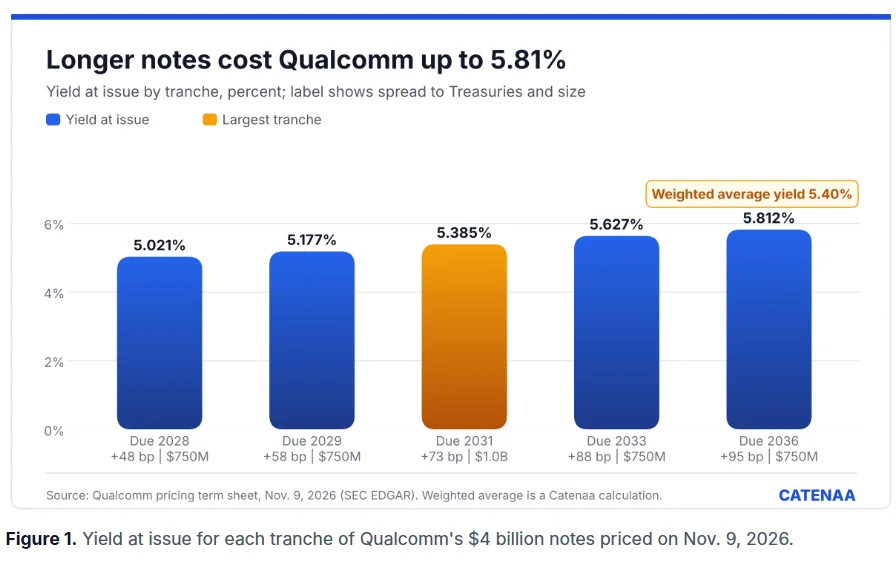
The notes mature in 2028, 2029, 2031, 2033 and 2036. Coupons range from 5.000% to 5.800%. The 2031 notes are the largest piece, at $1 billion. Each of the other four tranches is $750 million.
However, the coupon range alone can mislead. Catenaa weighted each tranche by size. The average coupon works out to about 5.38%. The average yield at issue is about 5.40%. Yearly interest on the new notes should total about $215 million.
Spreads over Treasuries ran from 48 basis points on the 2028 notes to 95 on the 2036 notes. The weighted average spread is about 72 basis points. Moody’s and S&P rate the notes A2 and A, both with stable outlooks. Each tranche also carries a make-whole call, and four of the five allow a par call shortly before maturity. Fourteen banks ran the books on the Qualcomm bond sale.
Borrowing costs are higher than in 2025
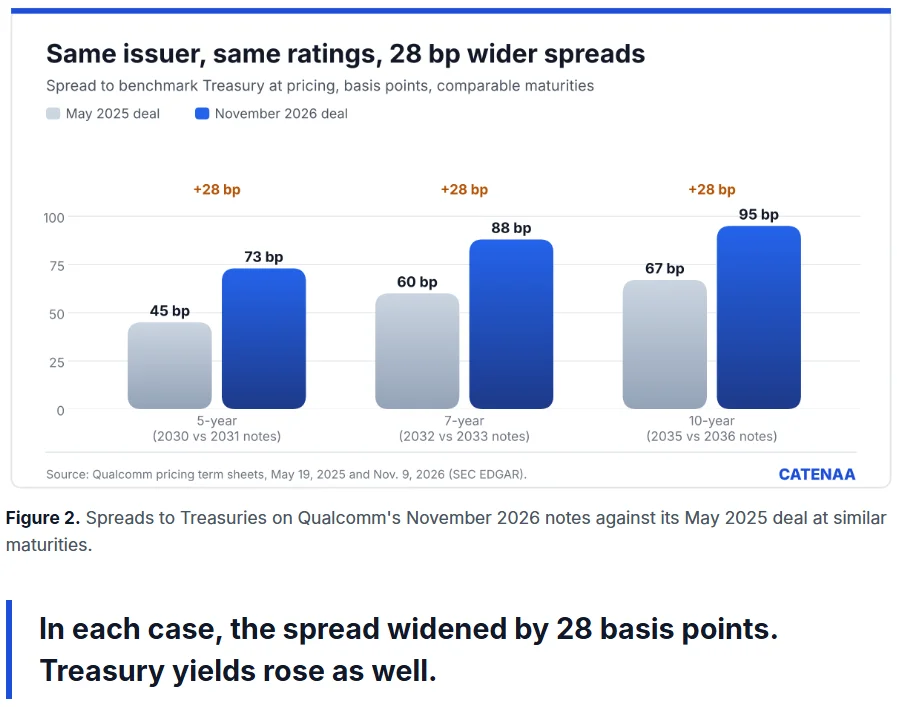
Qualcomm last tapped this market in May 2025. That earlier deal priced its five-year notes at 45 basis points over Treasuries. The new 2031 notes priced at 73. Seven-year spreads moved from 60 to 88. Ten-year spreads widened from 67 to 95.
In each case, the spread widened by 28 basis points. Treasury yields rose as well. As a result, the all-in five-year yield climbed from 4.51% to 5.39%.
Timing helped, though. Qualcomm priced before a sharp bond sell-off. The five-year Treasury yield rose 31 basis points between Nov. 9 and Nov. 13, based on US Treasury data.
Where the money goes
The prospectus supplement puts net proceeds at about $3.98 billion. Qualcomm plans to repay $2.0 billion of 3.250% notes due in May 2027. The rest goes to general corporate purposes. That may include paying down commercial paper.
That refinancing carries a cost. The 2027 notes cost about $65 million a year in interest. By contrast, the new notes cost roughly $215 million on twice the principal.
A credit scorecard
Qualcomm’s balance sheet still looks strong. In fiscal 2026, it reported revenue of $43.1 billion, per its annual report. That was down 2.6% from a year earlier. Operating income fell to $8.7 billion from $12.4 billion. Meanwhile, research spending rose to $10.2 billion. Adding back $1.6 billion of depreciation and amortization gives EBITDA of about $10.3 billion.
Total debt rises to $17.1 billion after the deal, or about 1.7 times EBITDA. Cash and securities, however, climb to $9.7 billion. Net debt stays near $7.4 billion, about 0.7 times EBITDA. EBITDA also covers last year’s $689 million interest bill about 15 times.
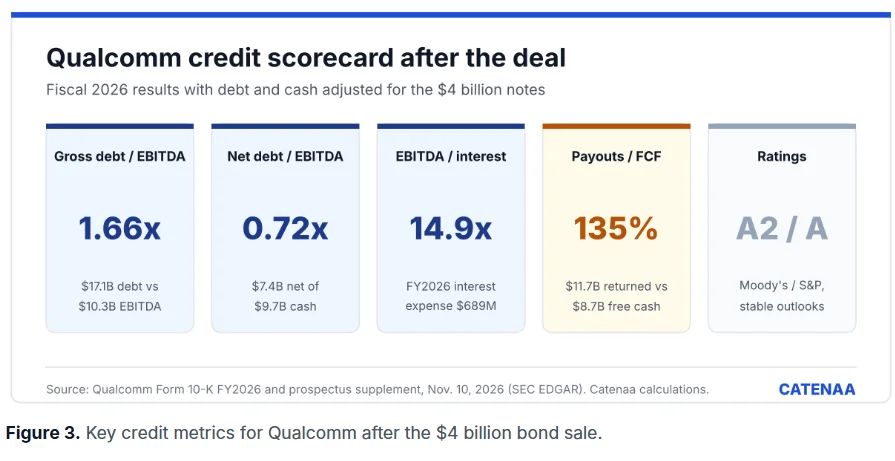
Cash returns deserve a closer look. Operating cash flow was $11.1 billion and capital spending was $2.5 billion. That left free cash flow of $8.7 billion. Yet Qualcomm spent $7.8 billion on buybacks and $3.9 billion on dividends. Payouts therefore ran about $3.0 billion ahead of free cash flow.
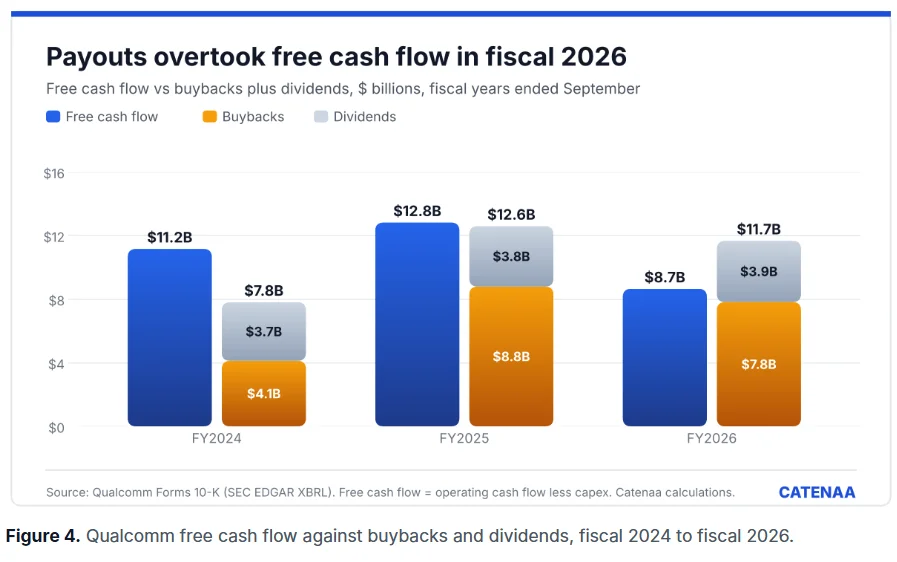
For bond investors, the cushion remains wide. Still, payouts above free cash flow and higher rates make each new deal cost more. That trend is worth watching in future filings.