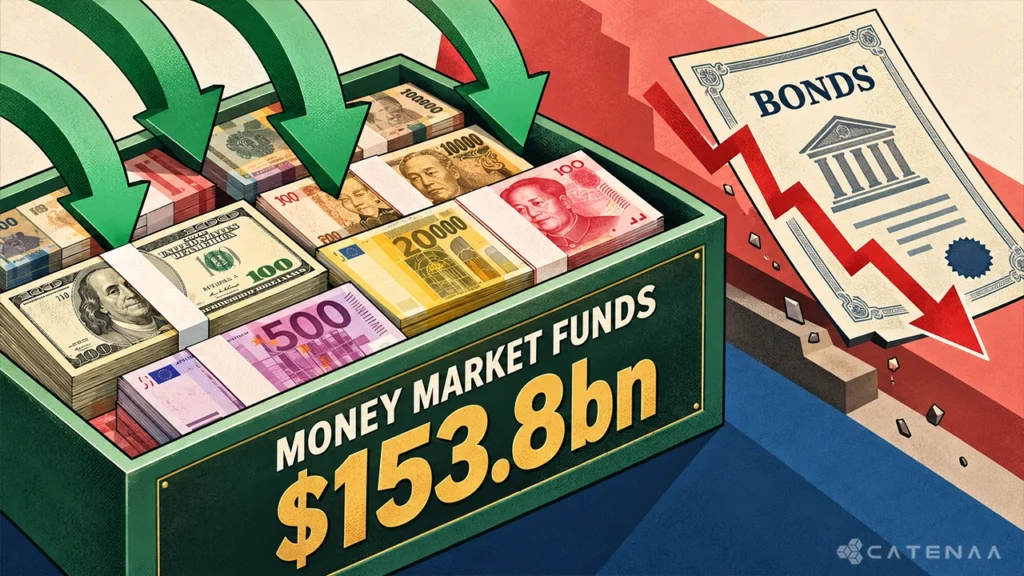


October 11, 2026 – Investors moved the most cash into safe funds since May as Treasury yields hovered near 24-year highs and oil stayed expensive.

In Summary
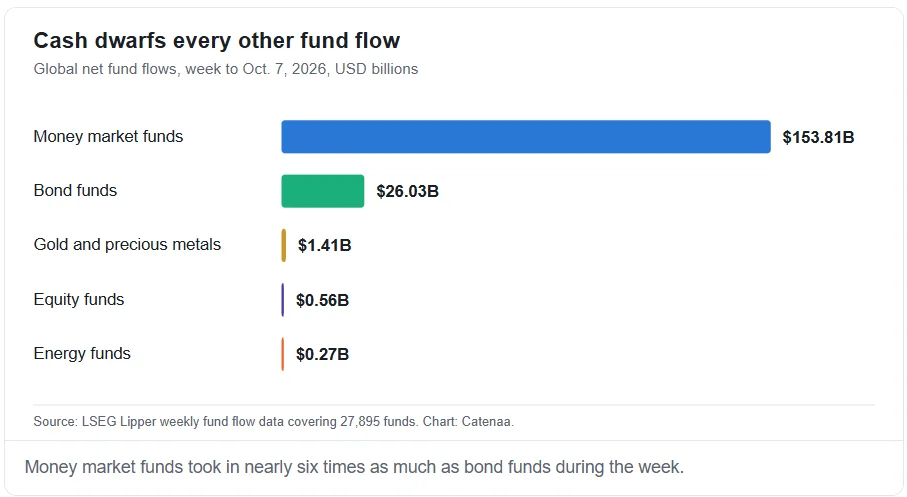
Global money market funds drew $153.81 billion in the week to Oct. 7, the most since May 6, per LSEG Lipper.
Bond funds gained $26.03 billion, led by short-term funds at $9.36 billion.
Equity funds barely grew: Europe and Asia gained, while US funds lost $5.11 billion.
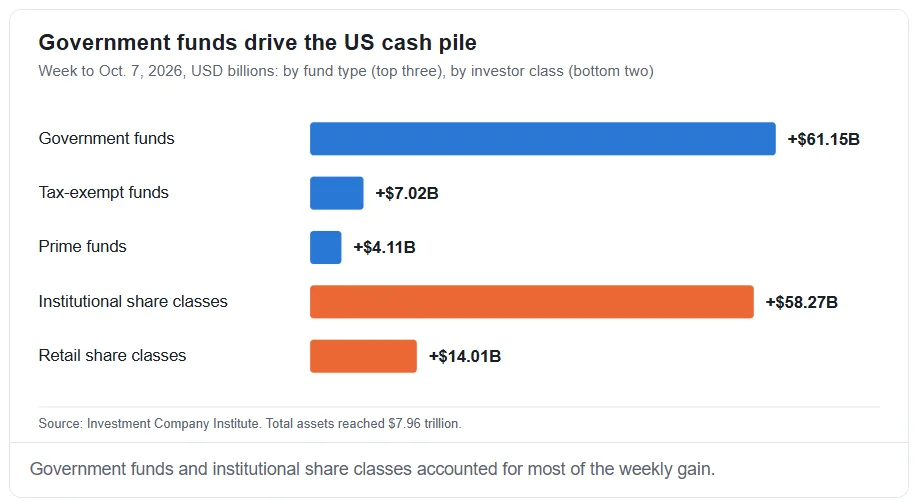
US money fund assets rose $72.27 billion to $7.96 trillion, the Investment Company Institute reported.
A 4.25% yield on 3-month Treasury bills keeps cash competitive as the Fed leans toward another hike.
Investors poured cash into money market funds last week as a global bond selloff rattled portfolios. Money market funds worldwide drew a net $153.81 billion in the week to Oct. 7, according to LSEG Lipper data. That marked their largest weekly inflow since May 6.
The data cover 27,895 funds, and the message looks clear. Investors want safety and quick access to cash. Bond funds also gained $26.03 billion, their biggest intake since July 8. By contrast, global equity funds took in just $560 million, the smallest inflow in three weeks. Taken together, money market and bond funds absorbed about $180 billion in one week.
Why money market funds are winning
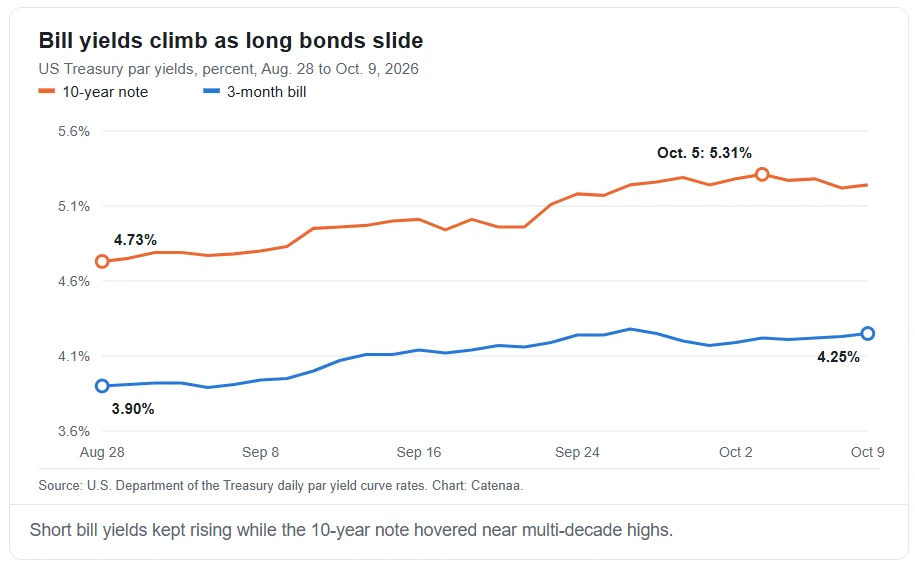
Cash pays well right now. The 3-month Treasury bill yielded 4.25% on Oct. 9, based on Treasury par yield data. On Aug. 28, the same bill yielded 3.90%. Investors can earn that return with little price risk. Notably, the bill now yields more than the top of the Fed’s 3.75% to 4% target range. That gap suggests traders expect another rate increase.
Longer bonds offer more yield, but far more volatility. The 10-year yield closed at 5.31% on Oct. 5, its highest close since May 2002. It started the year at 4.19%. Because bond prices fall when yields rise, holders of long debt have taken losses. That swing has made short-dated cash look safer than long-dated bonds.
Oil keeps that pressure alive. Brent spot prices averaged $114.16 a barrel in September, up from $91.08 in August, EIA data show. Early October readings ran higher still, at an average of $125.32 over four sessions. Costlier energy could keep inflation sticky, and yields elevated.
US money market funds swell to $7.96 trillion
US figures tell a similar story. Total US money market fund assets rose $72.27 billion to $7.96 trillion in the week to Oct. 7, the Investment Company Institute reported. Government funds drove most of the gain, adding $61.15 billion. The jump also reversed a $45.45 billion drop in the prior week. Prime funds, which hold more corporate debt, added only $4.11 billion.
Institutional investors led the charge. Their money fund assets climbed $58.27 billion, while retail assets rose $14.01 billion. That split suggests companies and other large holders drove the shift.
Meanwhile, ICI data show US stock funds lost money in late September. Domestic equity mutual funds and ETFs shed an estimated $7.33 billion in the week to Sept. 30, based on combined flow estimates. In contrast, world equity funds gained $2.67 billion.
Europe and Asia attract equity money
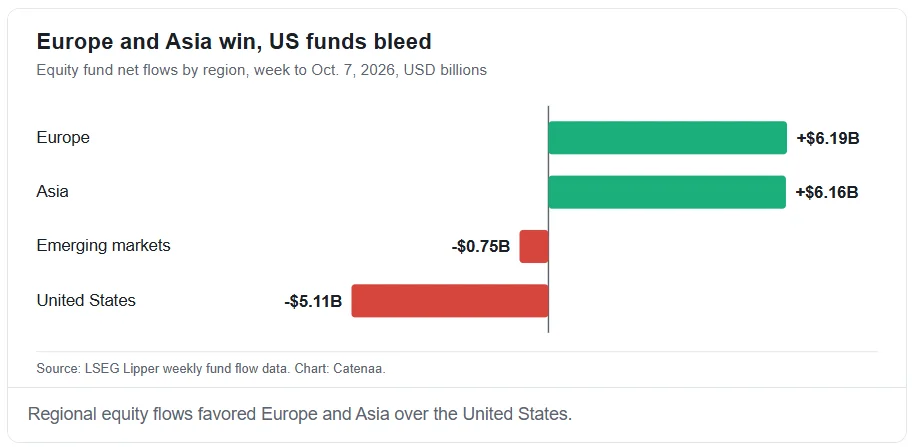
Equity flows split sharply by region. European equity funds drew $6.19 billion, their largest inflow in four weeks, LSEG Lipper data show. Asian funds added $6.16 billion. However, US equity funds lost $5.11 billion, and emerging market equity funds shed $752 million. In effect, investors trimmed US exposure while adding to markets abroad.
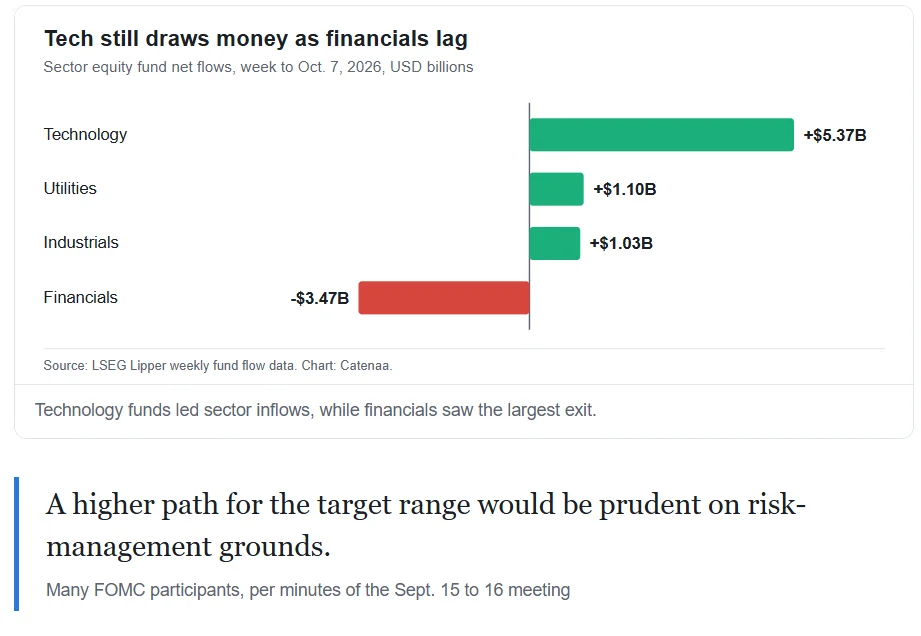
Sector bets showed a mix of caution and conviction. Technology funds still attracted $5.37 billion, a sign that the AI trade keeps its backers. Utilities gained $1.10 billion and industrials $1.03 billion. Financials funds, however, lost $3.47 billion.
Bond buyers stay short
Inside fixed income, investors favored short maturities. Short-term bond funds took in $9.36 billion, the most in three months. Government bond funds added $4.65 billion, and loan participation funds gained $1.89 billion. Short-term funds carry less rate risk, so they suit investors who expect yields to keep rising.
Emerging market bond funds also drew $1.48 billion, reversing a $1.86 billion outflow a week earlier. Elsewhere, gold and precious metals funds attracted $1.41 billion, a fourth straight weekly inflow. Energy funds added $269 million.
What the Fed signals for cash
The Fed’s own guidance supports the cash trade. Minutes from the September meeting show most officials judged another hike “would likely be appropriate by year end.” Higher policy rates would lift money fund yields further. The next decision comes at the end of the Oct. 27 to 28 meeting.
Therefore, the next test arrives with September consumer price data on Oct. 14. A hot reading could deepen the bond selloff and send more cash into money market funds. On the other hand, a softer print could tempt investors back toward longer bonds and stocks.