

October 03, 2026 – The prediction market’s worth has climbed twentyfold since mid-2025. A widening court split over sports contracts is the main cloud.

In Summary
Kalshi is reportedly in talks to raise funds at about $40 billion, led by Sequoia and Wellington.
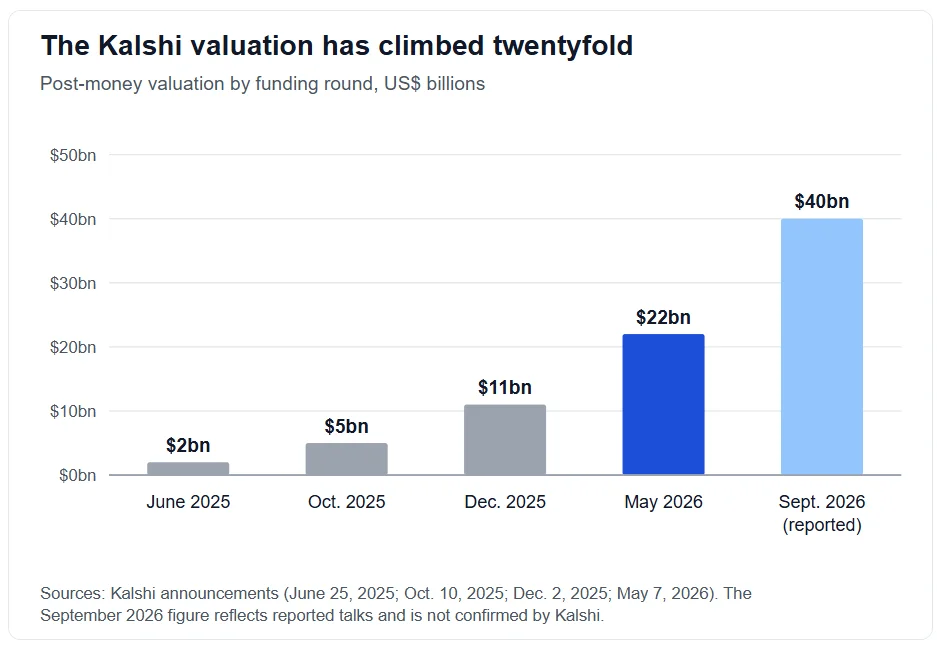
Investors valued Kalshi at $22 billion in May and at $2 billion in June 2025.
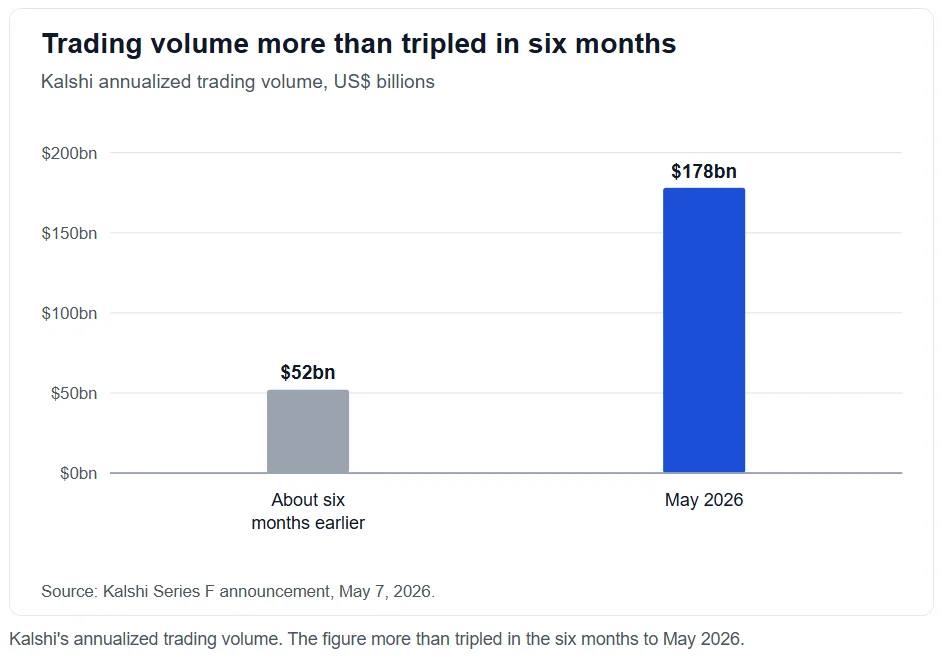
Annualized trading volume more than tripled to $178 billion in the six months to May 2026.
A Sept. 25 Sixth Circuit ruling against Kalshi deepened a court split over sports contracts.
The Kalshi valuation could nearly double again. According to reports this week, the prediction market is in talks to raise new funding at about $40 billion. Sequoia Capital and Wellington Management would lead the round, those reports said. Kalshi has not announced the deal.
If it closes, the round would mark another steep climb. Kalshi was worth $22 billion after a $1 billion Series F it announced in May. That, in turn, was double the $11 billion valuation it reached in December 2025.
The company is also eyeing public markets. Reports said it could list as early as 2027, though Kalshi has not set a date.
How the Kalshi valuation climbed
The pace of the rise is striking. In June 2025, Kalshi raised $185 million at a $2 billion valuation. By October, a $300 million Series D valued it at $5 billion. A $40 billion price would mean a twentyfold increase in about 15 months.
Put another way, the Kalshi valuation would rise by about $18 billion in roughly five months. That is a larger jump than the company’s entire value as recently as December 2025.
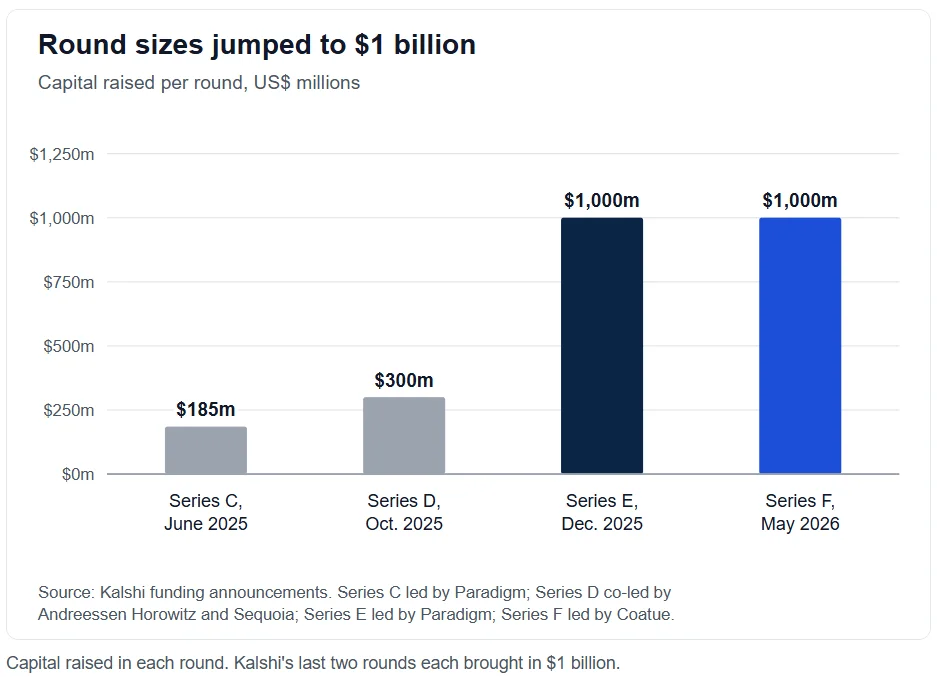
Each round has drawn big names. Paradigm led the $1 billion Series E in December 2025, which included Sequoia and Andreessen Horowitz. Coatue then led the Series F, joined by Sequoia, Andreessen Horowitz, IVP, Paradigm, Morgan Stanley and ARK Invest.
The round sizes have grown just as fast. Kalshi raised $185 million in its Series C and $300 million in its Series D. Since then, it has raised $1 billion in each of its last two rounds.
Volume growth fuels the bet
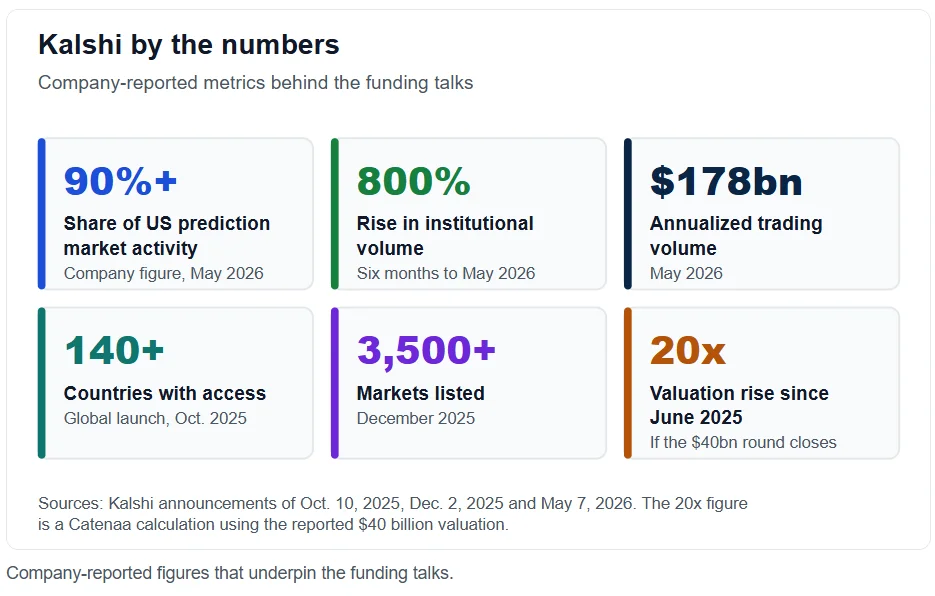
Investors are paying for growth. In May, Kalshi said annualized trading volume had more than tripled in six months. It rose from $52 billion to $178 billion. Institutional volume jumped 800% over the same period.
At that time, Kalshi also claimed more than 90% of US prediction market activity. Back in December 2025, weekly volumes had already topped $1 billion, up more than 1,000% from 2024. In October 2025, the company opened access to users in more than 140 countries. At that point, it said trading volume had grown 200 times in a year. Its user base had grown 20 times.
The product line has widened too. In May, Kalshi said it would use fresh capital to court hedge funds, asset managers, trading firms and insurers. It pointed to new block trading tools, upcoming risk products and deeper broker links. More recently, it added crypto perpetual futures. Those products could support the Kalshi valuation beyond event contracts.
CEO Tarek Mansour has framed the opportunity in sweeping terms. In May, he said event contracts could grow into a trillion-dollar market. He also argued that the shift is still at an early stage.
Legal fights cloud the Kalshi valuation story
The regulatory picture is less tidy. Kalshi operates as a federally regulated exchange, and the CFTC designated KalshiEX as a contract market in November 2020. Sports contracts, however, have drawn challenges from state gambling regulators.
On Sept. 25, a federal appeals court sided with Ohio and Tennessee. The Sixth Circuit held that Kalshi had not shown its sports-event contracts are swaps. Therefore, they do not fall under the CFTC’s exclusive jurisdiction, the court said. Even if the contracts were swaps, it added, federal law would not override Ohio’s or Tennessee’s gambling laws. The panel upheld the Ohio court’s refusal to block state action. It also vacated an injunction Kalshi had won in Tennessee.
The ruling deepens a split among appeals courts. In August, the Ninth Circuit ruled against Kalshi in a Nevada case. By contrast, the Third Circuit backed Kalshi in New Jersey. A Fourth Circuit appeal involving Maryland is still pending.
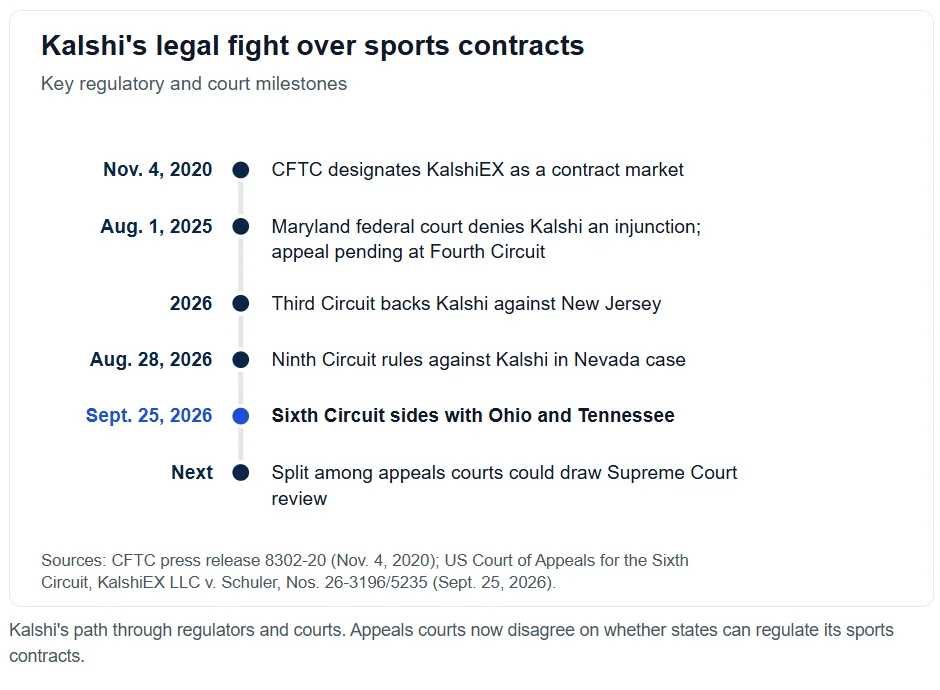
As a result, the dispute could end up at the Supreme Court. That uncertainty matters for a company that lists contracts on major US sports leagues. Kalshi also rejected online claims of wash trading in its new crypto perpetuals market last month.
For now, investors appear willing to look past those risks. A $40 billion price would value Kalshi at nearly twice its May level, despite the legal fight. The next test will be whether volumes keep growing once the courts settle the sports question.