

November 08, 2026 – Midterm trading topped $2.5 billion, yet viewers outnumbered traders five to one. A new voter study shows why regulators may care about who is watching.

In Summary
Kalshi says viewers outnumbered traders five to one on its 2026 midterm markets.
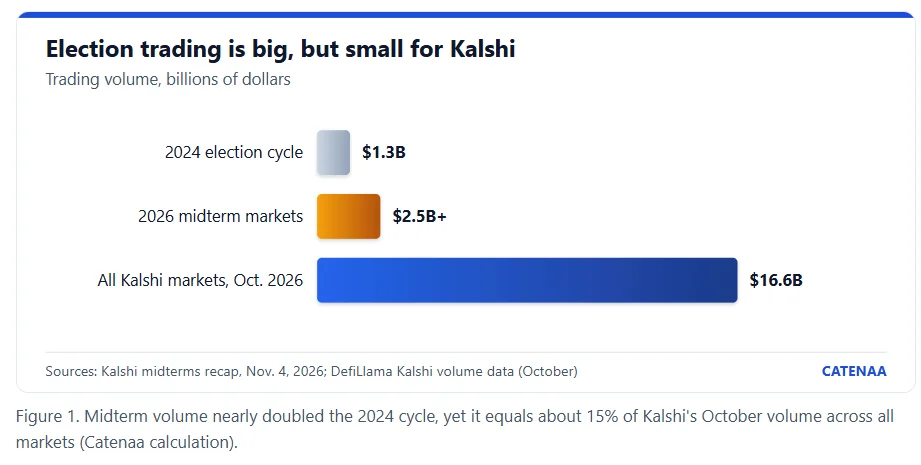
Midterm trading passed $2.5 billion, almost double the $1.3 billion of the 2024 cycle.
Favorites won 479 of 487 races that had resolved by 6 a.m. Eastern on Nov. 4.
A Brennan Center study found displayed odds shifted voter expectations by up to 20 points.
Kalshi’s election odds became a second scoreboard on Nov. 3, and most of the people watching never placed a trade. In October, the company said viewers outnumbered traders five to one on its midterm markets.
That gap matters. It turns a trading venue into a news source, with prices that many people read as forecasts rather than bets. It also invites the kind of scrutiny pollsters know well.
Election odds pulled a crowd, not just cash
Kalshi’s own figures show the scale of the shift. Total visits to its midterm markets ran 50 times the number of traders, the company said. Across the platform, three in four users do not trade at all. Election trading also grew six times faster than football volume this year, the company added.
Money still flowed in. Trading on the 2026 midterms passed $2.5 billion, Kalshi said in its post-election recap. That compares with $1.3 billion for the whole 2024 election cycle.
Even so, elections remain a small slice of the business. Kalshi handled about $16.6 billion across all markets in October alone, based on DefiLlama data. The whole midterm total equals about 15% of that single month. In other words, the midterms worked more like a shop window than a main source of volume.
How the night unfolded in real time
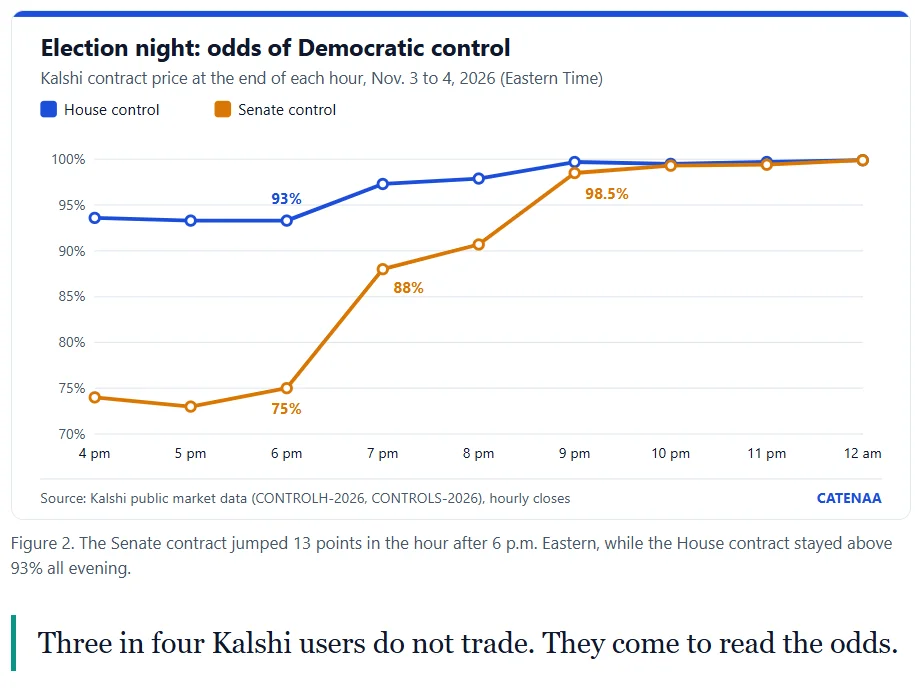
Prices moved well ahead of official results. At 6 p.m. Eastern, the Democratic Senate contract traded at 75 cents, or roughly a 75% chance. By 7 p.m., it had jumped to 88 cents, according to Kalshi’s public market data.
Markets for House control then hit 99% at 8:10 p.m., the company said. Senate control passed the same mark at 9 p.m. By 6 a.m. the next day, favorites had won 479 of 487 resolved races, or 98%.
Payouts follow a stricter rule. Kalshi settles a race once at least four of eight major news organizations call it, with none disagreeing. Trading on the Senate contract closed at 11:46 p.m., nearly three hours after it passed 99%.
Do election odds sway voters?
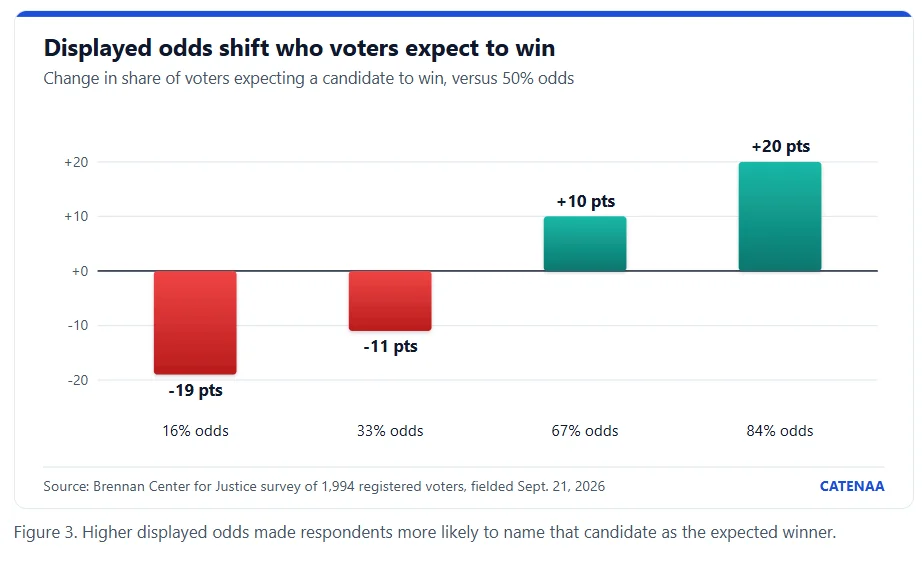
The Brennan Center for Justice tested that question with 1,994 registered voters in September. Respondents saw made-up candidates with random poll numbers and market odds attached.
The odds moved opinions. Showing an 84% chance raised the share expecting that candidate to win by 20 points, against even odds. By contrast, a 16% chance cut that share by 19 points.
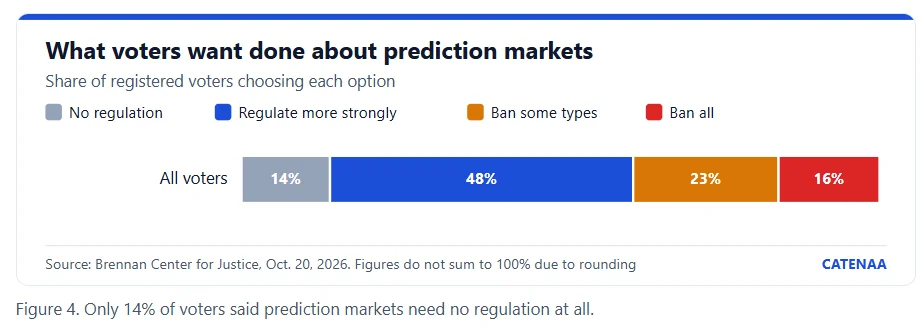
Yet voters do not trust the numbers much. Only 19% called prediction markets accurate, compared with 37% for traditional polls. Meanwhile, 48% wanted stronger rules, and 16% wanted all such markets banned.
The trust gap runs wider on representation. Just 29% said the markets reflect public opinion, versus 55% for polls.
Kalshi leans on transparency
Kalshi has tried to get ahead of that debate. On Oct. 6, it added accuracy scores, volume labels and live trade feeds to its election pages. It also said it had fined and suspended four congressional candidates for trading on their own races.
That reach cuts both ways. Thin election odds can still shape beliefs, even when few dollars stand behind them. Kalshi’s new volume labels tackle that risk by showing how much money backs each market.
Chief executive Tarek Mansour framed the appeal plainly. “People are turning to prediction markets because they offer something traditional forecasts can’t,” he said.
Still, the company’s own pricing guide calls its prices “snapshots of belief, not guarantees.” For the crowd that watched without betting, that caveat may matter most.