

November 11, 2026 – Catenaa sorted the 36 payment firms chosen by the ECB by country and business model. Banks dominate, Italy leads, and three host countries have no local firm.
In Summary
The ECB picked 36 payment firms from more than 50 applicants for a 12-month pilot starting in late 2027.
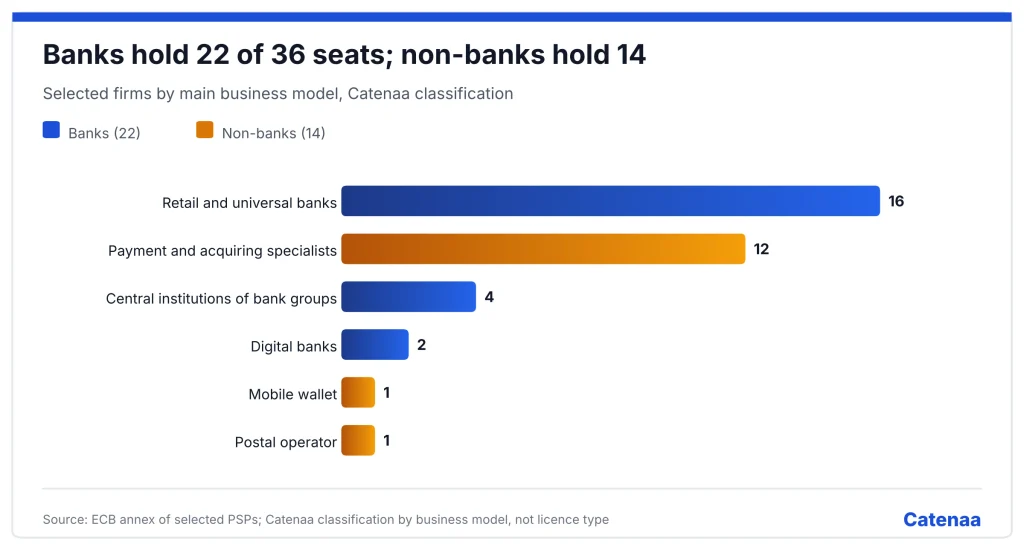
Banks hold 22 of the 36 seats, or 61%, on Catenaa’s classification by business model.
Italy supplies seven firms and Germany five, together a third of the group from 16 countries.
Belgium, Estonia and Latvia host the pilot but have no locally based firm on the list.

The digital euro pilot is moving from paperwork to people. In July, the European Central Bank picked 36 payment firms from more than 50 applicants, its press release shows. Testing is due to start in the second half of 2027 and run for 12 months.
However, the ECB has not published which firms will run accounts and which will serve merchants. So Catenaa built its own map of the list, by home country and business model.
Italy and Germany lead the digital euro pilot
The ECB annex lists each firm by application country. Italy leads with seven firms. Germany follows with five. Greece and Portugal have three each.
Together, Italy and Germany supply a third of the group. In all, 16 countries appear on the list. Italy’s seven alone span three banks, a digital bank, two payment firms and the postal group.
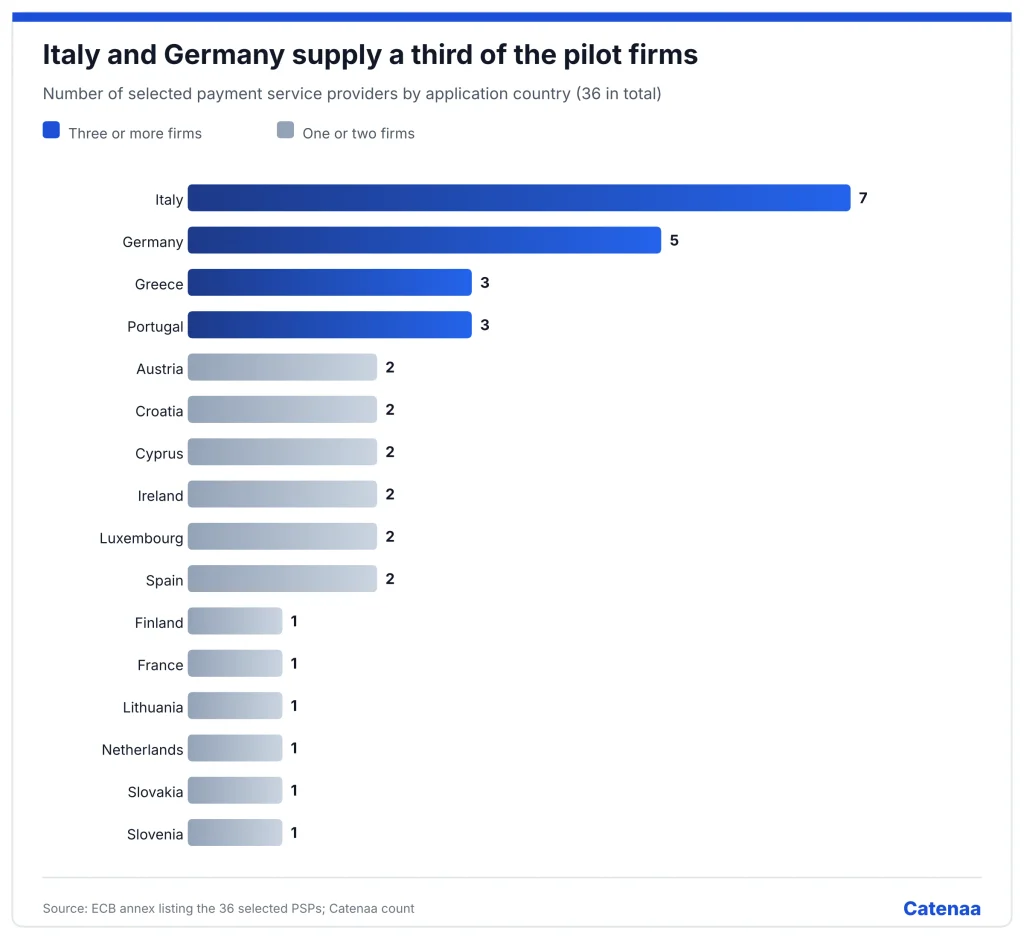
Notably, three host countries have no local firm. Belgium, Estonia and Latvia take part through their central banks, yet no firm from those markets made the cut. Still, the ECB says firms may serve countries beyond their home market.
Banks still hold most seats
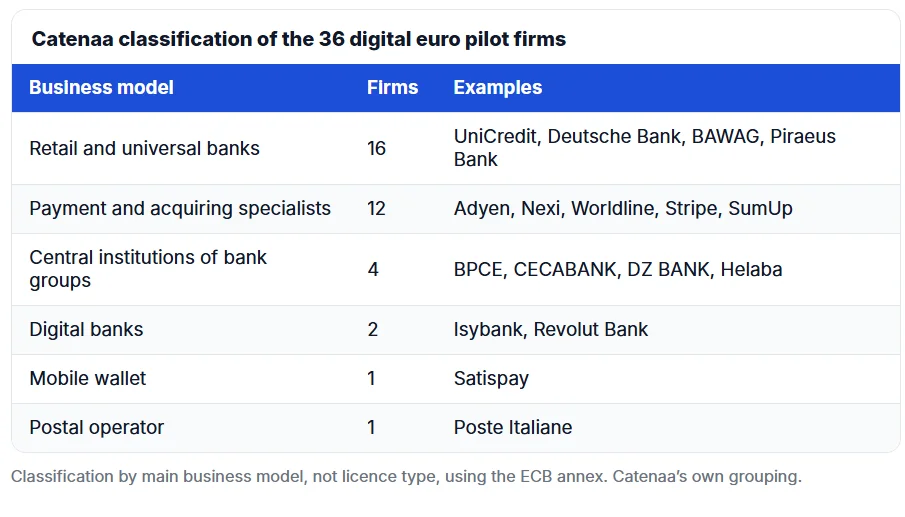
Catenaa grouped the firms by main line of business. Banks make up 22 of the 36, or 61%. Of those, 16 are retail or universal lenders, such as UniCredit and Deutsche Bank.
Four more act as hubs for savings or cooperative bank groups, such as DZ BANK and Helaba. The last two are digital banks: Isybank and Revolut Bank.
Payment specialists form the second block. Twelve firms focus on card acquiring, processing or checkout, including Adyen, Nexi, Worldline and Stripe. A mobile wallet, Satispay, and Poste Italiane complete the list.
In other words, non-bank firms hold 14 seats, or 39%. That is a sizable share for a project often framed as a bank matter.
Two jobs in the pilot
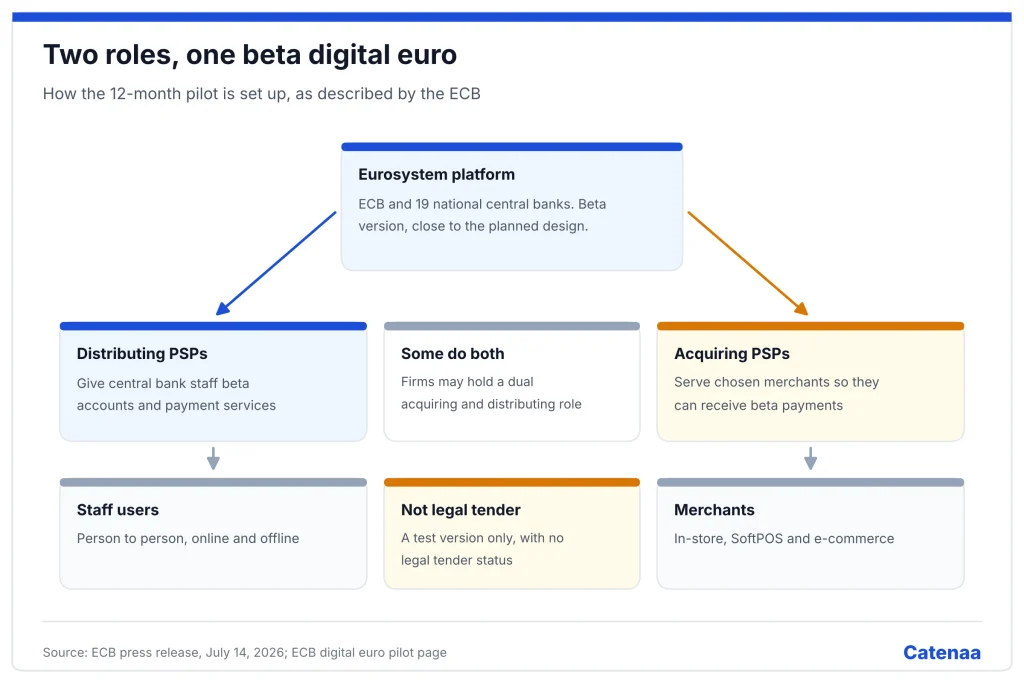
The pilot splits the work into two roles. Distributing firms will give central bank staff beta digital euro accounts. Acquiring firms will help chosen merchants take payments. Some will do both.
That split points to a likely pattern. Banks already hold customer accounts, so they suit distribution. Acquirers already serve shops. Yet the ECB has not published role lists, so this remains Catenaa’s inference.
Testing will run at the ECB and 19 national central banks. Staff will pay each other online and offline, and pay merchants in shops and online. Even so, the beta version will not be legal tender.
Why the mix matters
The ECB sees the project as a way to cut reliance on foreign card networks. In an October speech, board member Piero Cipollone said two-thirds of euro area card payments rely on international schemes.
He added that 13 of the 21 euro area countries have no domestic card scheme. In his view, European private options tend to cover only specific markets or uses. Seen that way, a digital euro pilot roster led by European banks and processors fits the policy goal.
What to watch
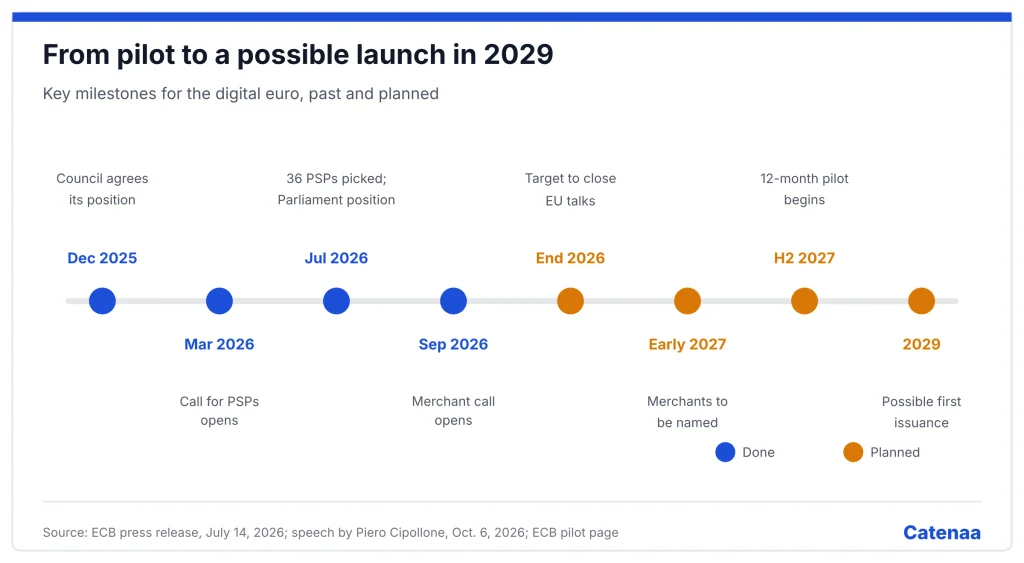
The law still decides the outcome. EU governments agreed their stance in December 2025, and Parliament followed in July 2026. Talks between them are under way, and EU leaders want a deal by the end of 2026.
If that happens, the ECB aims to be ready for a first issue in 2029. Its merchant call has closed, and picks are due by early 2027, the pilot page says. That list will show where people first meet the new money.
Editorial note: This article is for information only and is not investment advice. Figures come from the primary sources listed above. Figures marked “by Catenaa’s math” and chart values labelled as Catenaa calculations are derived by Catenaa from those sources and may differ slightly from company figures because of rounding.