

November 06, 2026 – Stocks rallied on the result, then slumped as investors priced in a slower AI buildout. Bonds rallied, and the 2-year yield fell 15 basis points in two sessions.

In Summary
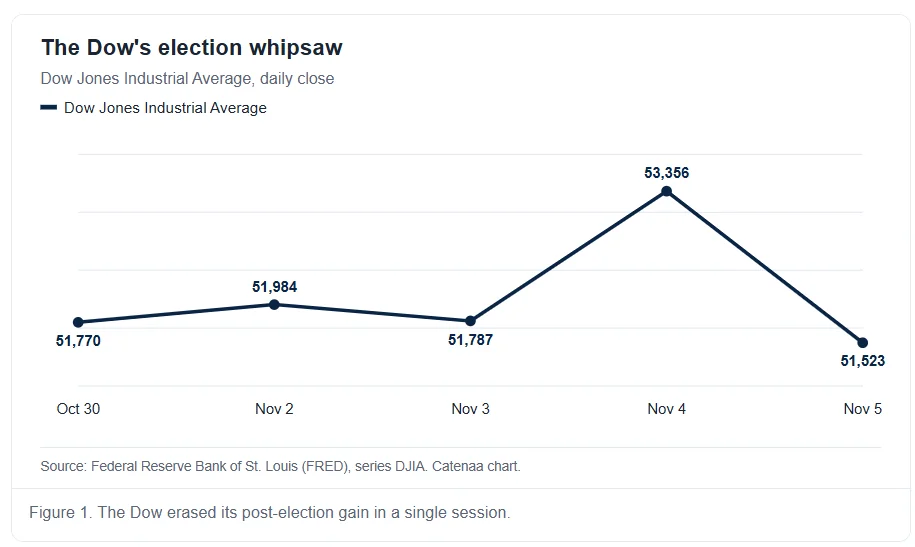
The Dow rose 3.03% on Nov. 4, then fell 1,833.06 points, or 3.44%, on Nov. 5.
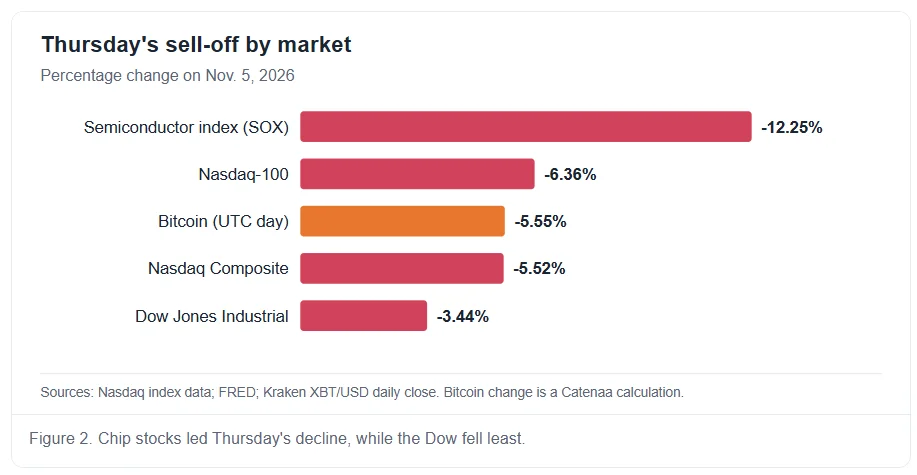
The PHLX Semiconductor Index dropped 12.25% as investors priced a slower AI buildout.
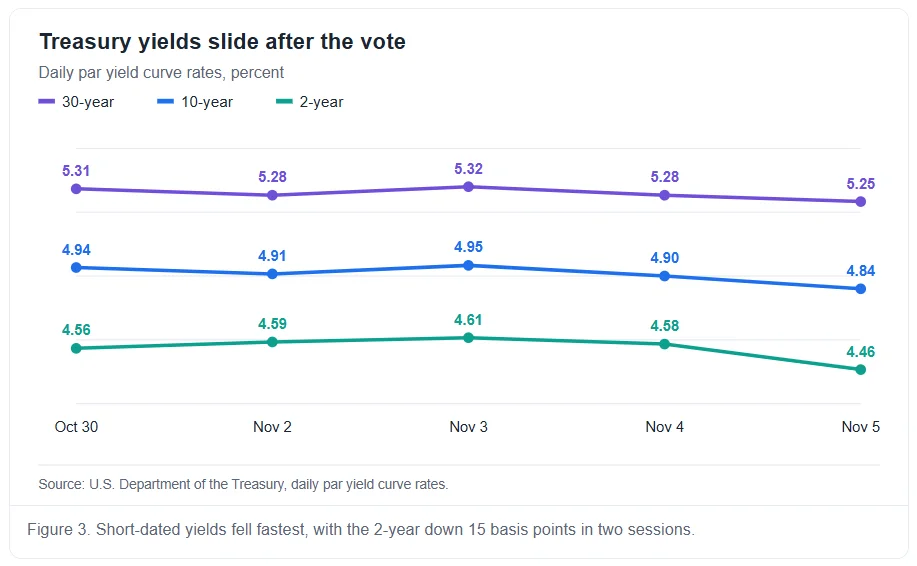
The 2-year Treasury yield fell to 4.46% from 4.61% over two sessions.
Democrats take both chambers in January, but the Fed and trade policy sit largely outside their reach.
Wall Street spent two days pricing a Democratic Congress, and it could not make up its mind. Stocks surged on Wednesday as the election ended. Then they slumped on Thursday as investors turned on the AI trade.
The Dow Jones Industrial Average jumped 3.03% to 53,356.12 on Nov. 4, FRED data show. That marked its biggest one-day gain since April 2025. A day later, the index lost 1,833.06 points, or 3.44%, to close at 51,523.06.
Wednesday’s relief rally was broad. The S&P 500 rose 1.58% to 7,688.62, and the Cboe Volatility Index fell to 16.61 from 20.83. Investors welcomed a clear result and the end of election risk.
Why a Democratic Congress spooked tech
Chips and data centers took the worst of it. The PHLX Semiconductor Index fell 12.25% to 9,011.14 on Thursday, according to Nasdaq data. Meanwhile, the Nasdaq Composite dropped 5.52%, and the Nasdaq-100 lost 6.36%. That left the Nasdaq-100 14.7% below its Oct. 6 record.
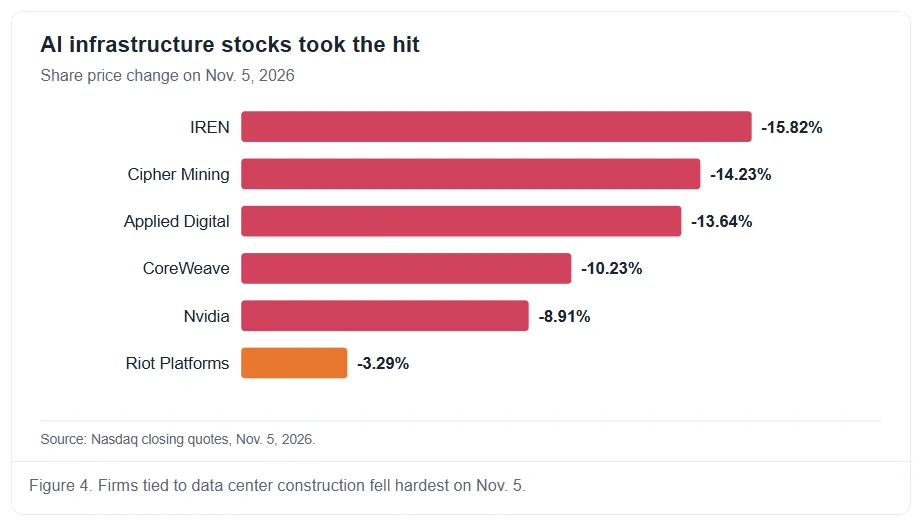
In addition, Nvidia fell 8.91% to $182.29. Data center landlords and former bitcoin miners fared worse. IREN lost 15.82%, and Cipher Mining dropped 14.23%.
Analysts tied the slide to power politics. Electricity bills became a campaign issue, and some Democrats called for limits on new data centers. Democrats also won races in Texas, a hub for planned AI campuses. As a result, investors began to price a slower and costlier buildout under a Democratic Congress.
Bonds rally as yields fall
Treasuries told a calmer story. The 2-year yield fell to 4.46% on Nov. 5 from 4.61% on Nov. 3, Treasury data show. Meanwhile, the 10-year slipped to 4.84% from 4.95%.
Lower yields suggest investors expect less fiscal stimulus from a divided government. They also point to demand for safety as stocks fell. Crypto, by contrast, traded like a tech stock. Bitcoin fell 5.5% to $75,979.9 on Thursday, based on Kraken daily closes. That followed a 4.0% gain the day before.
What changes for the economy
Policy shifts will come slowly. Democrats take control of both chambers in January. Until then, Republicans keep their majorities. After that, President Trump can still veto bills, and he keeps wide power over trade.
However, a Democratic Congress controls spending and the debt limit. That gives Democrats leverage over budgets and new tax plans. It also opens the door to oversight hearings on agencies and trade policy. Any budget deal will now need sign-off from Democratic leaders and the White House. That raises the odds of standoffs over funding deadlines.
The Federal Reserve sits apart from the fight. It held its target range at 3.75% to 4.00% on Oct. 28, in a 10 to 2 vote. Two officials wanted a hike. The next decision lands on Dec. 9.
Inflation also limits the room for relief. Consumer prices rose 3.7% in the year to September, well above the Fed’s 2% goal. Energy remains the main driver. Brent crude settled at $107.03 a barrel on Nov. 3, down from $120.15 on Oct. 30.
History offers some comfort. After the 2018 and 2022 midterms, the S&P 500 gained 11.7% and 14.5% over the next year. Past results, though, do not guarantee a repeat.
For now, markets face a split verdict. Gridlock may calm bond markets and limit new deficits. Yet it also raises doubts about the pace of AI spending. That trade had carried stocks for much of 2026.