

September 21, 2026 – The one-year loan prime rate stayed at 3.0% and the five-year at 3.5%. With inflation at 0.8%, China now has one of the highest real rates among major economies.

In Summary
China’s one-year loan prime rate held at 3.0% and the five-year rate at 3.5% for a 16th month.
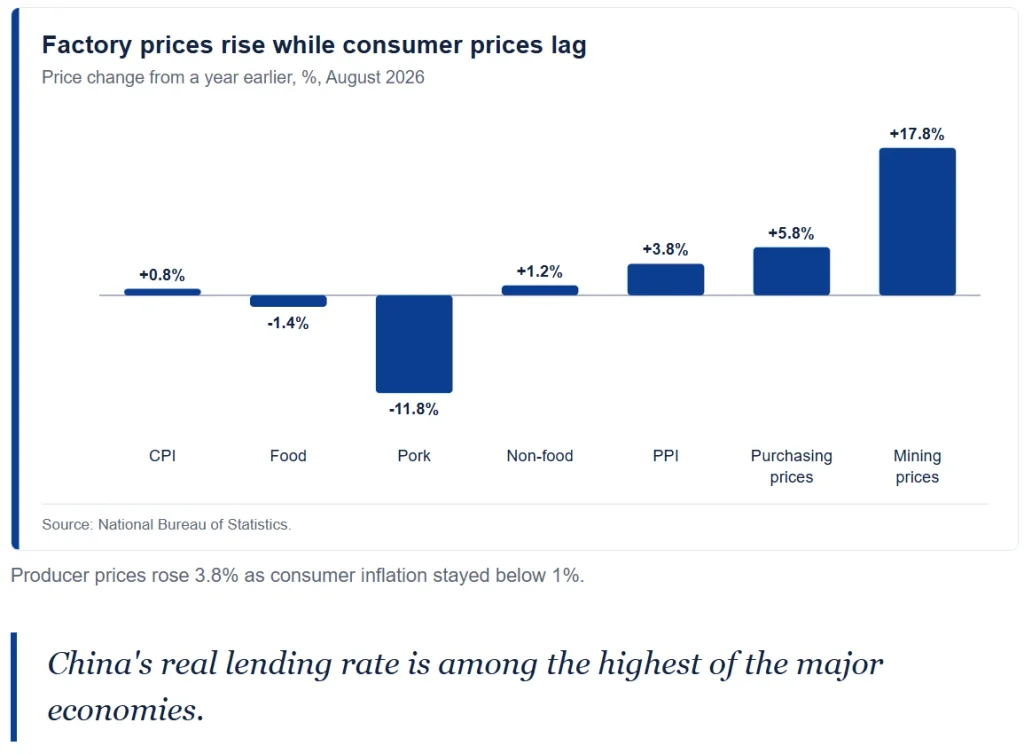
New corporate loan rates averaged below 3% in August, and mortgage rates held near 3.1%.
Industrial output grew 5.2% in August, while retail sales rose just 0.4%.
CPI rose 0.8% and PPI 3.8%, leaving a real lending rate of about 2.2%.
The yuan strengthened about 6.1% against the dollar in the year to 11 September.
China kept its benchmark lending rates on hold again in September. The one-year loan prime rate stayed at 3.0%, and the five-year rate held at 3.5%, official data show. Both have now sat unchanged for 16 consecutive months, since June 2025.
The loan prime rate works as a pricing reference for new bank loans. Each month, 20 designated banks submit quotes, and the National Interbank Funding Center publishes the result. Notably, the five-year rate anchors most mortgage pricing.
The decision stands out against moves elsewhere. On 16 September, the Federal Reserve raised rates. Two days later, the Bank of Japan followed. China’s quoting banks, by contrast, saw little need to move.
Why the Loan Prime Rate Stayed Put
The case for holding rests on growth and credit costs. Wen Bin, chief economist at China Minsheng Bank, pointed to strong exports and faster industrial output. He also said lending rates “remained relatively low in August,” which reduced the need for a cut.
The lending data back that up. New corporate loans carried an average rate below 3% in August. That was about 0.2 percentage points lower than a year earlier. Meanwhile, new mortgage rates held near 3.1%.
In other words, banks already lend below the headline benchmark. So a formal cut would add little to credit conditions right now.
Factory Output Gathers Speed
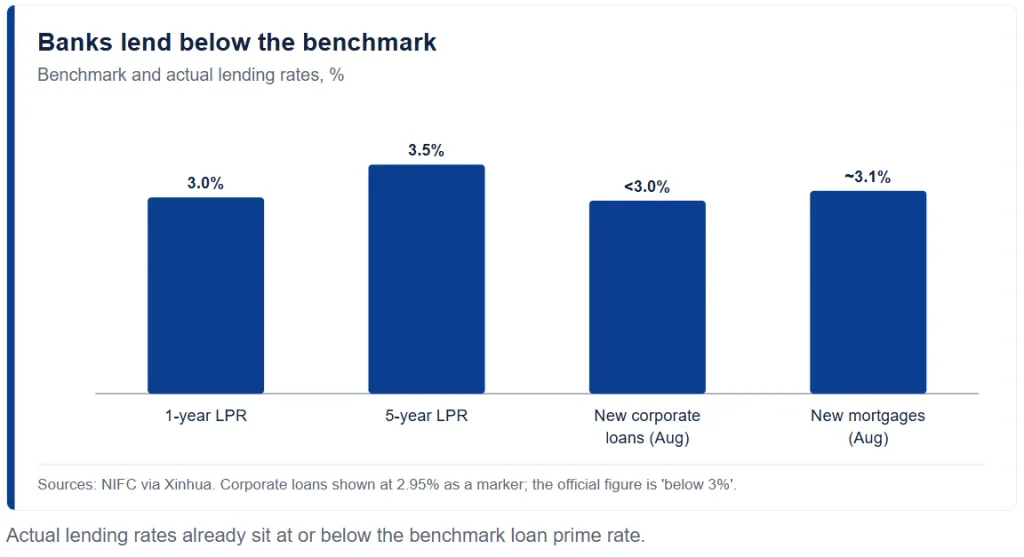
Industry is doing the heavy lifting. Industrial value added rose 5.2% from a year earlier in August, up from 4.5% in July, the statistics bureau reported. Manufacturing grew 6.1%. On a monthly basis, output rose 0.54%.
The high end grew fastest. Equipment manufacturing rose 12.1%, and high-tech manufacturing jumped 16.7%. Mining output, by contrast, fell 1.4%.
However, domestic demand remains soft. Retail sales grew only 0.4% in August. Fixed-asset investment fell 7.2% in the first eight months, and property investment dropped 19.9%.
Prices Split Between Factories and Shops
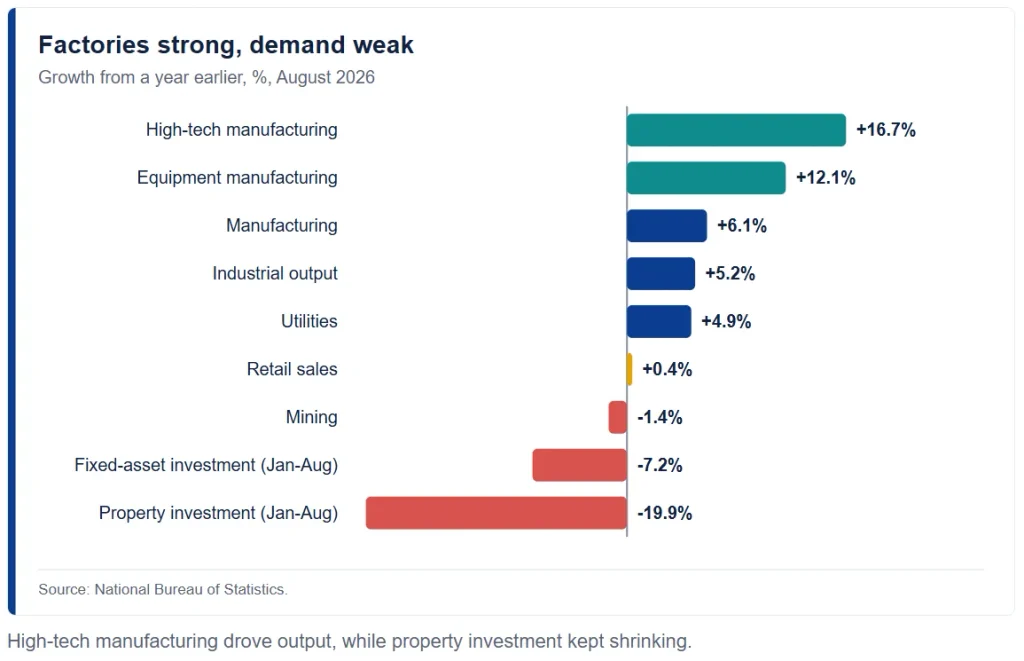
Price data show a two-speed economy. Consumer prices rose just 0.8% from a year earlier in August, the bureau said. Food fell 1.4%, and pork dropped 11.8%. Non-food items rose 1.2%. On the month, prices climbed 0.4%, and inflation has averaged 0.9% so far this year.
Factory gate prices tell a different story. The producer price index climbed 3.8%, according to the bureau. Mining and quarrying prices rose 17.8%, and nonferrous metals input costs rose 19.8%. Producer prices also gained 0.4% on the month.
Therefore, companies face higher input costs while consumers see little inflation. That squeeze could weigh on factory margins if it lasts.
China Has High Real Rates
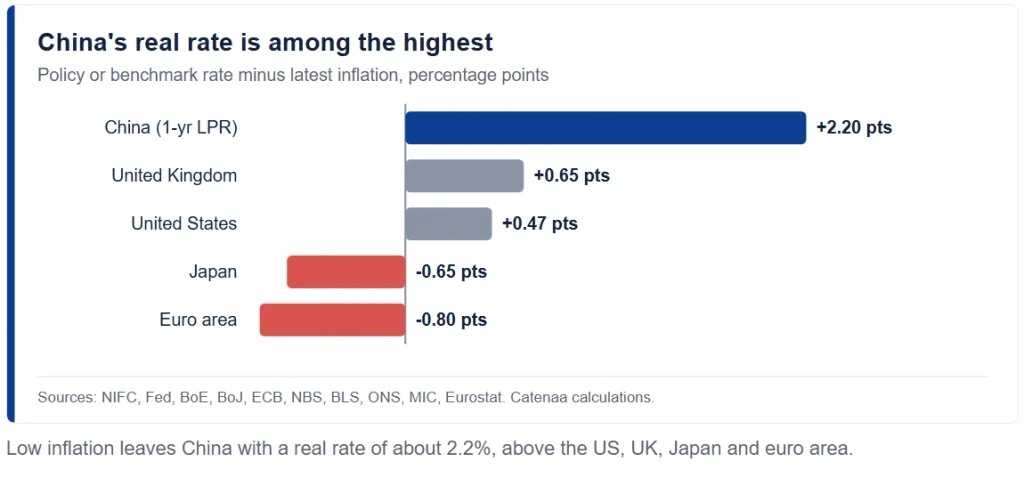
The mix of low inflation and steady rates leaves China with high real borrowing costs. A 3.0% loan prime rate minus 0.8% inflation gives a real rate of about 2.2%, by Catenaa’s calculation.
The United States, by comparison, has a real rate of about 0.5%. That figure uses the midpoint of the Fed’s 3.75% to 4.00% range and 3.4% inflation. Japan, by contrast, has a negative real rate of about minus 0.65%. The euro area also sits below zero.
For credit analysts, this matters. High real rates raise the burden on indebted property firms and local borrowers. Heavily indebted local government financing vehicles feel that burden most keenly. Yet high real rates also support the currency.
The Yuan Holds Firm
The currency has strengthened despite the policy gap. The yuan traded at 6.708 per dollar on 11 September, Federal Reserve data show. A year earlier, it stood at 7.118. That is a gain of about 6.1% for the yuan. Since the end of 2025, the currency has gained about 4.2%.
Several forces explain the move. Strong exports bring in dollars. A firmer yuan, in turn, cheapens imported commodities for Chinese factories. High real yields also make yuan assets relatively attractive. Even so, nominal gaps remain large. The 10-year U.S. Treasury yield closed at 5.01% on 18 September, far above China’s one-year loan prime rate.
What Comes Next for the Loan Prime Rate
Policymakers still have room to move. The government’s work report calls for a more proactive fiscal policy and an appropriately accommodative monetary stance this year.
Next, watch the calendar. The next monthly fixing falls on 20 October. Banks also face a quieter squeeze. Loan rates keep drifting lower while the benchmark stays flat, which narrows lending margins.
For now, though, the bar for a cut looks high. Industry is growing, and factory prices are rising. Unless consumer demand weakens further, the loan prime rate may stay at 3.0% into the fourth quarter.