

November 24, 2026 – Beijing paid about one basis point over Treasuries. The bigger shift was who bought: sovereign investors took 59% of the notes.

In Summary
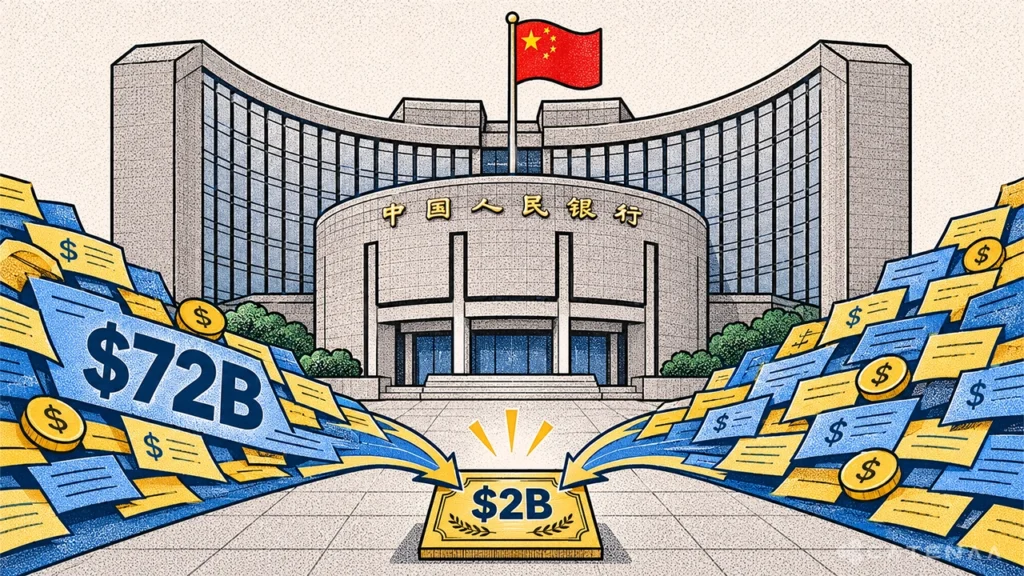
China’s Ministry of Finance sold $2 billion of three-year notes at 4.821% on Nov. 19.
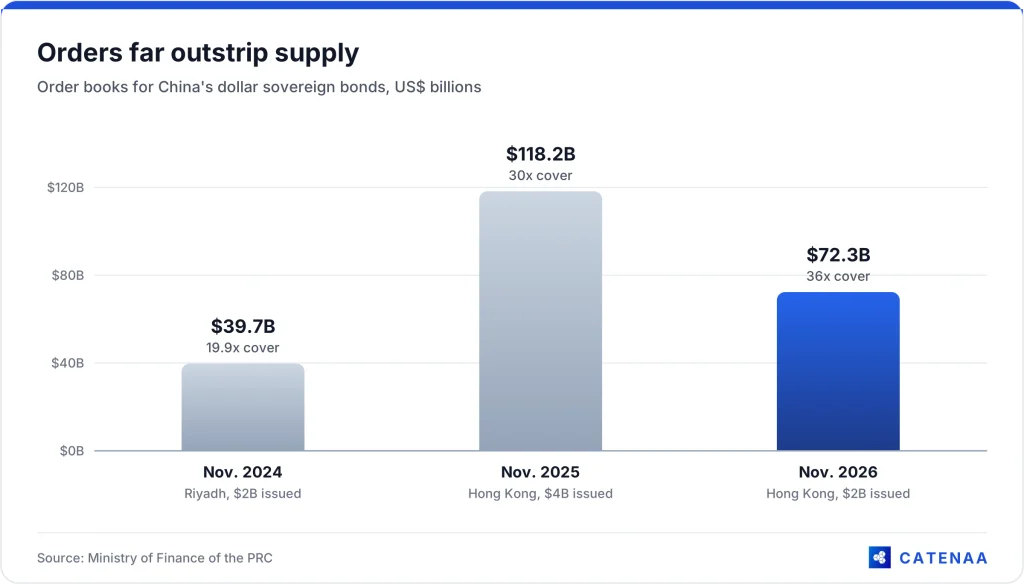
Orders reached $72.3 billion, or 36 times the deal size.
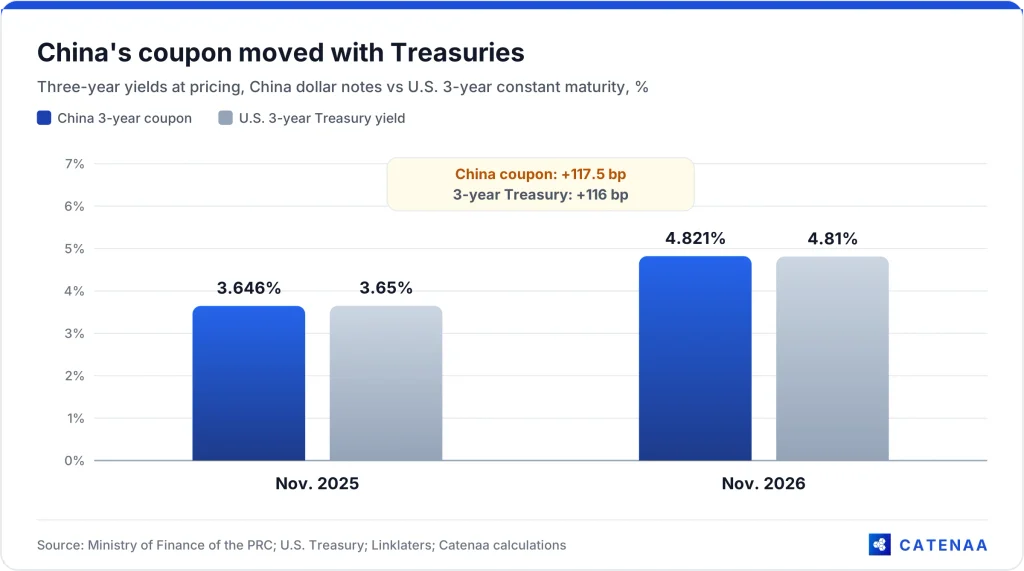
The yield sat about 1 basis point above the 3-year Treasury rate that day.
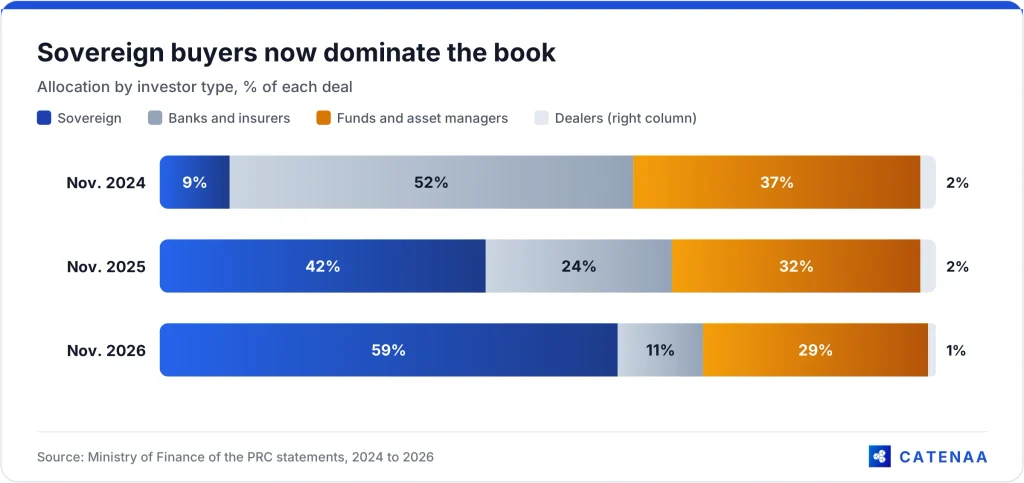
Sovereign investors took 59% of the notes, up from 42% in 2025 and 9% in 2024.
China’s latest dollar sale drew $72.3 billion of orders for just $2 billion of notes. The Ministry of Finance priced the three-year China dollar bond at 4.821% on Nov. 19. Once again, investors accepted almost the same yield they get from U.S. Treasuries.
How the China dollar bond priced
The Treasury’s 3-year constant maturity yield closed at 4.81% that day. So China paid roughly 1 basis point more than Washington. Unlike in past deals, the ministry did not state a spread this time.
Deal counsel Linklaters says the 2025 three-year notes priced flat to Treasuries, with five-year notes 2 basis points over. Since then, China’s three-year coupon has risen 117.5 basis points. Over the same span, the 3-year Treasury yield rose 116 basis points. In other words, the higher cost reflects U.S. rates, not a wider China spread.
Timing also helped buyers. The next day, the 3-year Treasury yield fell 16 basis points to 4.65%. A drop like that lifts the price of fixed-rate notes.
Demand for the China dollar bond outran supply
The ministry flagged the sale on Nov. 11. It said it would raise up to $2 billion in the week of Nov. 16. The ministry then stuck to that cap despite heavy demand.
Orders reached 36 times the deal size, up from 30 times in 2025. That makes this China dollar bond the best covered of the three recent deals. In 2024, a $2 billion sale in Riyadh drew 19.9 times cover. Scarcity helps explain the pull. Across 2025 and 2026, the ministry sold just $6 billion of dollar notes in Hong Kong.
The fill rate shows how tight supply was. With $72.3 billion chasing $2 billion, the average order received under 3% of its request. By contrast, the 2024 deal had two tenors. It paired $1.25 billion of three-year notes at 4.284% with $750 million of five-year notes at 4.340%.
Sovereign buyers took the lion’s share
Sovereign-type investors took 59% of the notes. Funds and asset managers took 29%, banks and insurers 11%, and dealers 1%. By region, Asia took 52%, Europe and the Middle East 34%, and the Americas 14%.
That mix has shifted fast. In the 2024 Riyadh deal, sovereign buyers took just 9% while banks took 50%. A year later, sovereigns took 42%, according to the ministry’s 2025 statement.
Regional demand has also widened. In 2024, Asia took 68% and U.S. investors just 4%. This time, the Americas took 14%. Meanwhile, Asia’s share fell to 52%.
Why geopolitics barely shows in the price
Geopolitical tension usually widens spreads. Yet this deal points to other forces. One is diversification, since reserve managers can hold dollar assets from a non-U.S. issuer. Another is size, because small deals let China favour long-term holders and keep trading supply thin.
Such deals also give Chinese companies a sovereign reference point for their own dollar borrowing. Each new China dollar bond refreshes that benchmark. Still, the price reflects a small, scarce bond, not China’s wider borrowing costs. A larger or longer deal would test that demand more fully. For now, the notes will list on the Hong Kong stock exchange.
Vice Finance Minister Guo Tingting marked the sale at a ceremony in Hong Kong on Nov. 20. She said the deal shows China’s commitment to opening up and supports Hong Kong as a financial centre. Hong Kong Financial Secretary Paul Chan also attended.