


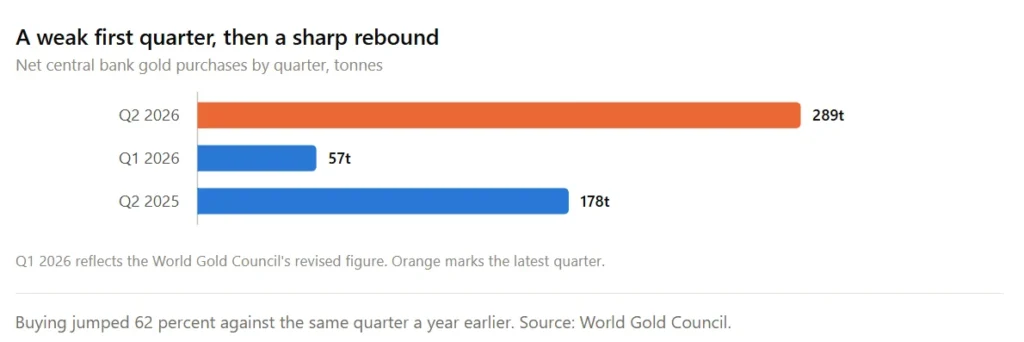
August 16, 2026 – Official purchases rebounded to 289 tonnes in the second quarter of 2026. Poland and China led the way. Notably, reserve managers stepped up buying while the gold price was falling back from its January record.
In Summary
Central banks bought 289 tonnes of gold in Q2 2026. That is a 62% rise on the 177.9 tonnes bought in Q2 2025.
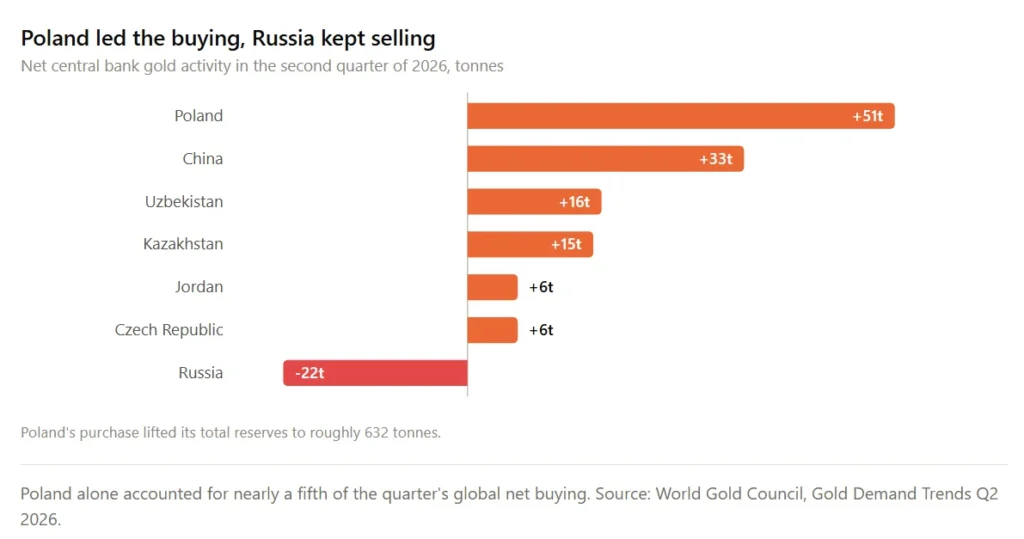
Poland led with 51 tonnes, lifting its reserves to roughly 632 tonnes. China added 33 tonnes, its biggest quarterly purchase since Q4 2023.
Russia sold 22 tonnes and stayed the quarter’s main seller. Turkey, by contrast, cut its own sales sharply.
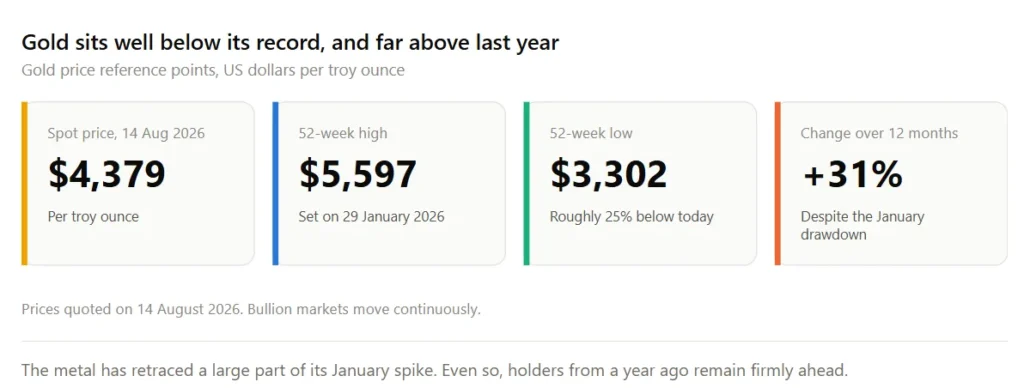
Officials bought into weakness. Gold traded near $4,379 in mid-August. That is about 22% below the record $5,597 set on 29 January 2026.
The first half still lags. Net demand of 345 tonnes is the weakest in the first half since 2022. So Q2 repaired a poor start rather than setting a record.
For investors: a record 45% of surveyed central banks plan to add gold within a year. That supports holding it as a core position.
Central banks bought 289 tonnes of gold in the second quarter of 2026. That total is a 62% jump on the same period a year earlier. Notably, central bank gold buying sped up while the price itself was falling. For investors, that behaviour says more than any price chart.
The quarter that broke the pattern
The World Gold Council put net official buying at roughly 289 tonnes for the April to June period. Q2 2025 had brought in 177.9 tonnes. The rebound looks all the more striking against a weak start to the year. On revised figures, the first quarter yielded only 57 tonnes.
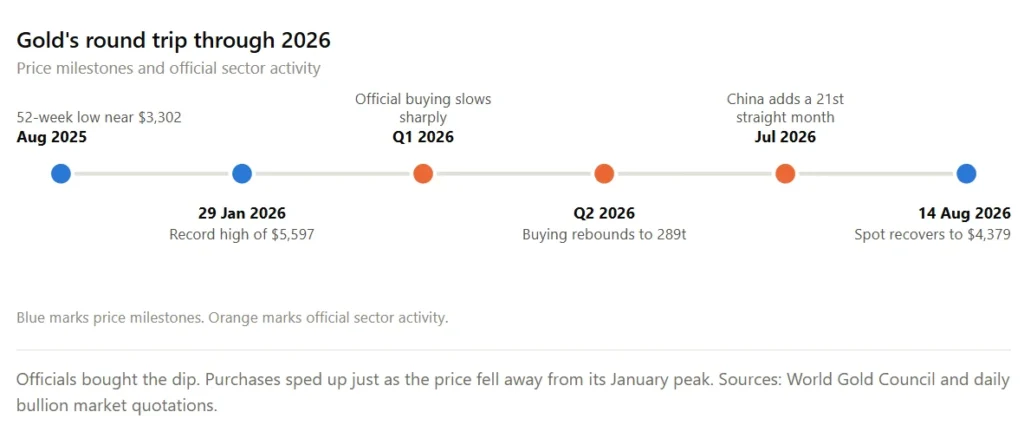
Timing matters here. Gold peaked at $5,597 an ounce on 29 January 2026. Prices then slid hard. Middle East tension lifted oil and dimmed hopes of rate cuts. Central banks used that weakness to buy.
Poland led, and China returned in size
Poland led the quarter with 51 tonnes. That purchase lifted Polish reserves to roughly 632 tonnes. China followed with 33 tonnes. For Beijing, that was the biggest quarterly addition since late 2023.
Smaller buyers filled out the list. Uzbekistan added 16 tonnes, while Kazakhstan took 15 tonnes. Jordan and the Czech Republic each bought 6 tonnes. Russia moved the other way and sold 22 tonnes. Turkey, by contrast, cut its own selling sharply.
Chinese buying has since carried on. The People’s Bank of China added roughly 20 tonnes in July. That marked its 21st straight month of purchases. Few reserve managers have shown such a steady hand.
Prices fell, yet officials kept buying
Gold traded near $4,379 an ounce on 14 August 2026. That level sits about 22% below January’s record. Even so, the metal has gained roughly 31% over the past 12 months. In the past month alone, it has rallied about 8%.
Private investors often chase strength. Official buyers work to a reserve target instead of a price target. So a lower price simply makes the same target cheaper to reach. That gap in motive explains a great deal.
The first half still lags historic highs
Context deserves a mention. Net demand for the first half reached 345 tonnes. That is the weakest first half since 2022, when the figure came to 241 tonnes. So the Q2 surge repaired a poor start rather than setting a fresh record.
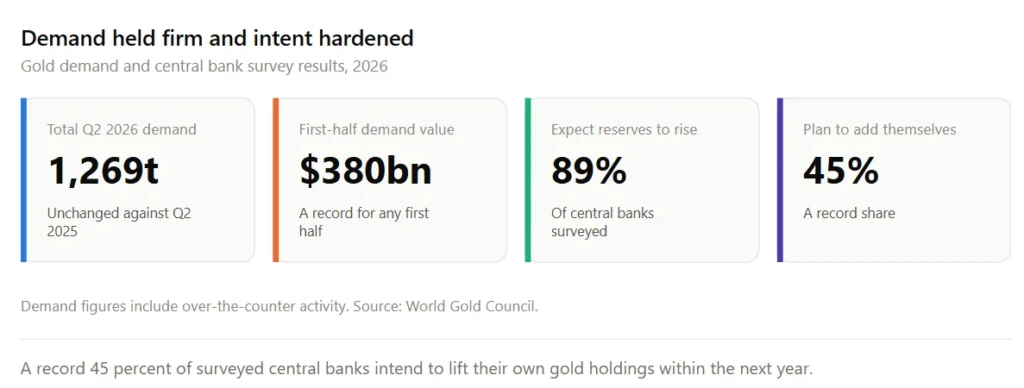
The World Gold Council now expects around 850 tonnes of central bank gold buying for the full year. That figure would broadly match the 863 tonnes logged in 2025. Total gold demand, including over-the-counter trade, held steady at 1,269 tonnes in the second quarter. Its value reached a record $380 billion across the first half.
Why central banks keep buying
Three motives explain the pattern. First, many emerging nations want to spread reserves beyond a single dominant currency. Second, gold carries no issuer behind it and no sanctions risk. Third, global political risk has stayed high right through 2026.
Survey evidence backs reading. The World Gold Council found that 89% of central banks expect global gold reserves to rise next year. A record 45% plan to add to their own holdings.

What this means for investors
Official demand is price-insensitive
Reserve managers buy on long-term targets, not on price. Their flows therefore act as a partial floor under the market. That habit differs sharply from ETF flows, which tend to chase momentum. Retail money often arrives late as a result.
Gold has behaved as an inflation asset, not a rate asset
Standard models say higher real rates should hurt gold. Yet the metal rose 31% over a year in which the Fed held policy tight. Stubborn energy inflation and global risk clearly outweighed the cost of holding it.
Position sizing beats timing
January’s peak and the slide that followed show the swings involved. A fall of more than 20% in seven months is not unusual for this asset. Investors should size their holdings to suit, rather than try to trade each move.

The bottom line
Central bank gold buying rebounded sharply in the second quarter. It did so into falling prices, which tells you a lot. Poland and China led, while Russia kept selling. The first half still trails recent records. Even so, stated intent among reserve managers has rarely been stronger. For long-term investors, that mix argues for holding gold as a core reserve asset rather than a quick trade.