

October 03, 2026 – A quarterly filing reveals a financing loop. Broadcom backstops leases and may lend to the AI lab that rents its chips.

In Summary
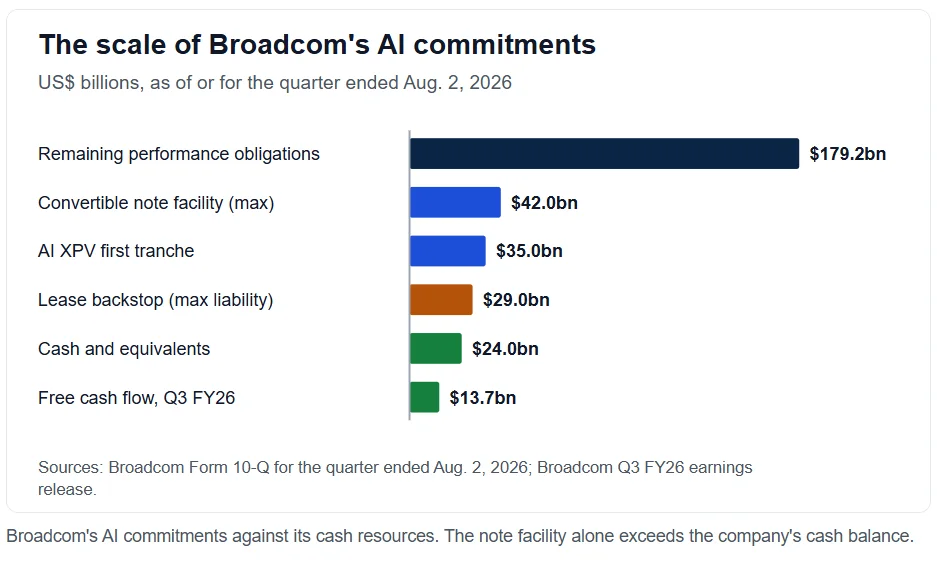
Broadcom’s 10-Q shows a customer may issue it up to $42 billion of convertible notes for lease costs.
Reports on Anthropic’s IPO filing identify Anthropic as that customer.
Broadcom also backstops five-year leases of its AI racks, with up to $29 billion of potential liability.
AI chip revenue hit $16.7 billion last quarter, and Broadcom guides to $21.7 billion next.
Broadcom could lend Anthropic up to $42 billion so the AI developer can lease computing power built on Broadcom chips. The chipmaker’s latest quarterly filing shows that a customer may issue it convertible notes up to that amount. Reports on Thursday, citing Anthropic’s IPO filing, named Anthropic as that customer.
The notes come with strict conditions. Any proceeds must go solely toward the customer’s lease obligations, the 10-Q says. As of Aug. 2, Broadcom had not received any notes. Because the notes are convertible, Broadcom could also end up holding Anthropic equity.
How the Broadcom financing loop works
The loan is one part of a larger structure. In June, Broadcom launched what it calls the AI XPV platform with an initial $35 billion tranche. A financial partner led that tranche to fund more than 1 gigawatt of compute for one customer.
Under the deal, the partner buys AI racks built around Broadcom’s custom accelerators. It then leases that capacity to the customer over five years. Broadcom, in turn, backstops the customer’s lease payments. Its maximum potential liability is about $29 billion.
The backstop has limits. On a default, the chipmaker pays the gap between 85% of the unpaid lease balance and the racks’ sale value. In some cases, it can also take over the lease or sell the racks back at a fixed price.
The company believes the odds of paying out are low. It cites the “strong profitability trajectory” of the leading AI labs and the lasting value of the hardware. Nevertheless, the 10-Q lists such guarantees as contingent liabilities. So far, it has paid nothing under the backstop.

Broadcom says it wants to bridge a gap. Frontier AI labs need huge upfront spending, yet their cash flows are still catching up, the filing explains. Through the platform, Broadcom aims to enable more than 20 gigawatts of compute capacity through 2028.
Anthropic’s compute plans
Anthropic has been open about its need for capacity. In April, it signed for multiple gigawatts of next-generation TPU capacity with Google and Broadcom. That capacity starts coming online in 2027, mostly in the United States.
At the time, Anthropic said its run-rate revenue had reached $30 billion. That was up from about $9 billion at the end of 2025. Moreover, more than 1,000 business customers were each spending over $1 million a year.
Reports on Anthropic’s filing said the notes would cover about a third of a $125.2 billion, five-year TPU lease commitment. However, Catenaa could not find that filing on the SEC’s public EDGAR database as of Friday. Broadcom’s own 10-Q does not name the customer.
What the deal means for Broadcom
The financing sits on top of a booming AI business. In its fiscal third quarter, Broadcom’s AI semiconductor revenue jumped 221% to $16.7 billion. Total revenue rose 86% to $29.6 billion. For the fourth quarter, the company guided to $21.7 billion of AI revenue.

The jump has been steep even by recent standards. Just one quarter earlier, AI revenue was $10.8 billion. In other words, sales rose about 54% in three months.
The order book is even larger. Remaining performance obligations reached about $179.2 billion at the end of the quarter. That figure includes a long-term custom accelerator contract signed in the prior quarter. Broadcom expects about 25% of the total to turn into revenue over the next 12 months.
Concentration is rising, though. The top five end customers made up about 55% of net revenue in the quarter. A year earlier, the figure was 40%. When a major customer also borrows from its supplier, that exposure carries extra credit risk.

For now, Broadcom can afford the commitment. It ended the quarter with about $24.0 billion in cash and generated $13.7 billion of free cash flow. Even so, the $42 billion note facility alone exceeds its cash pile.
Investors took the news in stride. Broadcom shares rose 2.8% to $353.33 by 11:43 a.m. in New York on Friday, according to Nasdaq data. The stock still trades well below its 52-week high of $495.

The structure shows how chip suppliers now help fund their biggest buyers. That can lock in demand for years. At the same time, it ties Broadcom’s fortunes more closely to a handful of AI labs.