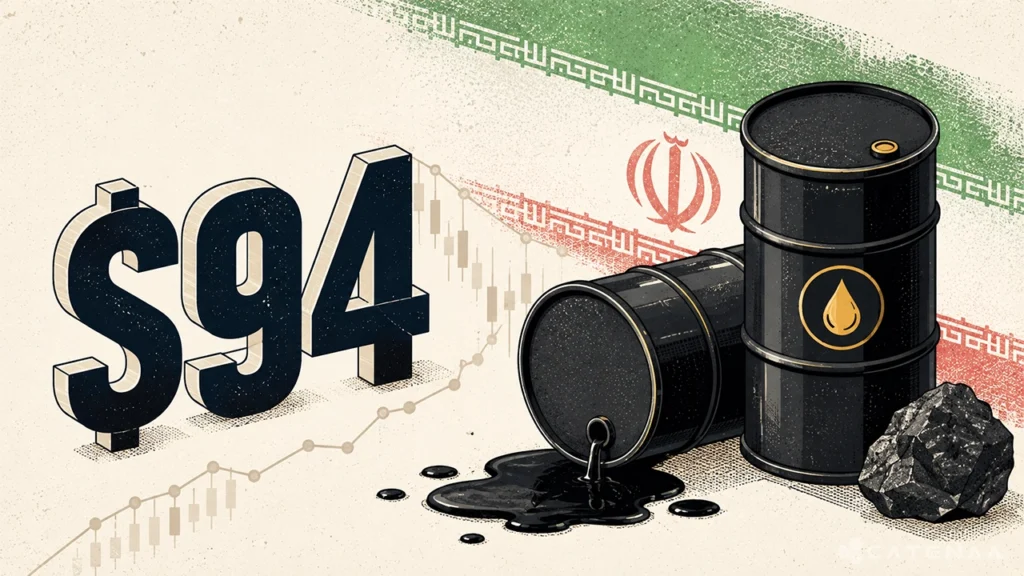


August 22, 2026 – Crude transiting the Strait of Hormuz has fallen to 4.9 million barrels a day. Global supply now sits almost two million barrels below demand.
In Summary
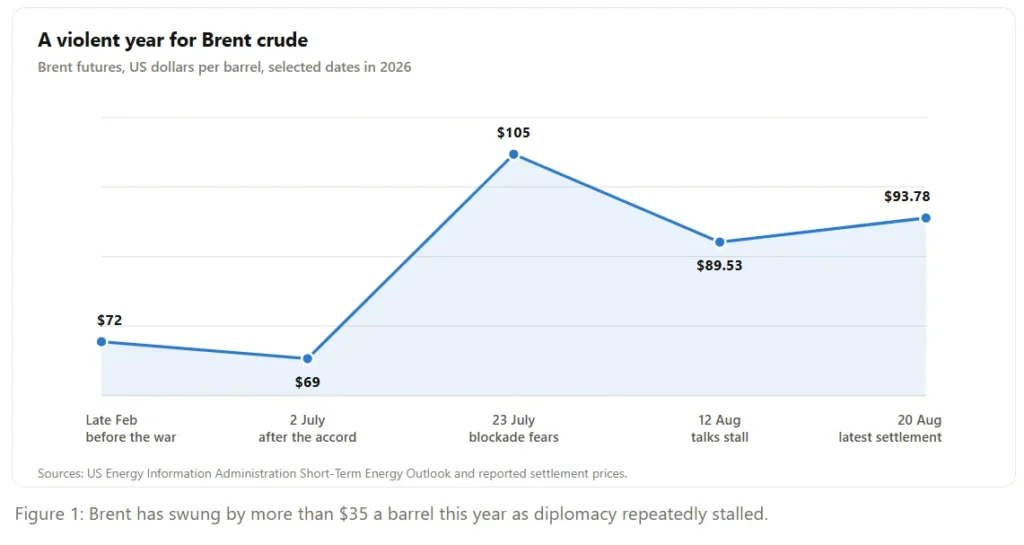
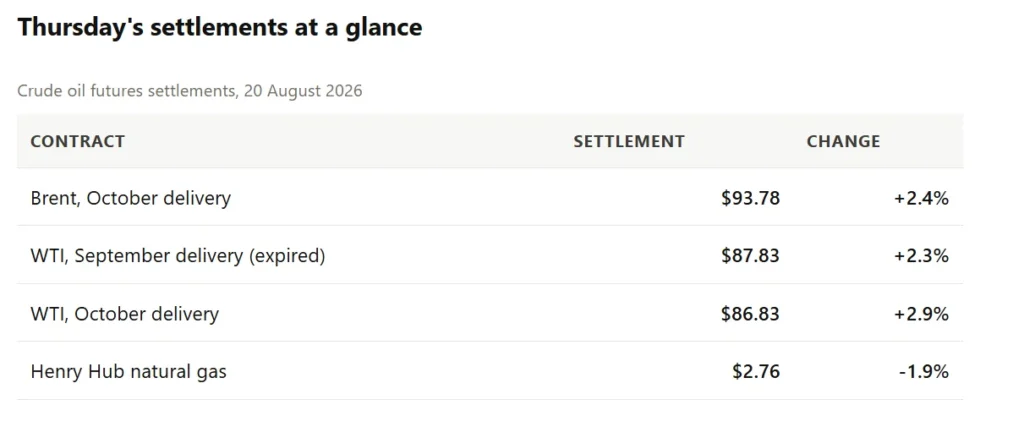
Brent crude for October settled at $93.78, up 2.4%, while WTI for October settled at $86.83.
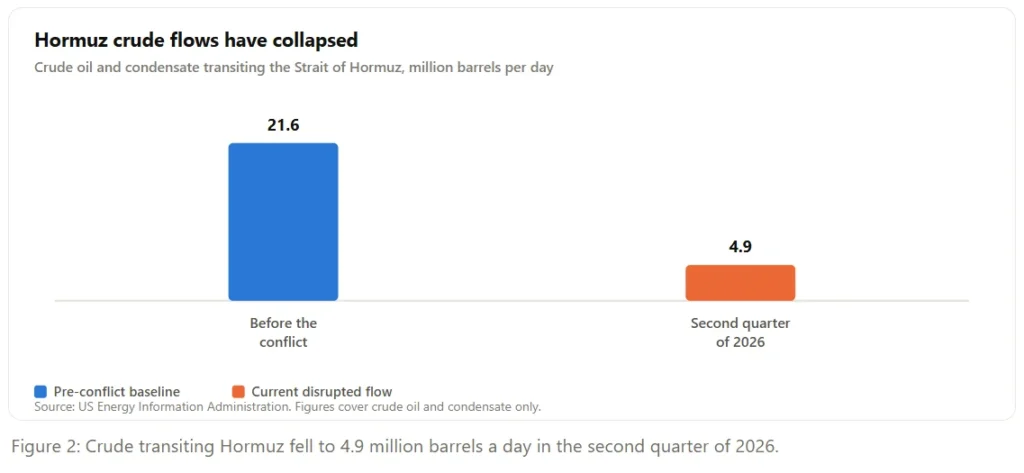
Crude flows through the Strait of Hormuz have fallen from 21.6 to 4.9 million barrels a day.
Iran’s central bank governor said the country’s oil exports have virtually stopped.
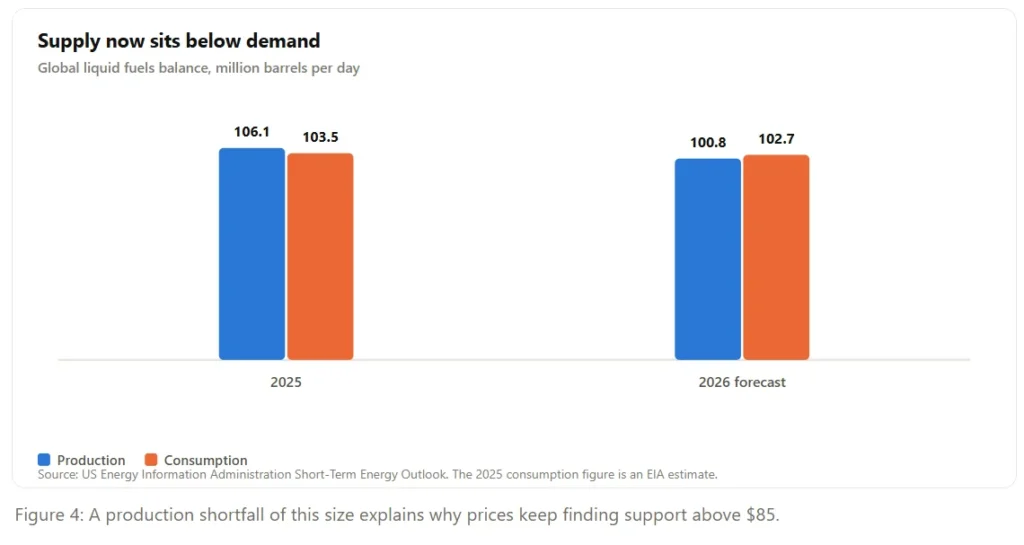
Global production is forecast at 100.8 million barrels a day in 2026 against consumption of 102.7 million.
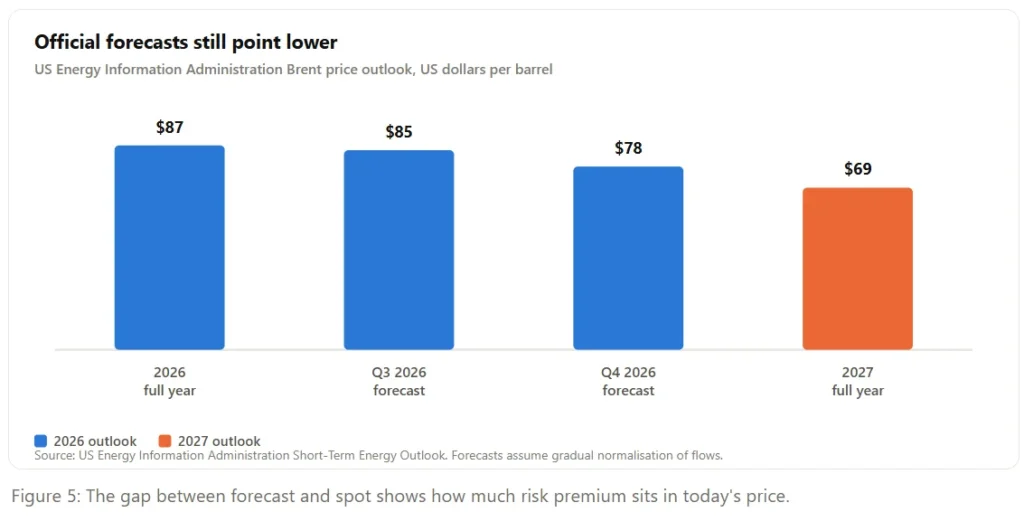
The EIA still expects Brent to average $87 in 2026 and $69 in 2027, well below current levels.
The Brent crude price returns to the mid-nineties
The Brent crude price pushed toward $94 a barrel on Thursday. October futures settled at $93.78, a gain of 2.4%. West Texas Intermediate for October settled at $86.83.
Fresh threats against Iran drove the move, traders said. Washington has signalled tougher economic measures, and traders read that as escalation. Supply risk returned to the front of the market.
Why Hormuz decides the Brent crude price
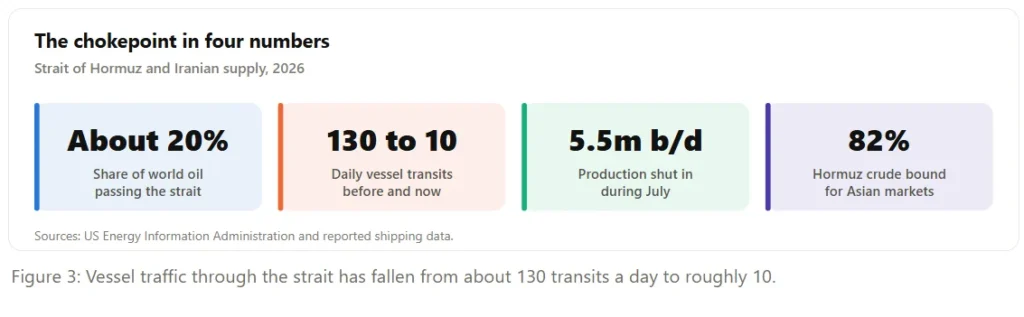
In short, one narrow waterway carries an outsized share of global energy. The US Energy Information Administration puts normal flows at about 21 million barrels a day. That equals roughly a fifth of the world’s petroleum consumption.
Around one-fifth of the global liquefied natural gas trade also passes through. Furthermore, about 82% of the crude heading out reaches Asian buyers. China, India, Japan, and South Korea dominate that demand.
Disruption there, therefore, touches every refinery margin on the planet.
Alternative routes exist, yet they carry limited volume. Pipelines across Saudi Arabia and the Emirates can bypass part of the flow. They cannot replace all of it.
Iran’s exports have all but stopped
Meanwhile, US forces are blockading Iranian ports. Abdolnaser Hemmati, the central bank governor, said oil exports have “virtually stopped”. China, the largest buyer of Iranian barrels, has lost its main discounted supply.
Furthermore, regional politics have shifted too. The United Arab Emirates has cut all economic ties with Tehran. Security incidents continue, and one tanker was hijacked 136 nautical miles east of Mukalla in Yemen.
The balance has flipped into deficit
Overall, supply losses now exceed demand weakness. Global production is forecast at 100.8 million barrels a day in 2026, down from 106.1 million in 2025. Consumption is running near 102.7 million.
Consequently, inventories are draining. Stocks fell by an average of 4.2 million barrels a day in the second quarter. A further draw of 3.8 million a day is expected in the third.
July alone saw about 5.5 million barrels a day of production shut in.
What analysts are saying
Meanwhile, Tamas Varga of PVM Oil Associates pointed to the political driver. “In this headline-driven environment, the latest Trump salvo is driving prices higher,” he said. He described the threat of economic warfare as an escalation.
Rebecca Babin of CIBC Private Wealth struck a calmer note on demand. “We’re still nowhere near pre-conflict levels,” she said. However, she called the trend in Chinese appetite encouraging.

Forecasts still assume relief
Even so, official projections remain below current prices. The EIA expects Brent to average $87 in 2026 and just $69 in 2027. Its fourth-quarter estimate sits at $78.
Importantly, those numbers assume shipping normalises. If the blockade persists, the forecasts will need revision. Traders are already paying above the official price.
What to watch next
Looking ahead, three indicators matter most. First, daily transit counts through the strait. Second, any change in Iranian export loadings. Third, OPEC production decisions in the coming weeks.
Consumers should prepare for volatility either way. Fuel costs feed into inflation within weeks, so central banks are watching closely too.
Similarly, airlines, shippers, and chemical firms face the same problem. Hedging costs rise sharply when prices swing this hard. Many will pass those costs to customers.
For now, the market trades on headlines from the Gulf. A credible reopening of the strait would change that overnight.