

October 04, 2026 – The S&P 500 is up 12.8% this year and sits 1% below its record. A 5.3% 10-year yield now leaves stocks with almost no valuation cushion.

In Summary
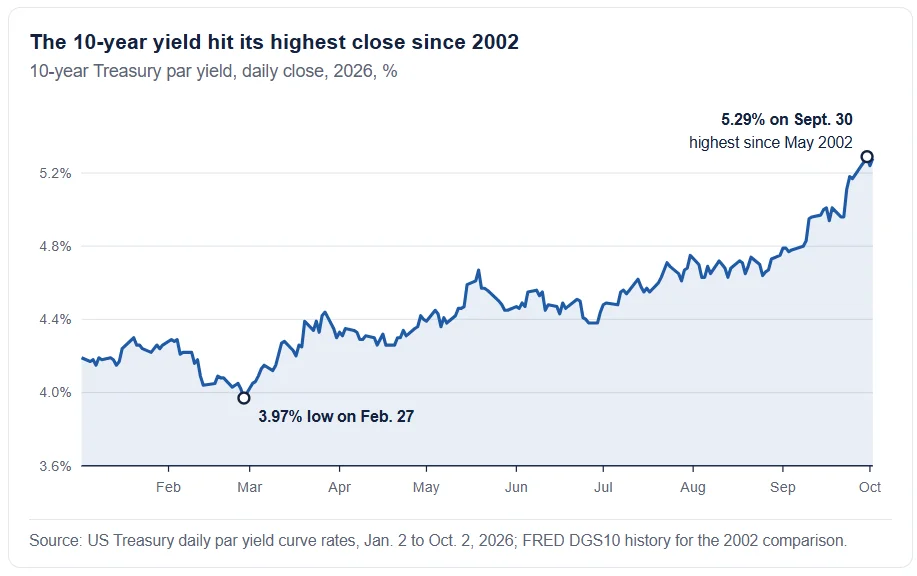
The 10-year Treasury yield closed at 5.29% on September 30, its highest since May 2002.
The S&P 500 is up 12.8% this year and just 1% below its August 13 record close.
Analysts expect 29.5% Q3 earnings growth, while the forward earnings yield roughly matches Treasuries.
Fed minutes, bank earnings, and the November 3 midterms will shape the fourth-quarter path.
Rising bond yields are now the biggest test for US stocks as the fourth quarter begins. The 10-year Treasury yield closed at 5.29% on September 30, its highest since May 2002. It ended Friday at 5.28%.
Stocks have held up so far. The S&P 500 closed Friday at 7,722.72, up 12.8% this year. That leaves it about 1% below its August 13 record close of 7,798.99.
This year’s deepest pullback was 9.1%, from a January 27 high to a March 30 low. Since then, the index has rallied despite higher borrowing costs.
Why Bond Yields Matter Now
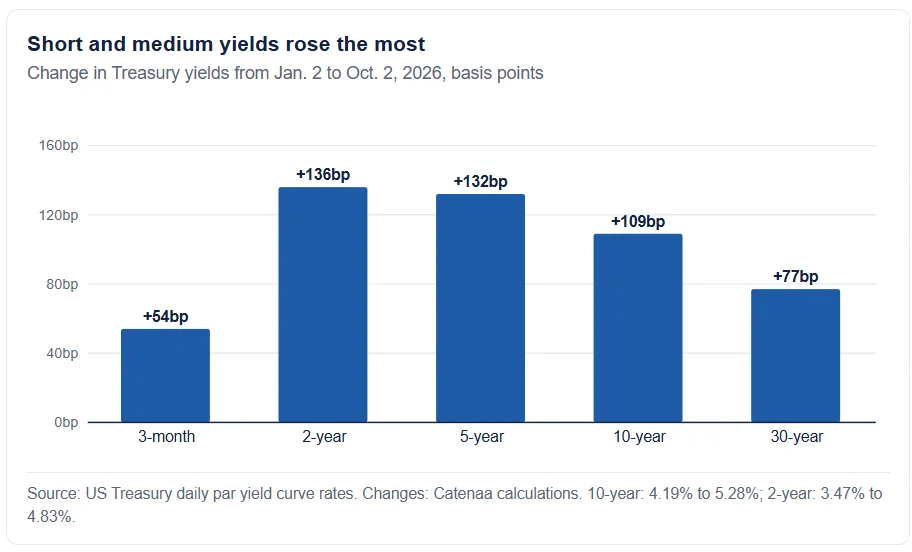
The 10-year yield has risen 109 basis points since January 2, when it stood at 4.19%. Shorter maturities moved even faster. For example, the two-year yield jumped 136 basis points to 4.83%.
As a result, the curve has flattened. The gap between 10-year and two-year yields narrowed to 45 basis points from 72 in January. Meanwhile, the 30-year yield ended the week at 5.63%.
Monetary policy explains part of that move. The Federal Reserve raised its target range by a quarter point to 3.75% to 4.00% on September 16. It was the first hike since July 2023, and the vote was unanimous. The statement said inflation remains elevated and called for a timelier return to the 2% goal.
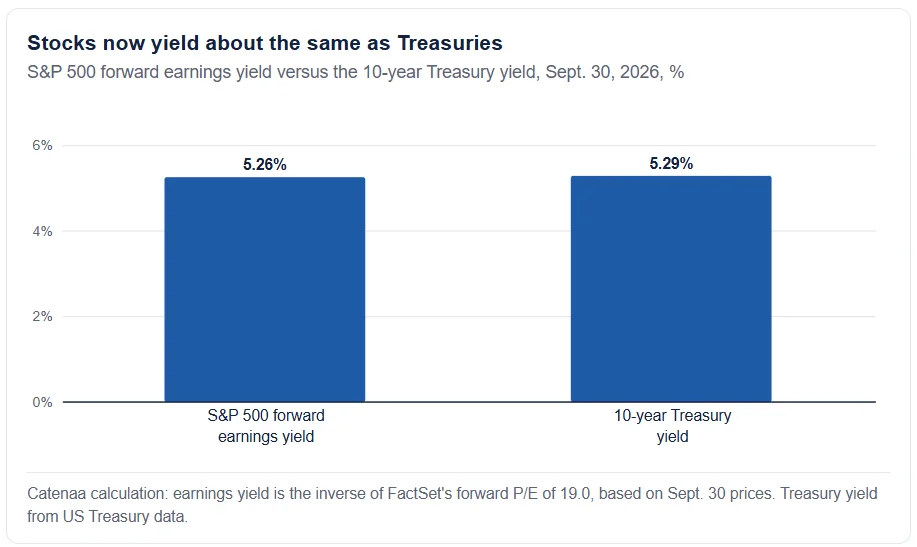
Higher yields also squeeze valuations. The S&P 500 traded at 19.0 times forward earnings on September 30, below its five-year average of 19.8. Even so, that multiple implies an earnings yield of about 5.26%. The forward multiple fell from 20.4 at the end of June. Forward earnings estimates rose 9.3% over that span, while the index gained only 2.0%.
In other words, stocks now offer roughly the same yield as a 10-year Treasury. Investors therefore earn little extra for taking equity risk. On trailing profits, the picture looks richer still, with a multiple of 25.7 against a five-year average of 24.4.
A High Bar for Earnings
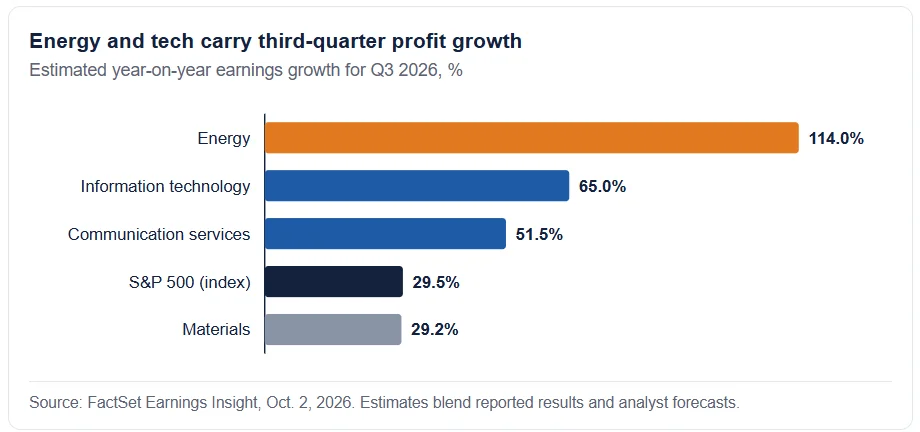
Profits have done the heavy lifting. According to FactSet’s season preview, analysts expect third-quarter earnings growth of 29.5%. That is up from 26.7% on June 30, and revenue should rise 12.3%. If confirmed, it would mark a third straight quarter of growth above 25%.
Analysts lifted their quarterly estimates by 1.4% during the period. Typically, they cut them by about 2.2% over that stretch. Moreover, 62% of companies issuing guidance gave a positive outlook, well above the five-year average of 40%.
Energy leads with expected growth of 114%, helped by a 32% jump in average oil prices. Information technology follows at 65%, driven by semiconductors. Without chipmakers, tech growth would slow to 24.4%. Looking further out, analysts see fourth-quarter growth of 27.6% and full-year growth of 32.4%.
PepsiCo reports before the opening bell on October 8, and Delta Air Lines follows on October 9. Then JPMorgan Chase helps open the bank season on October 13. Bank results will show how higher yields are affecting loan demand and deposit costs.
Jobs, the Fed and the Midterms
The economy sent mixed signals on Friday. Payrolls rose by just 29,000 in September, while the unemployment rate stood at 4.2%. Revisions also cut 60,000 jobs from July and August combined. Average hourly earnings rose 3.0% from a year earlier, to $37.81.
Minutes from the September Fed meeting are due on Wednesday. Investors will look for how many officials favour another hike. September consumer prices follow on October 14, and policymakers meet again on October 27 and 28.
Inflation data matters most for the long end. A hot reading could push the 10-year yield above 5.3%, while a soft one could ease pressure on valuations.
The November 3 midterms add a further layer of risk. History offers some comfort. Over the past nine years, the S&P 500 rose in eight fourth quarters, Catenaa’s review of FRED data shows. On average, the index gained 5.1%.
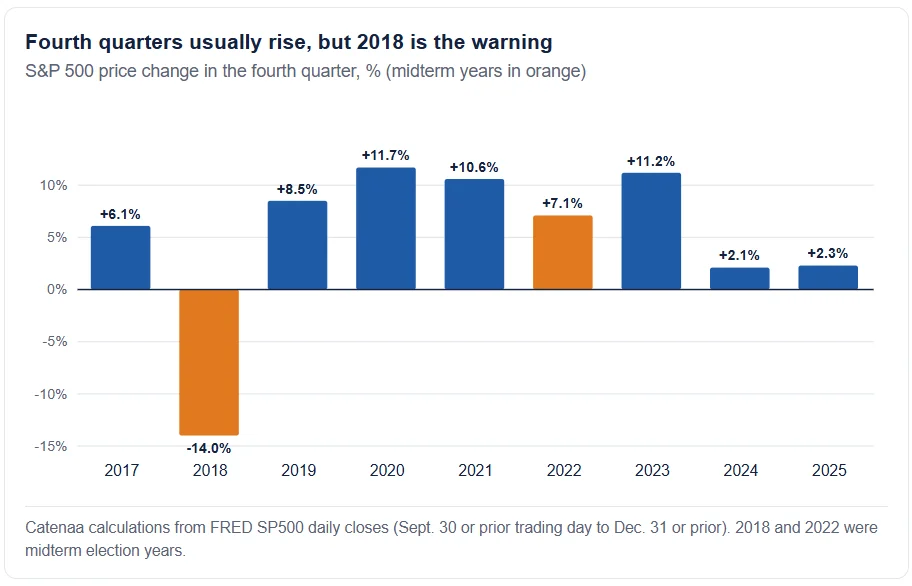
The exception was 2018, a midterm year when the Fed was also raising rates. Stocks fell 14.0% that quarter. By contrast, the 2022 midterm quarter brought a 7.1% gain.
Analysts remain upbeat. Their bottom-up target for the index sits 21.3% above the September 30 close, according to FactSet.
For now, strong profits are fighting rising bond yields. If yields keep climbing while estimates stall, the usual fourth-quarter lift may prove harder to earn.