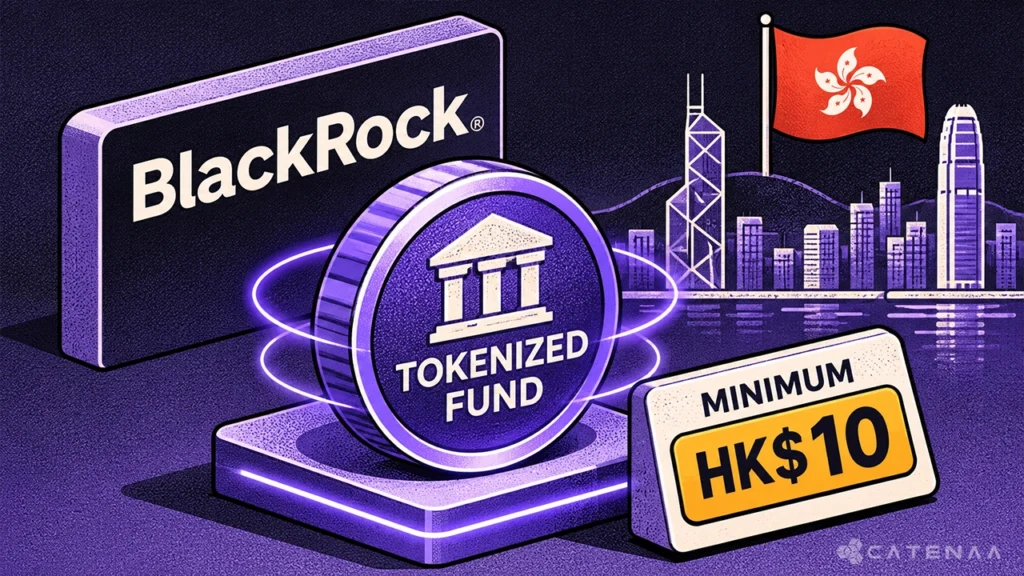


November 28, 2026 – BlackRock’s first tokenized fund in Asia lets investors in from HK$10. Catenaa checked the share classes, fees and yields, and found the HK$10 classes pay over four times the institutional fee.

In Summary
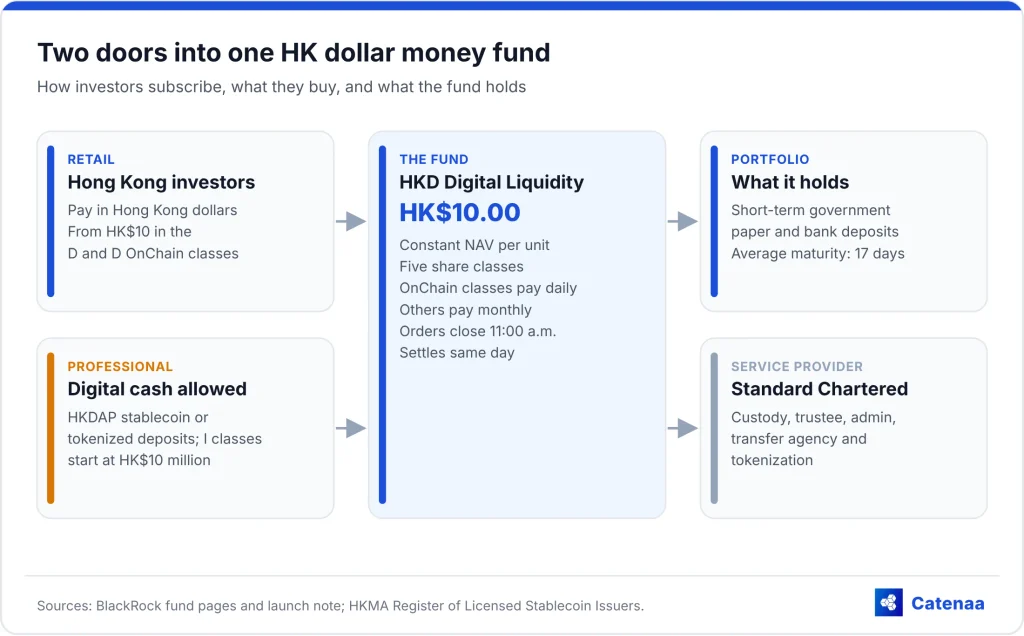
BlackRock’s HKD Digital Liquidity Fund lists five share classes; the D and D OnChain classes start at HK$10.
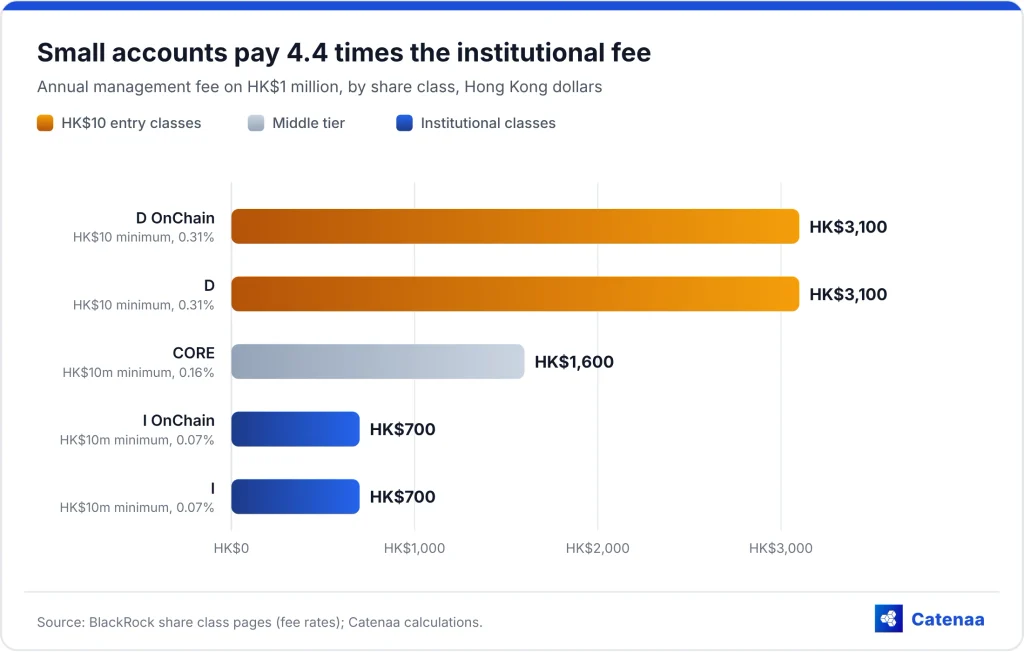
Those classes charge a 0.31% management fee, versus 0.07% for the HK$10 million I classes, a 4.4-fold gap.
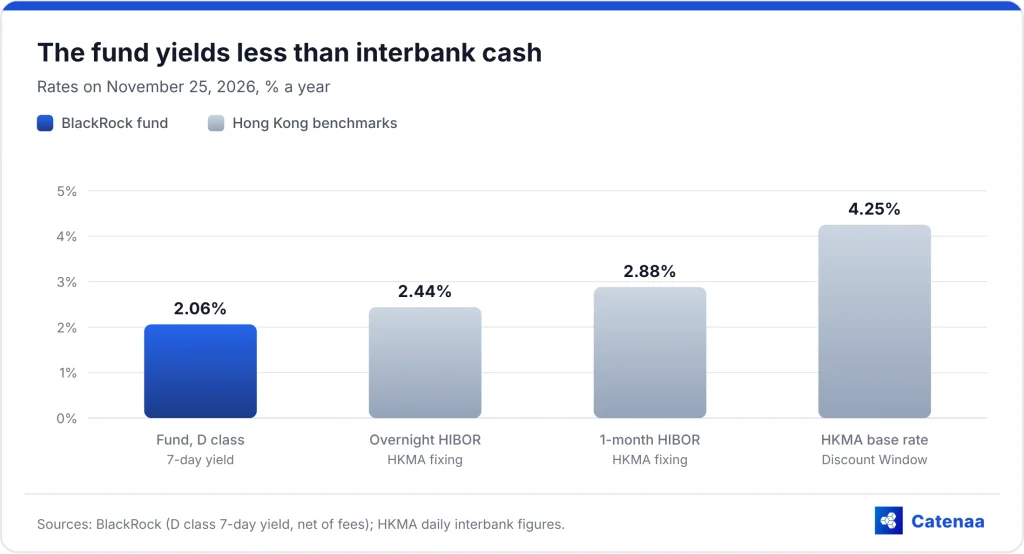
The D class showed a 7-day yield of 2.06% after fees on November 25, below one-month HIBOR at 2.88%.
BlackRock says professional investors can deal in digital cash such as HKDAP, issued under an HKMA licence.
A BlackRock tokenized fund now lets Hong Kong investors start with just HK$10. BlackRock opened the HKD Digital Liquidity Fund on November 24, its first tokenized fund in Asia-Pacific. The fund buys short-term government paper and holds bank deposits. It also aims to keep a constant net asset value of HK$10.00 per unit. BlackRock calls it the first Hong Kong-domiciled money fund to offer that structure to both retail and institutional investors.
BlackRock’s fund page says the Securities and Futures Commission (SFC) has authorized its Hong Kong funds for public sale. However, BlackRock stresses that SFC authorization is not an endorsement.
Five share classes, two price tiers
The fund lists five share classes, all in Hong Kong dollars. Both the tokenized D OnChain class and the conventional D class start at HK$10. Each charges a 0.31% management fee. By contrast, the I class and I OnChain class need HK$10 million and charge 0.07%. A CORE class also needs HK$10 million and charges 0.16%.
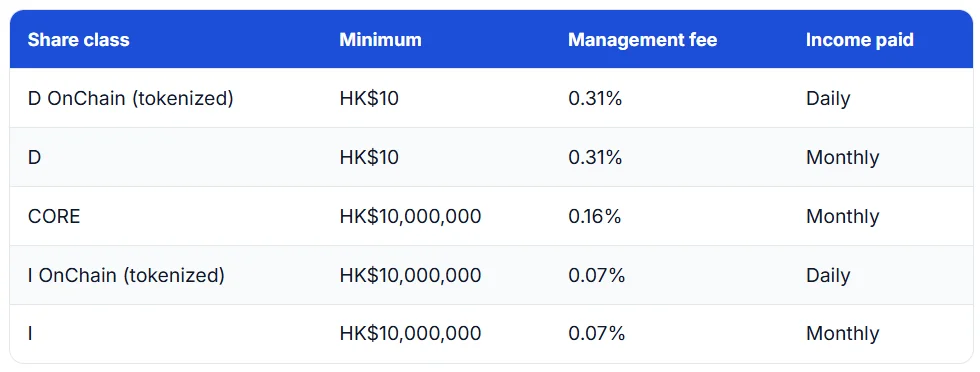
The tokenized OnChain classes pay income daily, while the conventional classes pay monthly. All five classes started on November 16. Orders close at 11:00 a.m. Hong Kong time and settle the same day.
The economics of a BlackRock tokenized fund account
Fees create the biggest gap. On HK$1 million, a D class holder pays about HK$3,100 a year in management fees. An I class holder pays about HK$700. That is a 4.4-fold difference for the same portfolio. Put another way, a HK$10,000 D class holding costs about HK$31 a year in fees.
Small balances also earn very little in cash terms. The D class showed a 7-day yield of 2.06% on November 25, after fees. At that rate, HK$10 earns about HK$0.21 a year. The fund’s daily distribution factor was 0.000566 per unit, roughly HK$0.0006 a day. So the HK$10 minimum works as an entry ticket, not as an income source.
How the yield compares
The quoted yield trails Hong Kong interbank rates. HKMA data show overnight HIBOR at 2.44% and one-month HIBOR at 2.88% on November 25. That leaves the fund’s net yield 0.82 percentage points below one-month HIBOR. Meanwhile, the HKMA base rate stood at 4.25%. Notably, the 2.06% figure applies to the D class, which carries the higher fee. Still, savers should compare it with bank time deposit offers before switching.
The portfolio is very short. Its weighted average maturity was 17 days on November 24. Furthermore, 56.7% of assets mature within a day.
Who can pay with stablecoins
The digital cash route has limits. BlackRock’s launch note says professional investors can subscribe and redeem with digital cash, including HKDAP, a Hong Kong dollar stablecoin. Anchorpoint Financial issues HKDAP under an HKMA licence effective April 10, 2026, the HKMA register shows. Standard Chartered acts as custodian, administrator, transfer agent, trustee and tokenization agent.
BlackRock also flags the risks. The fund is not a bank deposit, and investors can lose capital. In stressed markets, the manager may charge redemption fees or impose gates. Tokenized units also carry smart contract and private key risks.
What comes next
BlackRock reported $100 million in assets as of November 20. Standard Chartered and Ant International provided seed money. With this launch, BlackRock’s tokenized money funds now cover four currencies: the US dollar, euro, sterling and Hong Kong dollar. The test now is whether small investors arrive through distributors, or whether institutions dominate the tokenized classes. A HK$10 ticket only matters if distributors actually offer it at scale.