


October 15, 2026 – JPMorganChase, Bank of America, Citigroup and Wells Fargo earned $33.4bn between them. Revenue reached $125.9bn as inflation reset rate bets.

In Summary
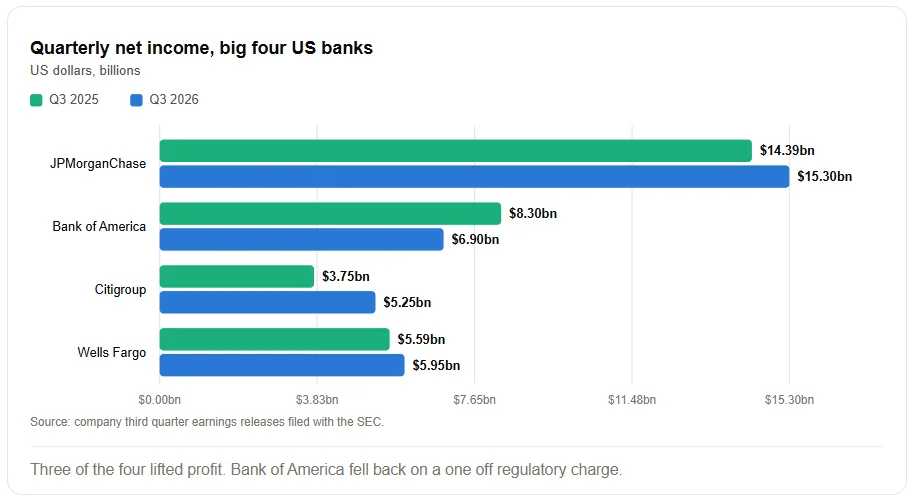
The big four US banks earned a combined $33.4bn on revenue of $125.9bn in the third quarter.
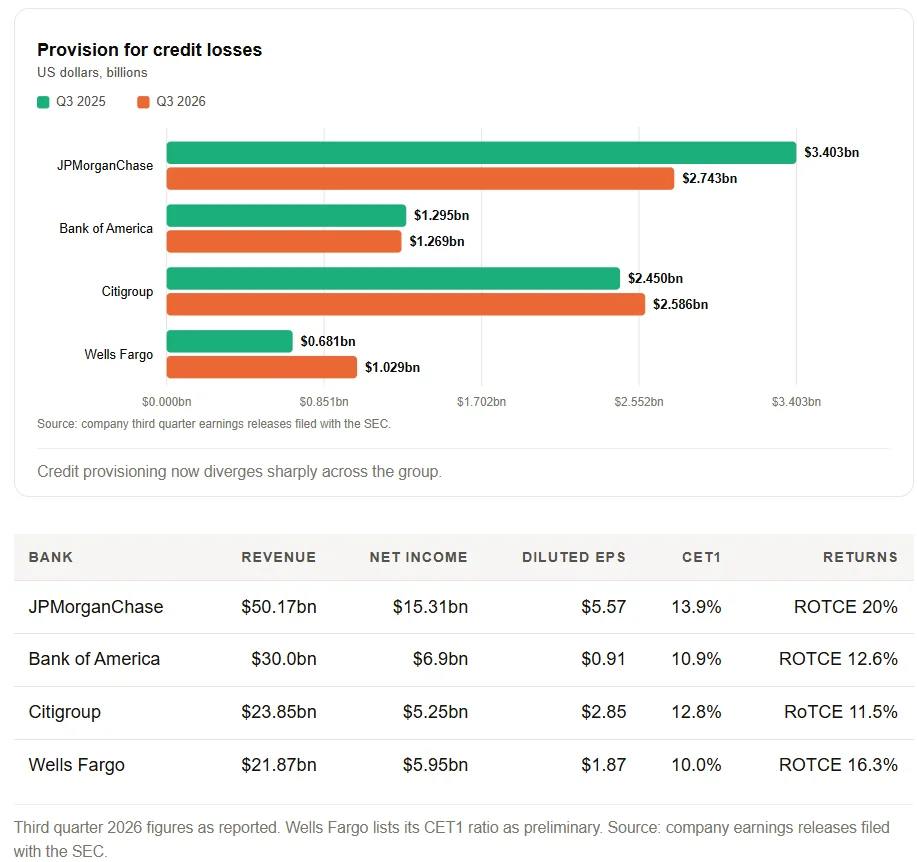
JPMorganChase led with $50.17bn of revenue, $15.31bn of net income and ROTCE of 20%.
Citigroup posted the sharpest gain, lifting net income 40% to $5.25bn.
Bank of America profit fell to $6.9bn after a $1.2bn regulatory settlement charge.
Wells Fargo raised its credit provision 51%, while JPMorganChase cut its own by 19%.
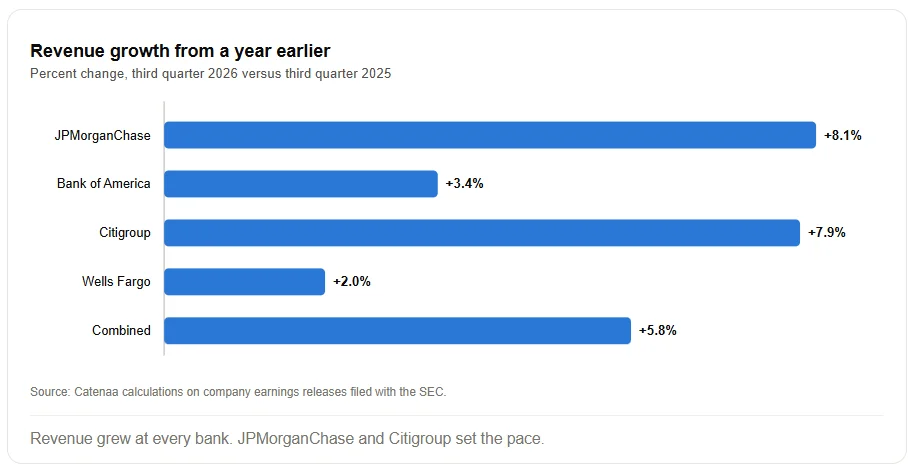
The four largest US banks have now reported. Together they earned $33.4bn in the third quarter, on revenue of $125.9bn. Both totals are Catenaa calculations on the four releases. Furthermore, net income rose 4.3% from a year earlier, while revenue climbed 5.8%.
JPMorganChase led on scale. The bank posted revenue of $50.17bn and net income of $15.31bn, as its earnings release shows. Diluted earnings reached $5.57 per share. Net interest income rose 13%, and Markets revenue hit $10.3bn.
Why one of the US banks slipped
Bank of America broke the pattern. Net income fell to $6.9bn from $8.3bn, and diluted earnings dropped to $0.91. However, the bank’s release strips out a $1.2bn regulatory settlement charge. On that adjusted basis, earnings reach $1.08 per share.
Underlying trends looked healthier. Net interest income grew 8% to $16.4bn. Likewise, wealth revenue rose 13%, and card spending gained 8% to $266bn. Trading slipped, though, with sales and trading revenue down 5%. Meanwhile client balances in wealth reached $5.1trn, up 9%.
Scale still shows in the deposit base. Bank of America averaged $2.02trn of deposits over the quarter. In addition, average loans grew 6% to $1.23trn. Therefore the lender retains plenty of funding capacity.
Citigroup delivered the standout
Citigroup produced the sharpest improvement. Net income jumped 40% to $5.25bn, and diluted earnings rose 53% to $2.85. Its release puts the efficiency ratio at 58.5%, down from 64.7%. Services revenue grew 15%, while Wealth matched that pace.
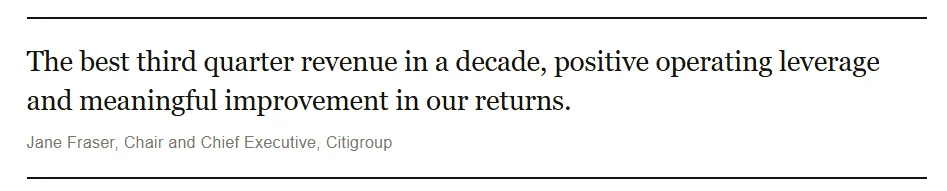
Capital markets did the heavy lifting. Citigroup’s Markets revenue rose 6% to $6.11bn, as equities jumped 14%. Similarly, investment banking fees climbed 9% to $1.35bn. Tangible book value per share reached $101.59.
Wells Fargo kept its momentum. Revenue rose 2% to $21.87bn, and net income gained 6% to $5.95bn, per the quarterly release. Return on tangible common equity reached 16.3%. Average loans grew 11%, and deposits matched that rate.
Credit costs tell the cautious story
Provisions moved in opposite directions. Wells Fargo raised its provision 51% to $1.03bn. Citigroup added 6%, reaching $2.59bn. By contrast, JPMorganChase cut its provision 19% to $2.74bn. Similarly, Bank of America trimmed its own slightly.
Actual losses stayed steady, however. Bank of America charged off $1.35bn, a ratio of 0.44%. Citigroup reported net credit losses of $2.22bn, almost flat on the year. In short, the provisioning gap reflects judgement rather than present stress.
Inflation reset the rate backdrop
The macro picture shifted mid week. American consumer prices rose 0.6% in September, and 3.7% over the year, according to the official release. Core prices rose 2.6%. Energy costs jumped 5.2% in one month.
Higher rates cut both ways for lenders. On one hand, loan yields stay elevated, which protects net interest income. On the other hand, borrowers struggle for longer. Rising provisions at two of the four hint at that second effect.
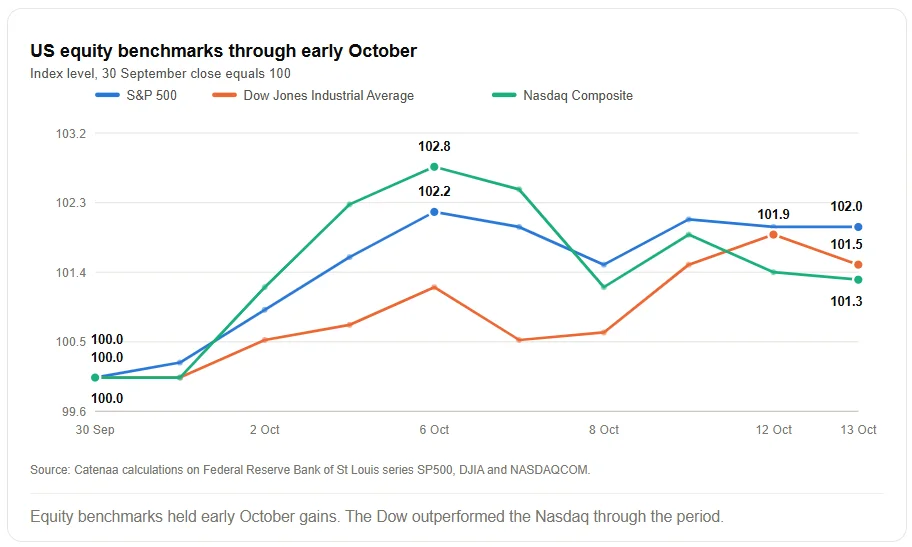
Equity markets had already priced a decent season. The S&P 500 closed at 7,805.45 on 13 October, roughly 2% above its September finish. Meanwhile the Dow added about 1.5%. Volatility stayed low, with the VIX near 15.3.
Two tests now follow. First, the Federal Reserve meets on 27 and 28 October. Second, fourth quarter guidance will show whether credit costs keep climbing.




