

November 22, 2026 – Nearly half of surveyed banks would let reserves fall if SOFR sat 5 basis points above IORB. That spread has already shown up this autumn.

In Summary
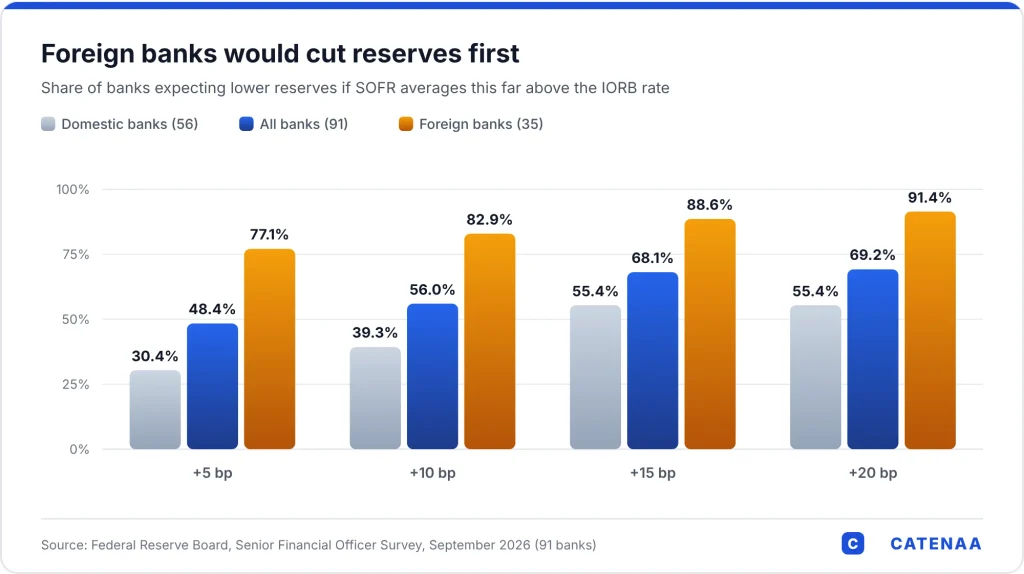
44 of 91 banks (48.4%) expect reserves to fall if SOFR averages 5bp above the IORB rate.
Foreign banks react far more: 77.1% would cut reserves at +5bp, versus 30.4% of domestic banks.
At a 20bp spread, 69.2% expect lower reserves, and 15.4% would cut them by more than half.
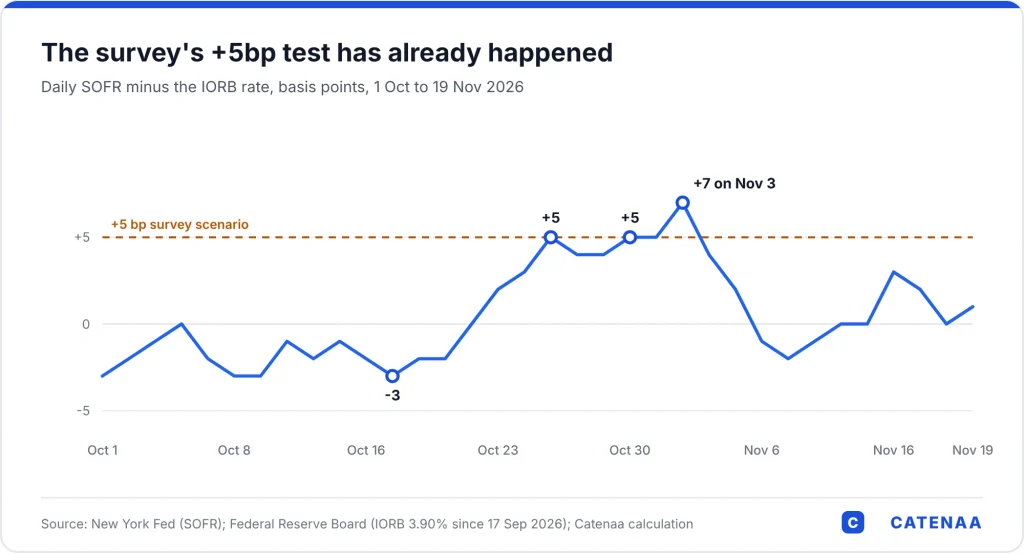
SOFR has printed at least 5bp above IORB on four days since late October.
Bank reserves may react to money-market rates more than headline totals suggest. That is the message of the Federal Reserve’s latest Senior Financial Officer Survey, released on November 20. The Board and the New York Fed ran it from September 18 to 28.
In total, 91 banks answered, 56 domestic and 35 foreign. Together, they held about three-quarters of all reserves in the banking system. The questions covered reserve targets, balance sheets, funding markets and weekend operations.
What the survey found on bank reserves
The key question tested set gaps between SOFR and the interest rate on reserve balances, or IORB. At a gap of plus 5 basis points, 44 of 91 banks expected their reserves to fall. That equals 48.4% of the sample. Most of those, 35 banks, foresaw cuts of up to 25%.
The response grows as the gap widens, according to the full survey results. At plus 10 basis points, 56.0% expected lower reserves. That share reached 68.1% at plus 15 and 69.2% at plus 20. At the widest gap, 14 banks said they would cut reserves by more than half.
Notably, these answers describe intentions, not observed outflows. They show intent under set conditions rather than a forecast. Also, the March survey used different scenarios, so a direct comparison does not hold.
The reverse case reveals an asymmetry. If SOFR sat 5 basis points below IORB, only 25 banks would add reserves. Another 57 would stand pat. In other words, banks shed reserves more readily than they add them.
Foreign banks react first
The split between bank types is stark. At plus 5 basis points, 77.1% of foreign banks expected to cut reserves. Only 30.4% of domestic banks said the same. At plus 20, the foreign share climbed to 91.4%, while the domestic share reached 55.4%.
Funding mix offers one likely reason. Foreign bank branches in the US rely heavily on wholesale funding rather than retail deposits. Therefore, when repo pays more than reserves, that cash can move quickly.
The +5bp scenario is already here
This matters because the tested gap has already appeared. The IORB rate has stood at 3.90% since September 17. Yet New York Fed data show SOFR at least 5 basis points above it on four days. Those were October 27 and 30, and November 2 and 3, when the gap hit 7 basis points.
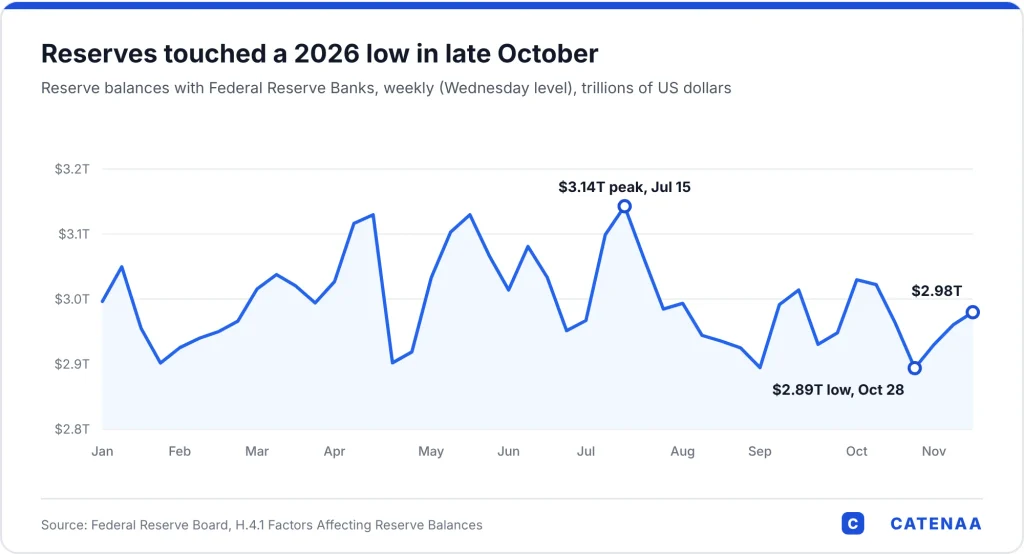
Reserve balances also dipped. On October 28, they fell to $2.89 trillion, their lowest weekly level this year. That is according to the Fed’s H.4.1 release. Reserves then recovered to $2.98 trillion by November 18. By comparison, they peaked near $3.14 trillion in mid-July.
What it means for funding markets
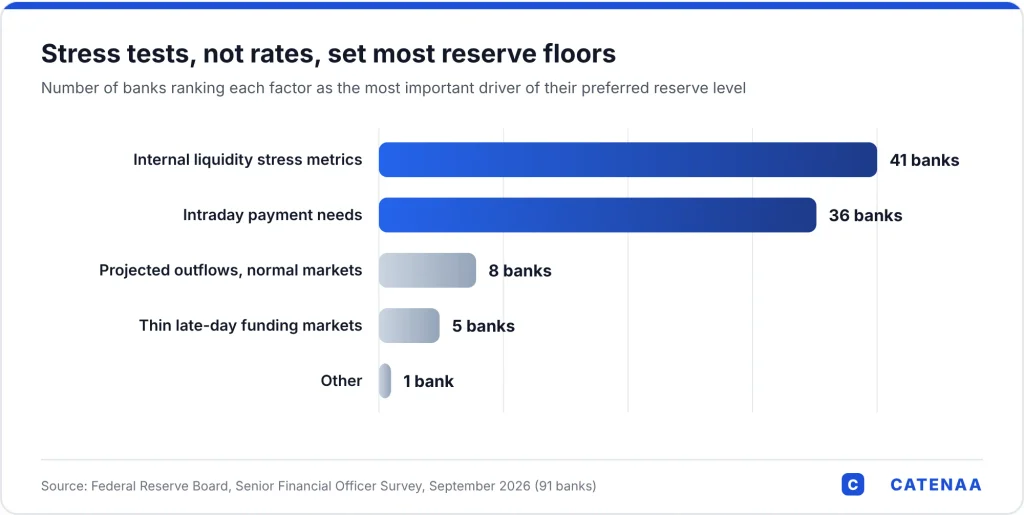
Asked what sets their reserve targets, 41 banks ranked internal liquidity stress tests first. Another 36 pointed to intraday payment needs. So, internal risk rules and payment flows, not just rates, anchor demand. Still, if repo keeps pricing above IORB, the survey suggests foreign banks will drain reserves first.
Banks also keep large floors. Seventeen respondents put their lowest comfortable reserve level at $20 billion or more. Moreover, 56 banks said their preferred reserves would fall if their main constraint eased. For the Fed, that means reserve demand depends on bank rules as much as on rates.