


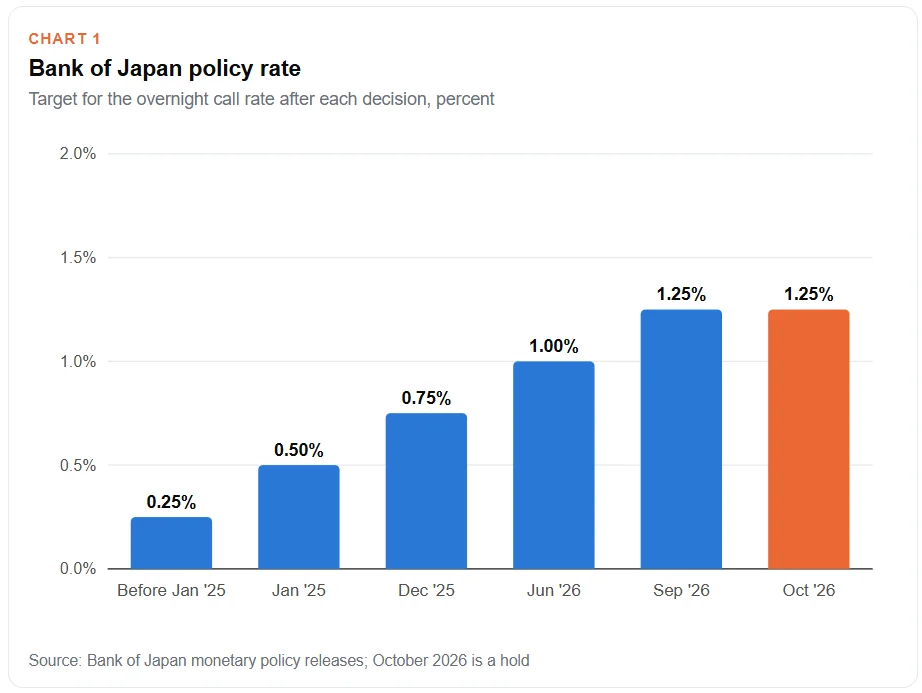
October 30, 2026 – The Bank of Japan kept its policy rate at around 1.25% on Oct. 30, but one board member pushed for 1.5%. It also decided to sell its huge ETF holdings much faster from January.

In Summary
The Bank of Japan held its short-term rate at around 1.25% in an 8-1 vote.
Board member Takata Hajime dissented and proposed raising the rate to around 1.5%.
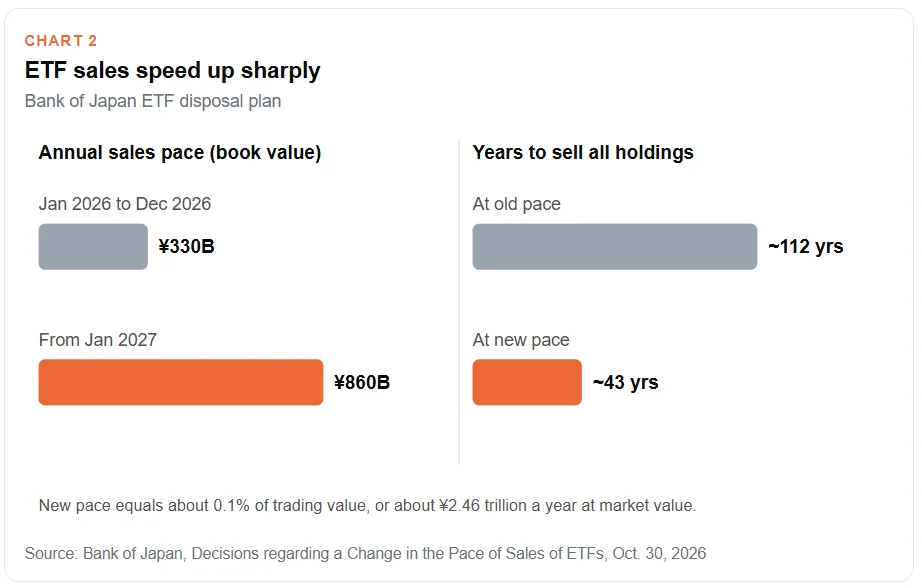
The bank will sell ETFs at about ¥860 billion a year from January 2027, up from about ¥330 billion.
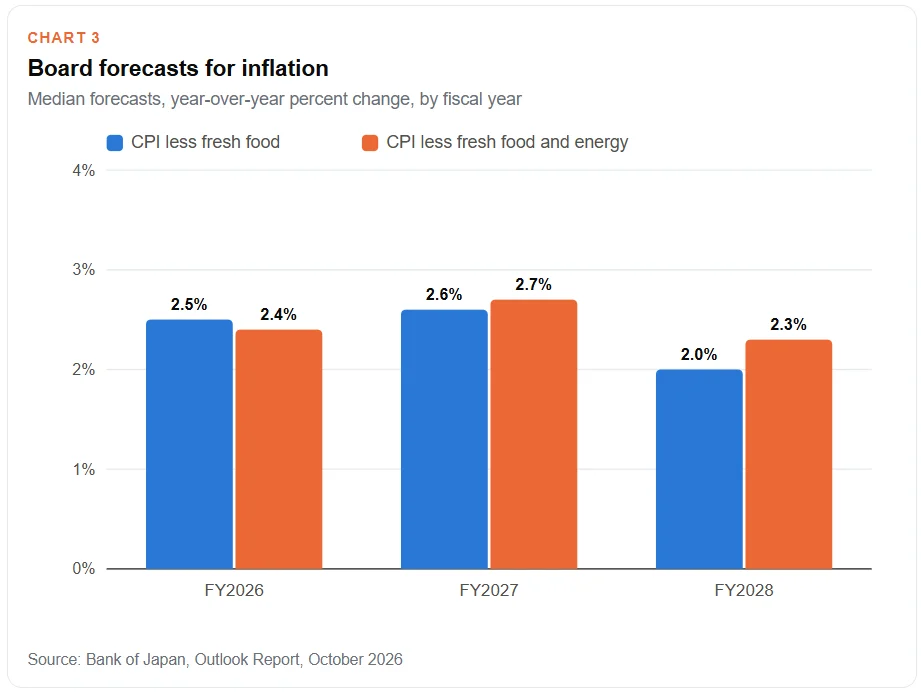
Its new outlook lifts the fiscal 2027 core inflation forecast to 2.6% and says price risks lean upward.
The Bank of Japan paused its tightening cycle on Friday, but not quietly. In its policy statement, the board voted 8-1 to keep the overnight call rate at around 1.25%. At the same time, it agreed unanimously to speed up sales of its exchange-traded fund holdings.
The hold follows two hikes this year. Policymakers raised the rate to 1% in June and then to 1.25% in September.
A hawkish dissent at the Bank of Japan
Board member Takata Hajime voted against the decision. He proposed lifting the rate to around 1.5% instead.
In his view, underlying inflation has already reached the 2% target. Therefore, he argued, the bank needs to move faster toward a neutral rate so it can respond nimbly. The rest of the board disagreed, for now.
Instead, the majority view rests on the bank’s own assessment. Its outlook says underlying inflation is “generally consistent” with the 2% target and should stay near that level. Medium- to long-term inflation expectations also sit at around 2%, it adds.
Faster ETF sales from January
Still, the bigger surprise came on the balance sheet. The Bank of Japan began selling its ETF holdings in January 2026. It sold about ¥330 billion a year, measured at book value. That pace equaled roughly 0.05% of stock market trading value.
From January 2027, the pace rises to about ¥860 billion a year, or about 0.1% of trading value. At market prices, that equals about ¥2.46 trillion a year, according to the bank’s reference note.
The change cuts the time needed to sell everything sharply. At the old pace, sales would have taken about 112 years. Now the bank expects about 43 years. Meanwhile, sales of real estate investment trusts stay at about ¥5 billion a year.
Inflation outlook edges higher
The October Outlook Report shows why the hawks are restless. Board members now see core inflation, which excludes fresh food, at 2.5% in fiscal 2026. They expect 2.6% in fiscal 2027, up 0.2 point from July, before 2.0% in fiscal 2028.
Excluding energy as well, they forecast 2.4%, 2.7% and 2.3% over the same years. The bank cites crude oil, chip prices and a weaker yen as upward forces. It also judges the risks to prices as “skewed to the upside.”
Growth, by contrast, looks modest. The median forecast sees real GDP rising just 0.7% in both fiscal 2026 and fiscal 2027.
What bond markets are saying
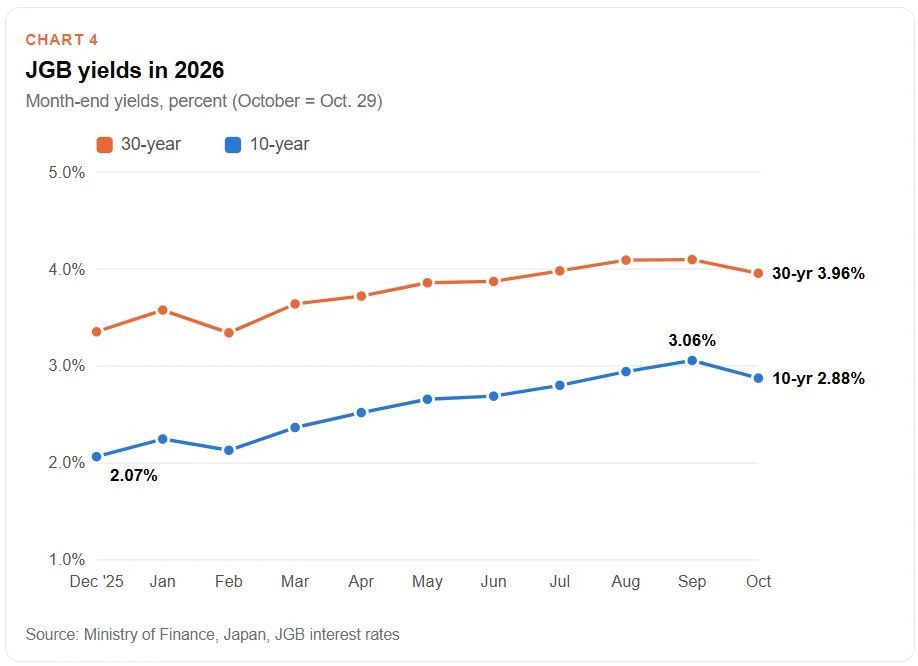
Japanese government bond yields remain far above last year’s levels. The 10-year yield stood at 2.876% on Oct. 29, according to Ministry of Finance data. That compares with 2.066% at the end of 2025.
However, yields have eased this month. The 10-year began October at 3.092%. Similarly, the 30-year yield slipped to 3.956% from 4.098% at the end of September.
For investors, the signals point in two directions. The Bank of Japan is not rushing, yet it keeps tightening policy through its balance sheet. Moreover, the dissent suggests the next hike may not be far off. Follow more central bank coverage on Catenaa’s global markets desk.