

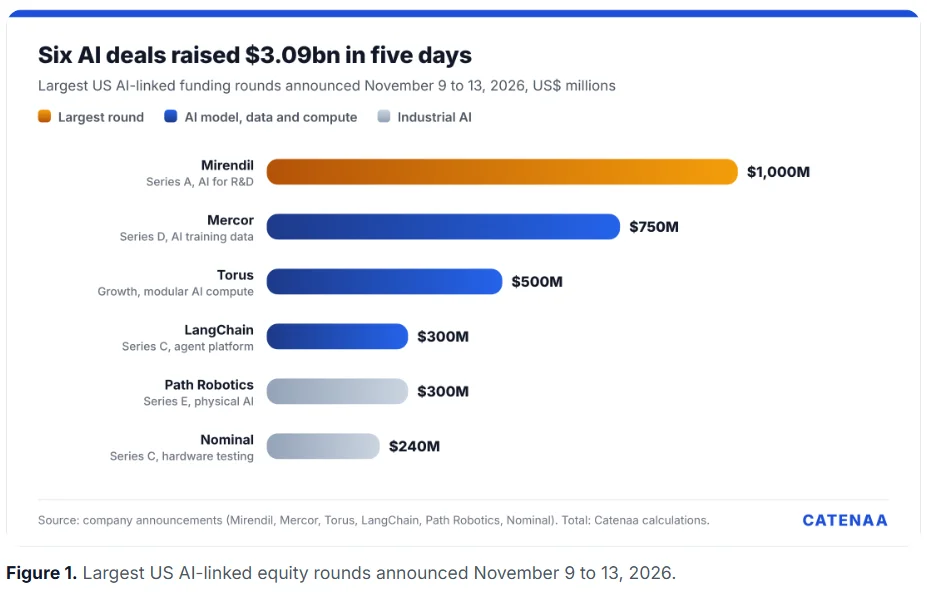
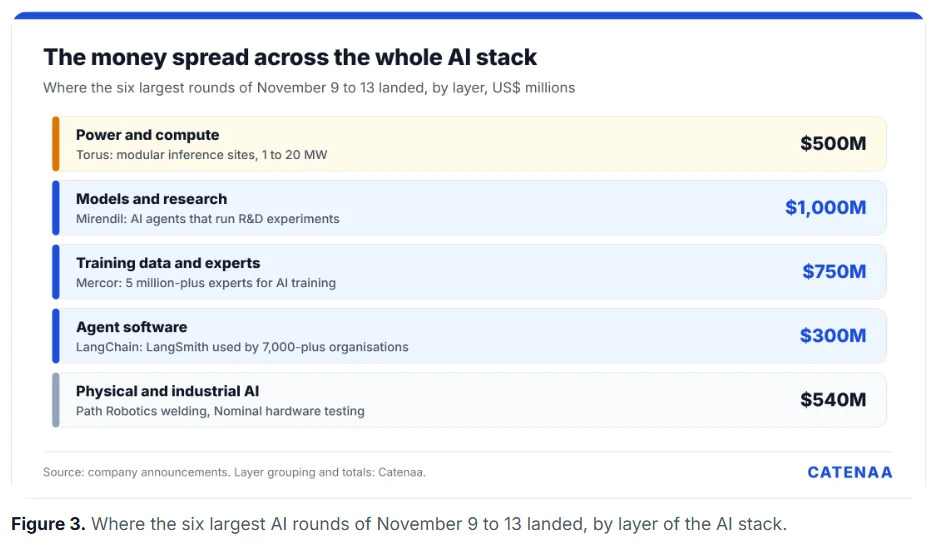
November 16, 2026 – Six US startups raised $3.09 billion between November 9 and 13. The cash reached every layer of the AI stack, from power-hungry compute to agent software.
In Summary
Mirendil raised a $1 billion Series A led by Kleiner Perkins and Clearlake Capital.
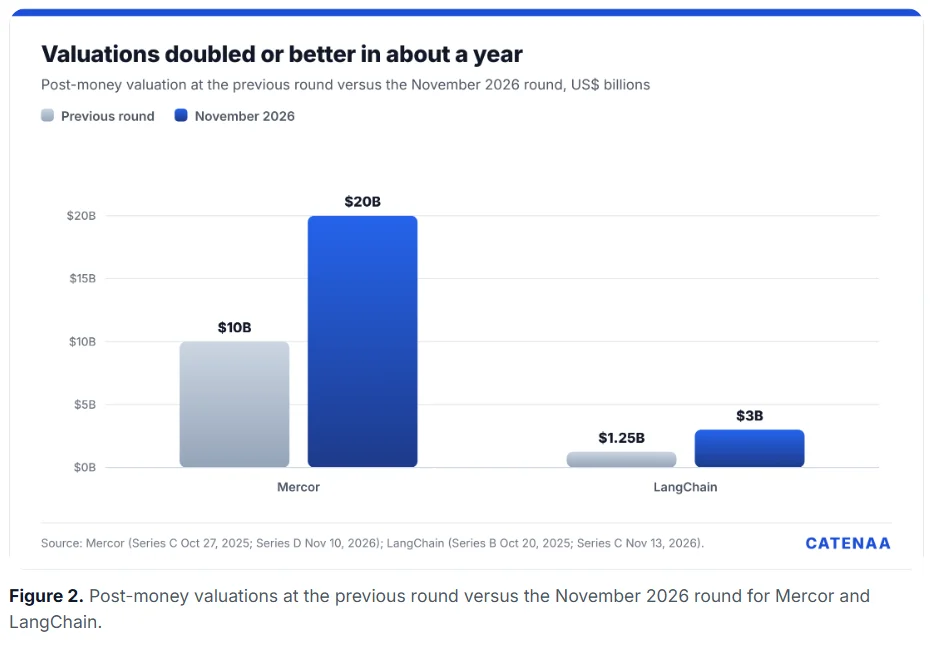
Mercor raised $750 million at a $20 billion valuation, double its October 2025 mark.
LangChain’s $300 million Series C valued it at $3 billion, up from $1.25 billion in October 2025.
Torus secured $500 million in growth capital to place modular AI compute where power already exists.

Investors poured fresh capital into AI funding rounds last week, and the largest deals went well beyond chatbots. Six US companies announced $3.09 billion in new funding between November 9 and 13, based on their own releases. Together, they span compute, research, data, agents and factory floors.
Mirendil leads the AI funding rounds
Mirendil raised $1 billion in a Series A on November 12. Kleiner Perkins and Clearlake Capital led the round, and Google joined other backers. Battery Ventures, M13 and Pear VC also took part. However, the company did not disclose a valuation.
Mirendil builds tools that open frontier AI research to scientists and engineers. It says it pretrained a competitive coding model in 3.5 months with under $10 million of compute. Its Lor system, now in private beta, runs hundreds of agents that write code and run experiments for days.
Data and agents command premium valuations
Mercor closed a $750 million Series D at a $20 billion valuation on November 10. That doubles the $10 billion valuation from its Series C in October 2025. The company says its network now includes more than five million experts who help train AI models.
In addition, Mercor says it spends three times as much on inference as on employee salaries. Backers included Benchmark, General Catalyst, NVIDIA and Salesforce. The round also included an employee tender. Earlier this year, Mercor bought Deeptune to build training environments for AI agents.
LangChain raised $300 million at a $3 billion valuation on November 13, with CapitalG leading the Series C. That price is 2.4 times the $1.25 billion valuation LangChain reached in October 2025. More than 7,000 organisations now use its LangSmith platform to build and monitor agents. For example, LangChain says Workday cut the time to deploy a new agent from five months to under a day.
Compute moves to the power
Torus secured $500 million in growth capital led by Magnetar. The Utah company builds Foundry, modular AI compute units for sites from 1 to 20 megawatts. It aims to place more than 47,000 GPUs in Foundry units by the end of 2027. Meanwhile, its GigaOne factory has capacity for 500 MW of IT load, with plans to reach 1 GW.
The pitch targets a clear bottleneck. Torus and its lead investor see power access as a key constraint on AI growth. Accordingly, it says Foundry can deliver compute 12 to 16 weeks after a contract.
Industrial AI joins the queue
Physical AI also drew big money. Path Robotics raised $300 million in a Series E at a $2.45 billion valuation, led by Georgian. The welding automation company says annual recurring revenue grew 17-fold in 18 months. It has raised more than $610 million since its 2018 founding. It also signed a $600 million production agreement with shipbuilder HII earlier this year.
Separately, Nominal raised $240 million at a $3 billion valuation to bring AI into hardware testing. Lightspeed Venture Partners led that round, with Insight Partners co-leading. Nominal says five of the seven largest defense contractors use its platform.
What the week signals
Two patterns stand out. First, valuations at repeat raisers doubled or better within about a year. Second, investors now fund the plumbing around models, not only the models themselves.
There is a caution, too. Mirendil kept its valuation private, and most of these companies disclose little revenue. Therefore, the numbers show investor appetite more than proven returns. The real test comes when these companies must grow into those prices.