


October 04, 2026 – Personal agents, housing software, cyber defence, and GPU clouds pulled in the biggest checks. Debt also played a growing role in compute-heavy deals.

In Summary
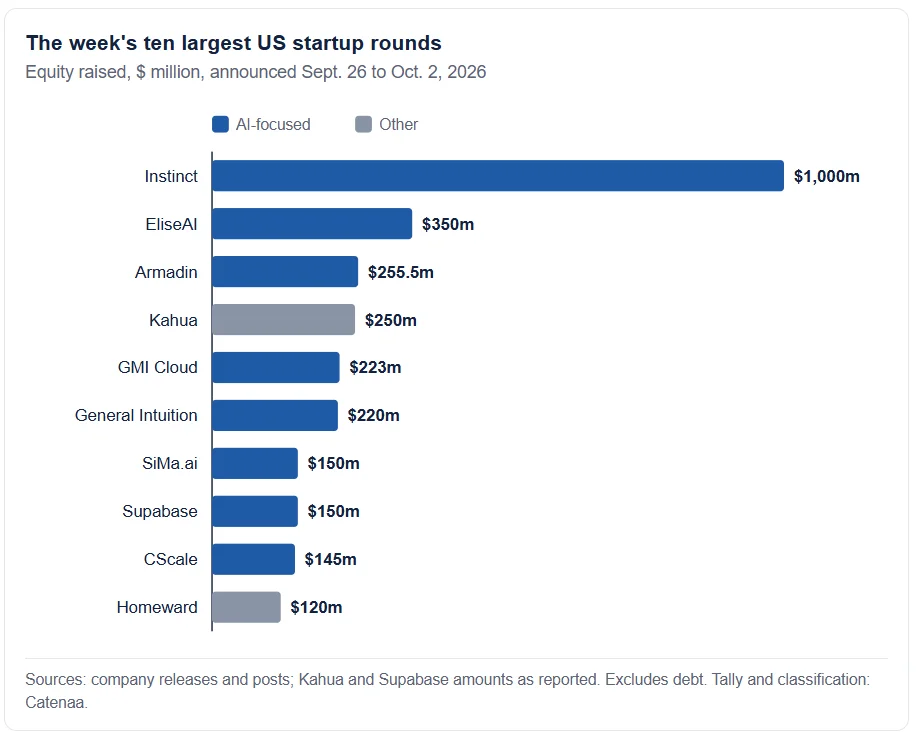
Instinct raised $1 billion at a $10 billion valuation from Sequoia, Benchmark and Coatue.
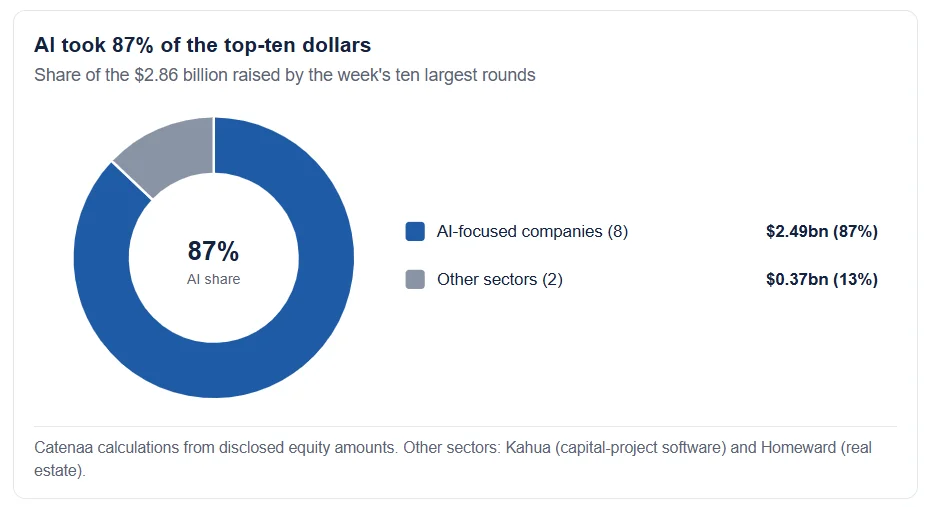
AI-focused companies took eight of the ten largest US rounds and about 87% of the dollars.
EliseAI and Armadin show investors paying up for vertical AI with real revenue or proven founders.
GMI Cloud paired $223 million of equity with a $445 million credit facility for GPU capacity.
AI funding dominated the week’s largest US venture deals, led by a $1 billion Series C for personal-agent startup Instinct. Catenaa reviewed the ten biggest rounds announced between September 26 and October 2.
Together, they raised about $2.86 billion in equity. AI-focused companies took eight of the ten slots and roughly 87% of the money. In addition, two deals carried $775 million of debt on top of their equity.
Instinct Sets the Pace for AI Funding
Sequoia Capital, Benchmark and Coatue backed Instinct’s Series C at a $10 billion valuation. The San Francisco company builds a personal agent for everyday errands. Users text or call it, and it plans trips, orders groceries, or cancels subscriptions.
The agent uses its own phone and computer to finish those tasks. Recent features include a concierge tier for complex requests and agent-to-agent messaging between trusted contacts. It also offers location sharing through iMessage.
On privacy, the company points to sandboxed execution and hallucination detection. However, the product remains in early access, and the company has not published usage figures. Founder Noah Shinn framed the goal plainly.
That single check equals about 35% of the week’s top-ten total. Moreover, the three largest rounds made up 56% of the money, a sign of heavy concentration.
Vertical AI Draws Big Checks
Housing software firm EliseAI raised $350 million at a $4 billion valuation. Andreessen Horowitz and Bessemer Venture Partners led, while Ontario Teachers’ Pension Plan also joined. EliseAI reports more than $200 million in annual recurring revenue as of June.
It says revenue has doubled every year for five straight years. Its tools now serve one in six US apartments, and it is expanding into specialty physician groups.
The money will fund new products, following September’s launch of Apollo, an agentic AI teammate. EliseAI also plans a second engineering hub in San Francisco.
Cybersecurity drew the third-largest check. Armadin, led by Mandiant founder Kevin Mandia, raised a $255.5 million Series B at more than $2.5 billion. Andreessen Horowitz and Accel co-led, taking total funding to $445 million. Bain Capital Ventures and Redpoint joined as new backers, alongside returning investors such as In-Q-Tel.
Mandia frames AI as a threat that now moves at machine speed. “AI lets an attacker find and chain weaknesses faster than any human team can respond,” he said.
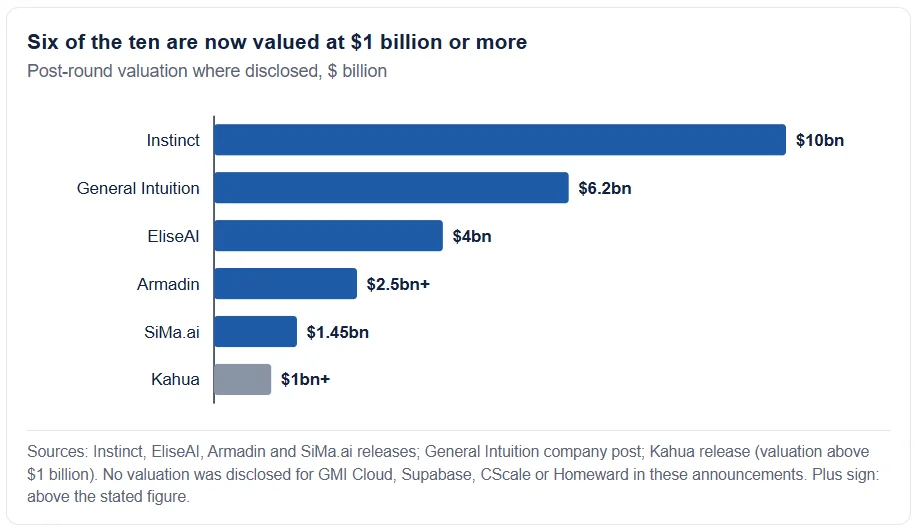
Further down the list, Georgia-based Kahua won Bain Capital backing at a valuation above $1 billion. Kahua sells software for managing large capital projects. Meanwhile, General Intuition said it raised $220 million at $6.2 billion.
Physical AI also featured. SiMa.ai closed a $150 million Series C at $1.45 billion, led by Fidelity and Amplify. Its chips and software target robots, vehicles, and drones. Likewise, database platform Supabase raised $150 million and agreed to buy Turso, citing demand from AI agents.
Compute Deals Lean on Debt
Infrastructure rounds looked different. GMI Cloud raised a $223 million Series B led by ARCHIV, with NVIDIA participating. It also secured a $445 million credit facility led by CTBC, for $668 million in total.
Debt therefore made up two-thirds of that package. GMI says contracted annual recurring revenue topped $600 million, up ninefold since the end of 2025. Its inference platform now handles about 4 trillion tokens a week. The cash will add GPU capacity in the US, Taiwan and Southeast Asia.
Optical interconnect maker CScale emerged from stealth with a $145 million Series C. Atreides Management led, while NVIDIA and Intel Capital joined as strategic investors. The Palo Alto firm has about 85 employees and $188 million in total funding. “Lasers will fail. Compute shouldn’t,” said chief executive Martin Lund.
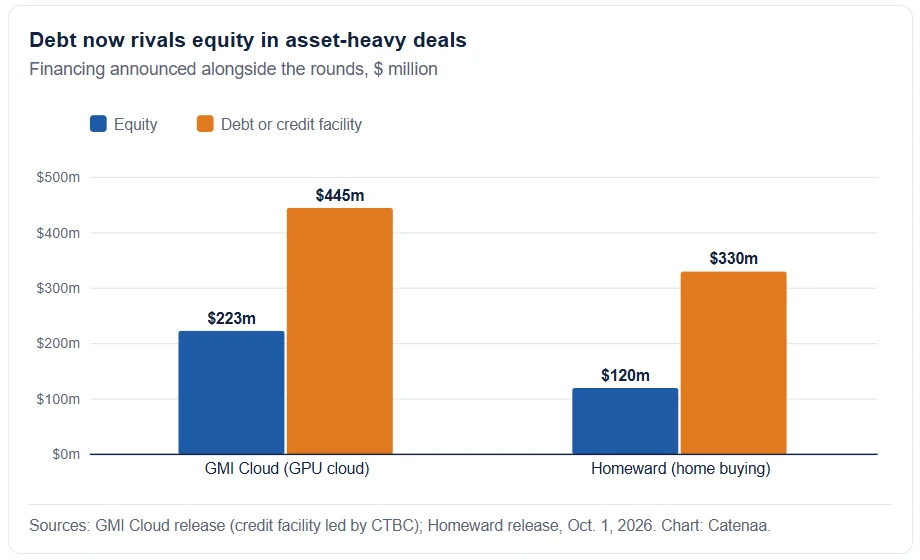
Outside AI, home-buying platform Homeward raised $120 million in Series D equity plus $330 million of debt. Lenders, it seems, will fund balance sheets that equity investors would rather not carry alone.
What the Week Tells Investors
Six of the ten companies now carry valuations of at least $1 billion. Still, most of those prices rest on private marks and company-reported revenue, not audited results.
The pattern is clear, though. Capital is flowing to agents that act for users and to vertical software with recurring revenue. It is also funding the chips and networks underneath. As a result, AI funding looks less like one bet and more like a full stack. Next, investors will watch whether that money converts into paying users and durable margins.