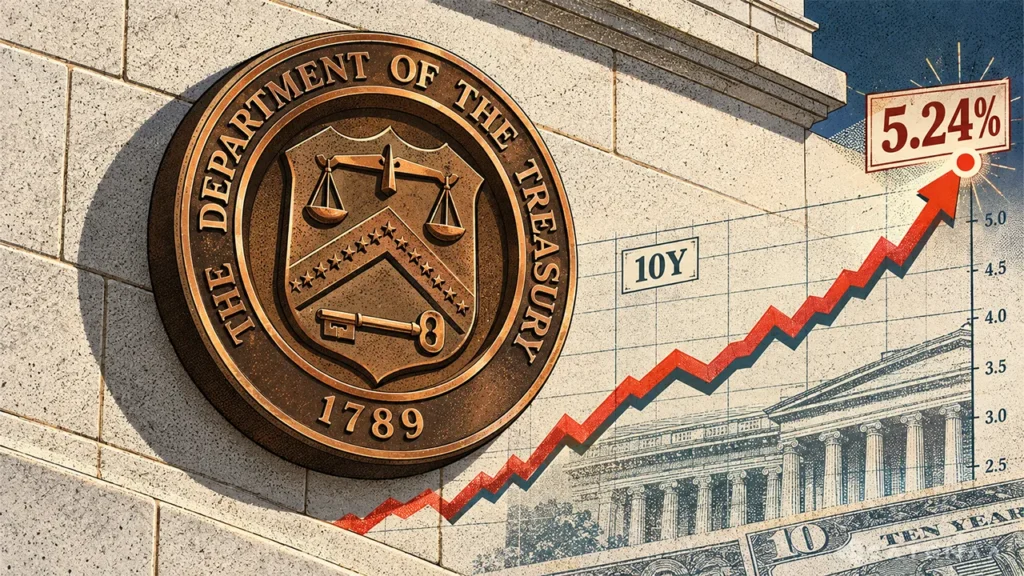


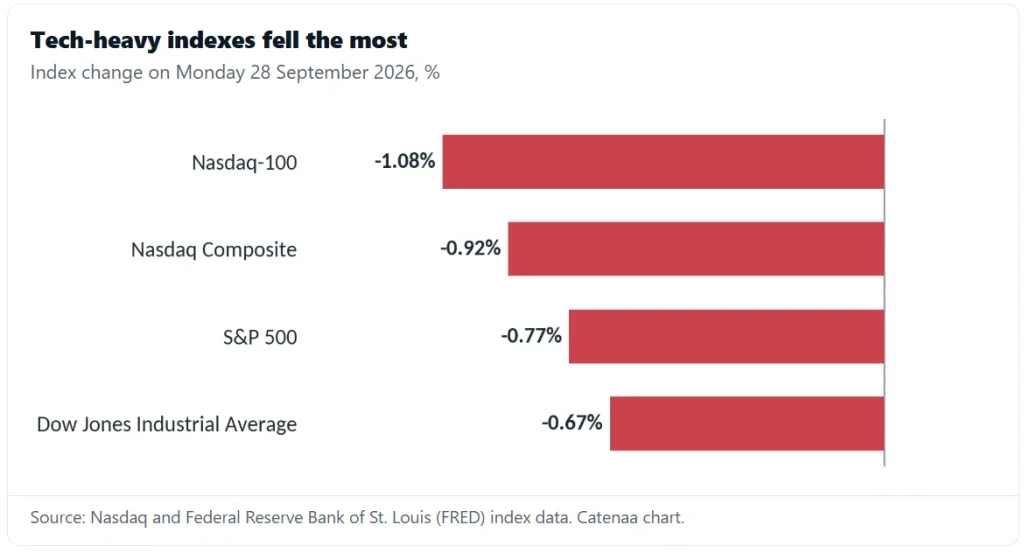
September 30, 2026 – Yields rose across the curve on Monday, led by two-year notes. Stocks slipped, with the Nasdaq falling almost 1%.
In Summary
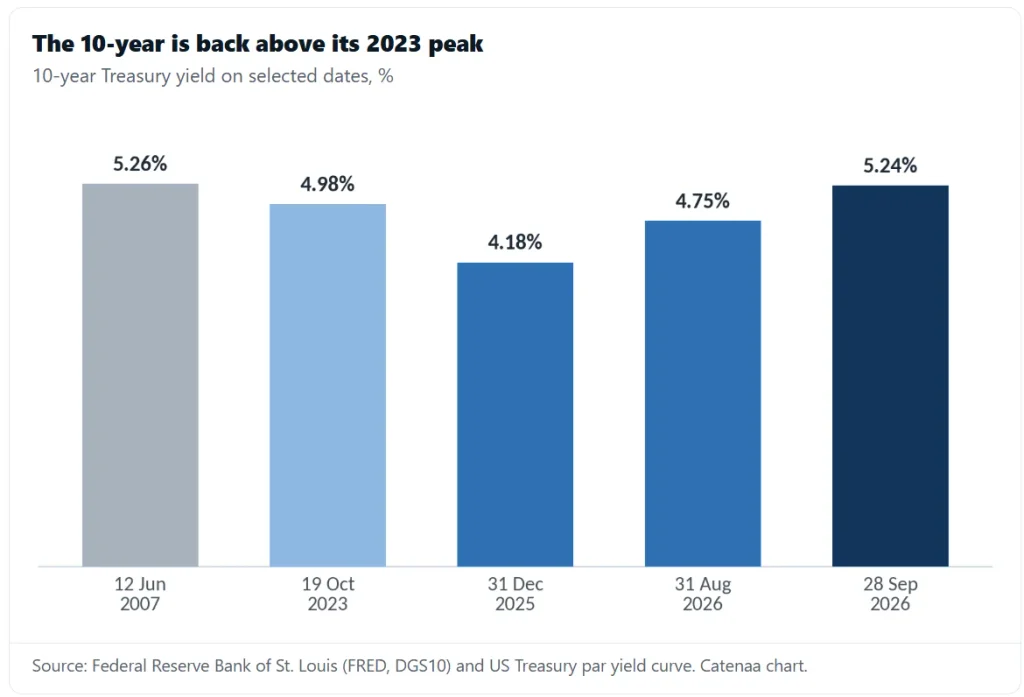
The 10-year Treasury yield closed at 5.24% on 28 September, the highest since 12 June 2007.
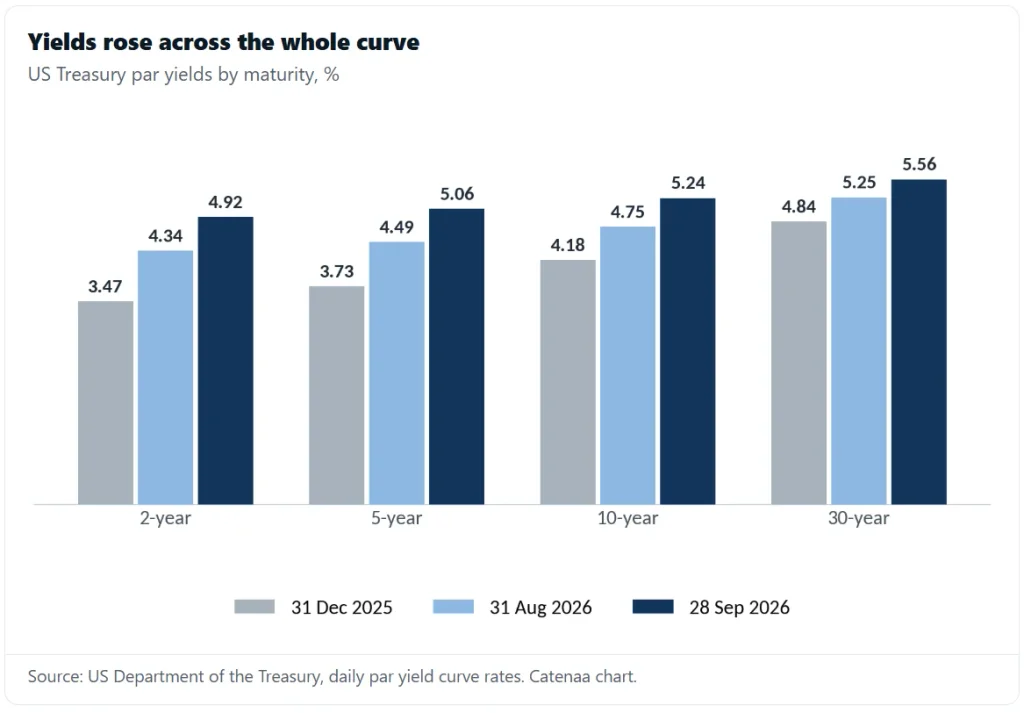
The two-year yield jumped 11 basis points to 4.92%, and the 30-year reached 5.56%.
The S&P 500 fell 0.77%, the Dow 0.67%, and the Nasdaq Composite 0.92%.
The Fed raised rates to 3.75% to 4.00% on 16 September, and inflation is running near 3.8%.

The 10-year Treasury yield rose to 5.24% on Monday, its highest close in more than 19 years. The move weighed on stocks, and all three major US indexes ended the day lower.
According to US Treasury data, the benchmark yield climbed seven basis points in one session. The last time it closed at that level or higher was 12 June 2007.
Meanwhile, the S&P 500 fell 0.77% to 7,683.69. The Dow Jones Industrial Average lost 0.67% to 51,481.51. The Nasdaq Composite dropped 0.92% to 26,820.38.
Why the 10-year Treasury yield matters
This yield acts as a base rate for much of the economy. It shapes mortgage costs, corporate borrowing and the discount rate investors use to value shares.
As a result, a higher yield makes future company profits worth less today. Growth stocks, whose value depends on earnings far in the future, usually feel that pressure first.
Monday followed that pattern. The Nasdaq-100 fell 1.08%, a steeper drop than the blue-chip Dow. Even so, the losses were orderly rather than a rout.
Single stocks told their own stories. Nvidia rose 1.7% after it expanded its buyback. Boeing, by contrast, fell 6.9% to a 2026 low, and MongoDB slid 18.5%.
The yield has now pushed well past its last peak. In October 2023, it topped out at 4.98%, based on Federal Reserve data. Monday’s close sits 26 basis points above that level.
The whole curve moved higher
The selling was not limited to one maturity. Instead, yields rose from two years to 30 years, and short-dated bonds led the way.
The two-year yield jumped 11 basis points to 4.92%, the highest since May 2024. Likewise, the five-year yield rose to 5.06%, its highest since July 2007.
At the long end, the 30-year yield reached 5.56%. That is its highest level since at least 2006, when the Treasury resumed regular 30-year sales.
The 20-year yield sat even higher, at 5.60%. In other words, investors now demand more than 5% to lend to the US government for five years or longer.
Front-end yields track expected Fed policy most closely. Their rise therefore suggests traders see a real chance of further rate increases this year.
Consequently, the gap between two-year and 10-year yields narrowed to 32 basis points. It had stood at 71 basis points at the end of 2025.
What is pushing yields up
The Federal Reserve raised its policy rate by a quarter point on 16 September. The target range now stands at 3.75% to 4.00%, and the vote was unanimous.
In its statement, the Fed said simply that inflation remains elevated. Energy is part of the story, as conflict in the Middle East has kept oil prices high.
Indeed, Brent crude futures settled at $105.28 a barrel on Monday. That is about 16% above their level at the end of August.
Other assets felt the pull as well. Gold fell almost 3% on the benchmark London price. Higher yields raise the cost of holding a metal that pays no interest.
Governor Lisa Cook added to that message in a speech on Monday. She said headline inflation reached an estimated 3.8% in the year to August, almost double the Fed’s 2% target.
Since the start of the year, the two-year yield has climbed 145 basis points. By contrast, the 30-year yield is up a smaller 72 basis points.
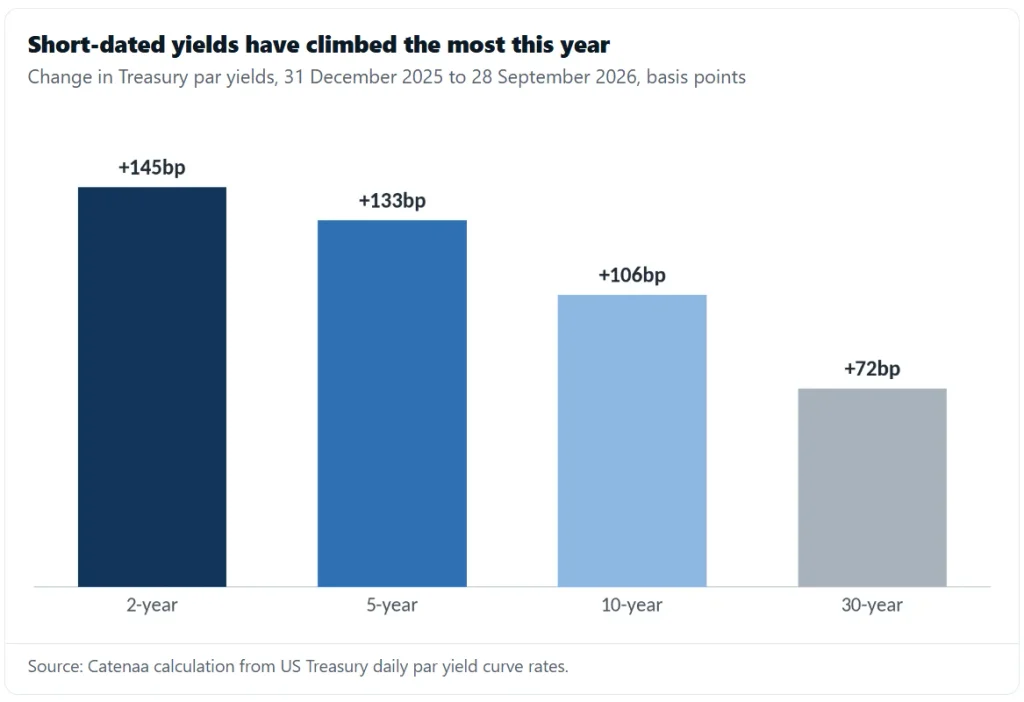
What it means for stocks and borrowers
Stocks remain higher for the year despite the pressure. The S&P 500 is up about 12% since December, while the Nasdaq Composite has gained about 15%.
However, both indexes now sit below their recent records. The S&P 500 peaked at 7,798.99 on 13 August. Similarly, the Nasdaq Composite set a record of 27,244.28 on 22 September.
For households, the rise feeds into loan rates. Mortgage rates tend to follow the 10-year yield, so borrowing costs for home buyers are likely to stay high.
Savers, on the other hand, gain. Even after inflation of about 3.8%, a 5.24% yield leaves a real return of roughly 1.4 percentage points.
Government finances feel the strain too. New 10-year debt now costs Washington about one percentage point more than it did last December.
Next, investors will watch inflation data and the Fed’s meeting on 27 to 28 October. For more on bond markets, read our report on Cook and AI inflation. The 10-year Treasury yield will remain a key signal for many asset classes.