

September 30, 2026 – The chipmaker’s top-up is bigger than Apple’s $110 billion increase of 2024. Its cash flow shows it can fund buybacks and still invest in AI.
In Summary
Nvidia added $150 billion to its share repurchase authorisation on 28 September, taking the total to $235 billion.
Nvidia plans to use the full amount by the end of fiscal 2028, implying about $44 billion of buybacks a quarter.
Nvidia spent $39.0 billion on buybacks and $6.3 billion on dividends in the first half of fiscal 2027, against $74.4 billion of operating cash flow.
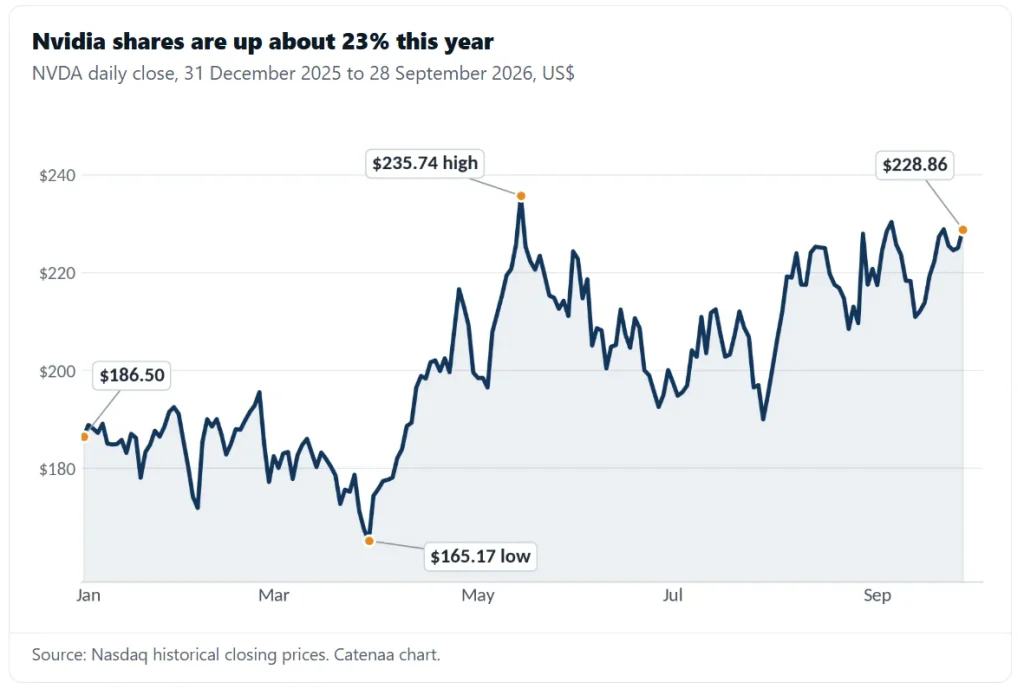
The shares rose 1.7% to $228.86 on Monday and are up about 23% this year.

Nvidia has added $150 billion to its share repurchase programme, the chipmaker said on 28 September. The Nvidia buyback authorisation now stands at $235 billion.
The board approved the increase as AI spending keeps lifting sales. Nvidia expects to use the full amount by the end of fiscal 2028, which closes in late January 2028.
Chief executive Jensen Huang pointed to cash generation. He said it lets Nvidia invest in AI technology and return capital to shareholders at the same time.
How big is the Nvidia buyback?
The top-up is larger than the $110 billion that Apple added to its own programme in May 2024. That Apple approval had drawn attention at the time for its sheer size.
Before this week, Nvidia still had room left from earlier approvals. At the end of July, it had about $99 billion available. The new total of $235 billion implies that roughly $85 billion remained before Monday.
In other words, Nvidia likely spent about $14 billion on its own shares in August and September. That fits the pace of recent quarters.
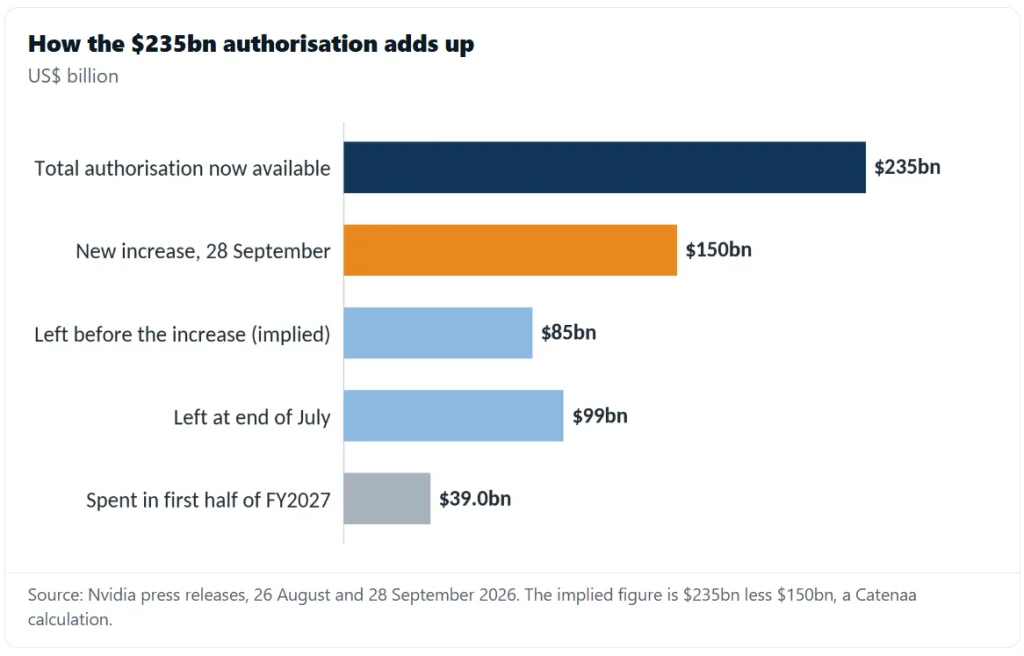
The timetable is ambitious. From now until late January 2028 is about 16 months. Spending $235 billion over that span would mean roughly $44 billion a quarter, more than double the first-half pace.
Even so, the increase is modest next to Nvidia’s size. The company had about 24.1 billion shares outstanding in August. At Monday’s close of $228.86, that equals a market value of roughly $5.5 trillion. The $150 billion top-up therefore covers about 2.7% of the company.
Cash flow pays for the buyback
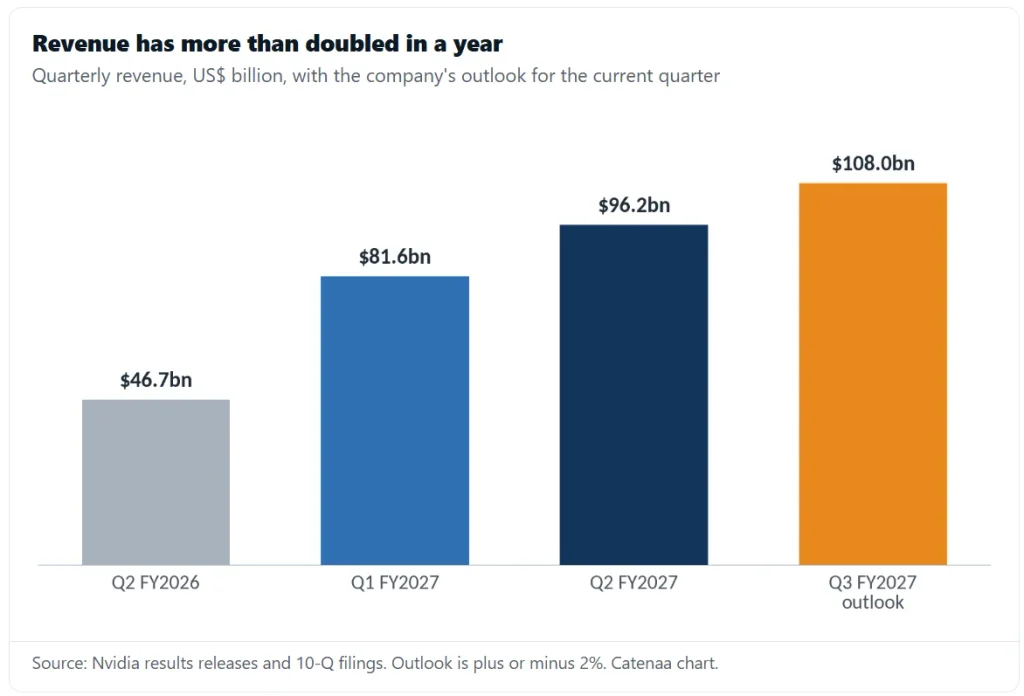
Nvidia can afford it. In its second-quarter results on 26 August, revenue rose 106% to $96.2 billion. Data centre sales, driven by AI chips, reached $89.0 billion, or about 92% of the total.
Profits kept pace. GAAP net income came to $59.7 billion for the quarter, or $2.46 per diluted share. Gross margin held at 75.0% on both GAAP and adjusted measures.
Looking ahead, the company guided for about $108 billion of revenue in the current quarter. It expects gross margin near 74%, slightly below the 75.0% it just reported. That outlook would mean growth of about 89% from the $57.0 billion it booked a year earlier.
Operating cash flow tells the same story. According to its quarterly filings, Nvidia generated $74.4 billion from operations in the first half of fiscal 2027. Over the same period, it spent $39.0 billion on buybacks and $6.3 billion on dividends.
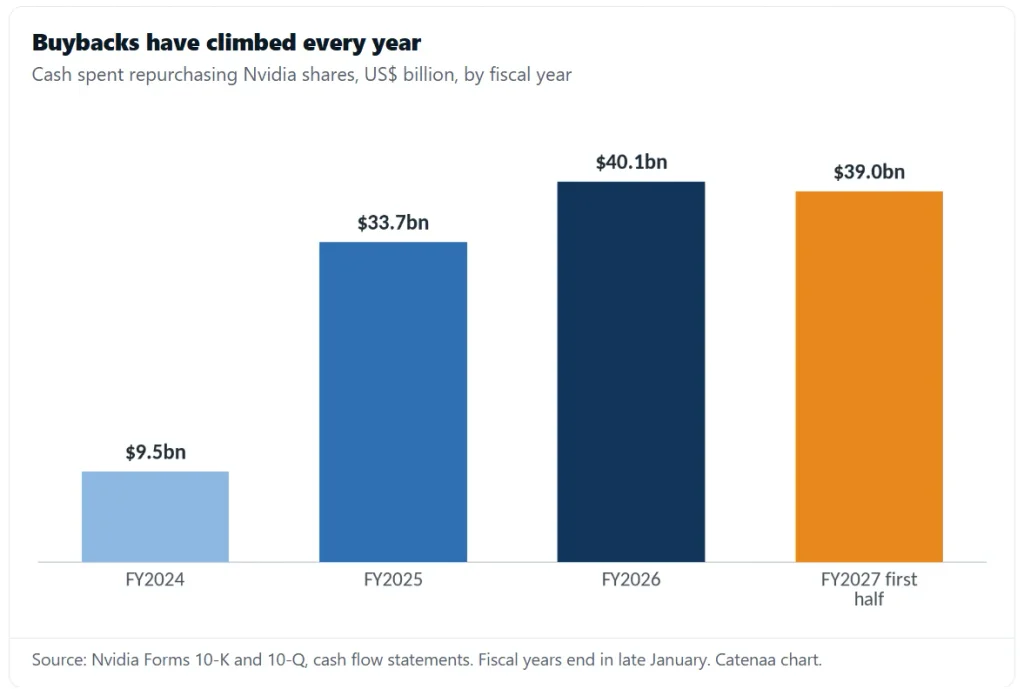
The buyback pace has risen year after year. Repurchases came to $9.5 billion in fiscal 2024, $33.7 billion in fiscal 2025 and $40.1 billion in fiscal 2026. The first half of fiscal 2027 alone nearly matched that last full-year total.
Dividends have grown too. Nvidia now pays 25 cents a share each quarter, with the next payment due on 1 October. At current share counts, that costs about $6 billion a quarter.
How the stock reacted
The market welcomed the news. Nvidia shares rose 1.7% on Monday, according to Nasdaq data, even as the S&P 500 fell 0.8%. The stock is up about 23% this year, although it remains below its May peak.
The ride has been bumpy. Nvidia closed at a 2026 low of $165.17 on 30 March and hit a high of $235.74 on 14 May. After the August results, the shares jumped 8.7% in a single session.
Buybacks can lift earnings per share by shrinking the share count. However, they also compete with other uses of cash, such as new chip capacity and long-term supply deals. Some investors may prefer more spending on growth while AI demand stays strong.
Timing matters as well. Companies often buy back more stock when they see their shares as cheap. Nvidia made this move with the stock about 3% below its 2026 high, which suggests it still sees value.
Share count data will show whether the Nvidia buyback works. The number of shares outstanding slipped from 24.3 billion in February to 24.1 billion in August. Faster buying would push that figure down more quickly.
What to watch next
The next test comes with third-quarter results in November. Investors will look for the pace of repurchases and any change in gross margin. For now, the Nvidia buyback signals that management sees its chip business generating cash well beyond its needs. That confidence also matters for the wider AI trade.