

September 22, 2026 – The Nasdaq Composite rose 2.26% to a record close as chipmakers and Meta surged. The S&P 500 had its best day since August, but the rally was narrow.

In Summary
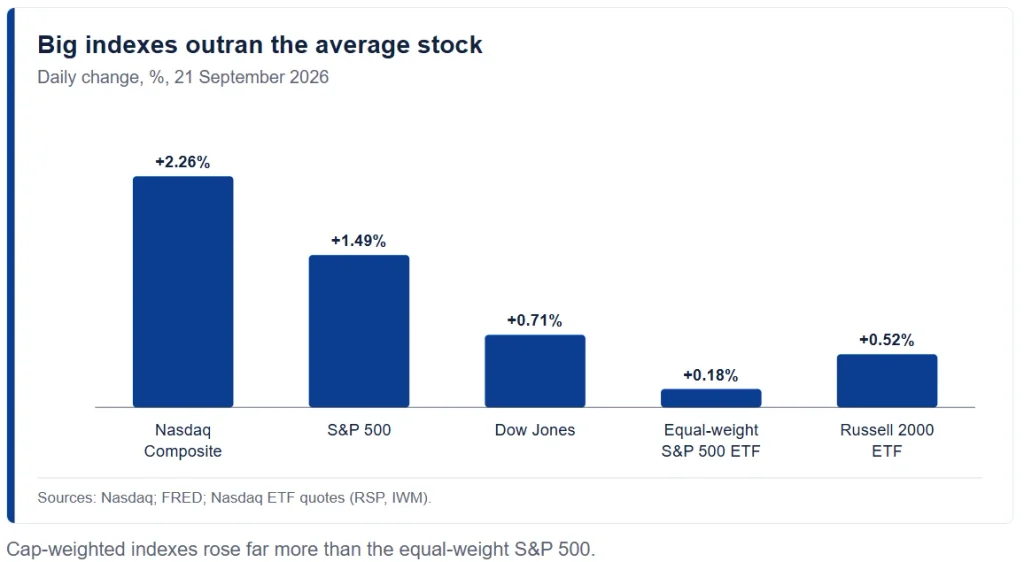
The Nasdaq Composite rose 2.26% to a record close of 27,122.09 on 21 September, above the 2 June high.
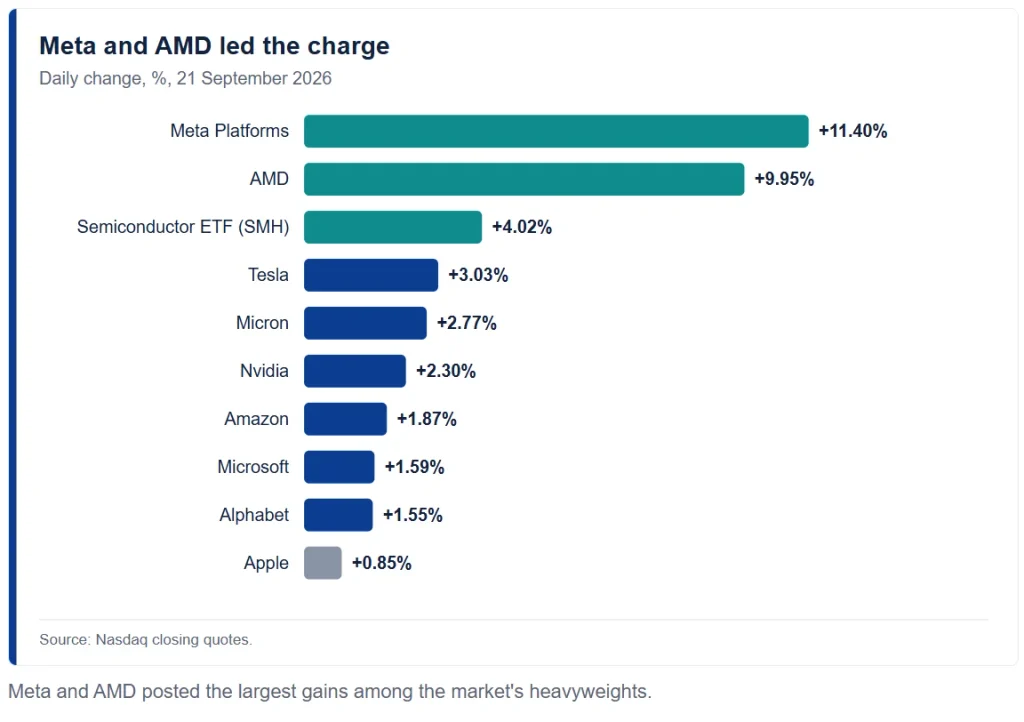
Chipmakers led, with AMD up 9.95% and a major semiconductor ETF up 4.02%; Meta jumped about 11.4%.
The S&P 500 gained 1.49%, its best day since 4 August, while the Dow rose 0.71%.
The equal-weight S&P 500 ETF rose just 0.18%, showing a narrow, mega-cap-led rally.
An oil fund fell 3.68% and the 10-year Treasury yield eased to 4.96% from 5.01%.
Wall Street set a fresh Nasdaq record on Monday as chip and internet stocks surged. The Composite jumped 2.26% to 27,122.09, Nasdaq data show. That topped its previous closing high of 27,093.90, set on 2 June. In points, the index added 599.54, and it traded as high as 27,183.93 during the session.
The move capped a sharp turn in mood. Only last week, the Dow Jones Industrial Average posted its worst week since March. This time, falling oil prices and easing bond yields gave technology buyers room to run.
Nasdaq Record Built on Chips and Meta
Semiconductors led the charge. The VanEck Semiconductor ETF, a basket of major chipmakers, rose 4.02%. Advanced Micro Devices soared 9.95% to $615.52. Nvidia gained 2.3%, and Micron added 2.8%.
Meta Platforms delivered the single biggest surprise. Its shares jumped about 11.4% to $741.25, Nasdaq trading data show. Volume reached about 48.7 million shares. No company filing from Meta with the SEC accompanied the move. Such a jump is rare for a company of Meta’s size.
Other mega caps joined in, though more modestly. Amazon rose 1.9%, Microsoft 1.6% and Alphabet 1.6%. Tesla gained 3.0%. Together, these names carry heavy weight in the Nasdaq record run.
S&P 500 Posts Best Day Since August
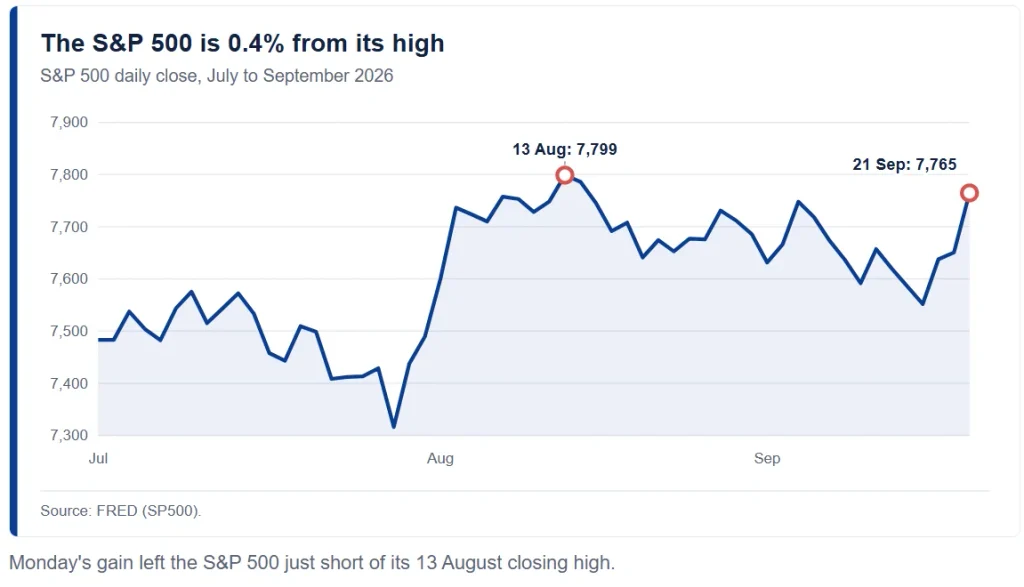
Elsewhere, the broader market also rallied. On Monday, the S&P 500 climbed 1.49% to 7,764.70, index data show. That was its biggest one-day gain since 4 August. The index now sits just 0.4% below its closing high of 7,798.99 from 13 August.
The Dow lagged, rising 0.71% to 52,048.83. That still leaves it 4.2% below its August peak. Last week, a slide in Goldman Sachs dragged on the price-weighted index. On Monday, Goldman recovered 1.9%.
A Narrow Rally Under the Surface
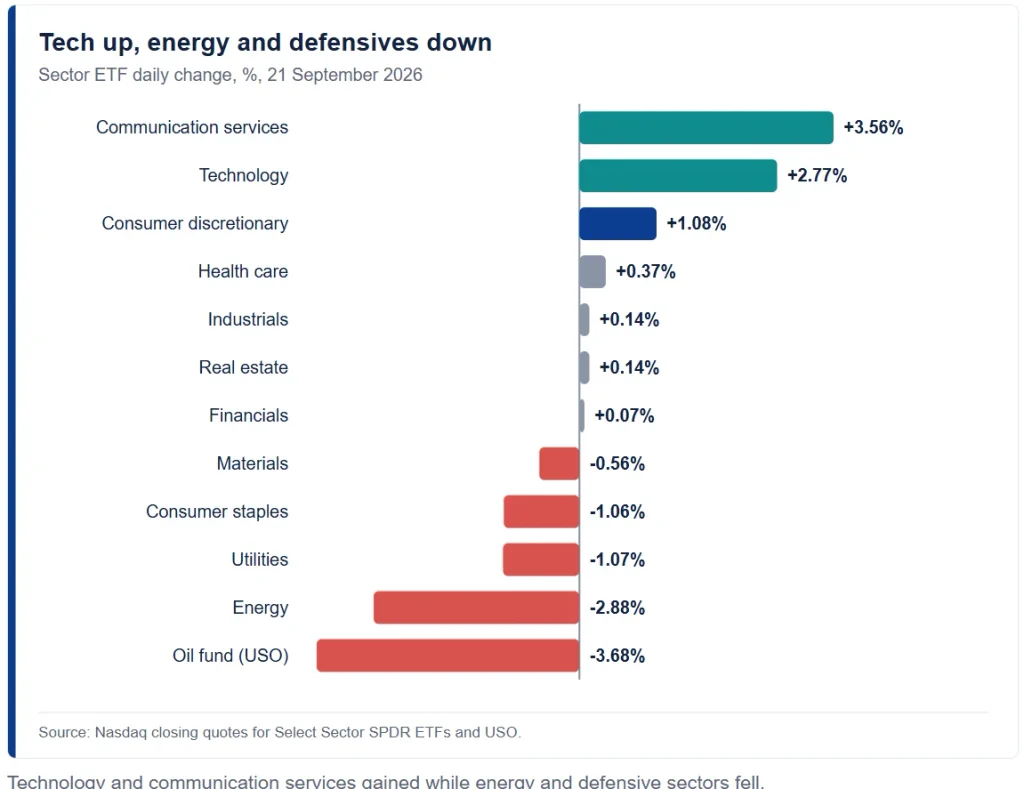
The gains, however, were far from even. Communication services rose 3.6%, and technology gained 2.8%, based on sector ETF prices. By contrast, financials barely moved, up just 0.07%.
Defensive sectors fell outright. Utilities and consumer staples each dropped about 1.1%. Meanwhile, the equal-weight S&P 500 ETF rose only 0.18%. That gap shows a handful of large companies did most of the lifting. Small caps offered little help either, with the Russell 2000 ETF up 0.5%.
Market breadth measures how many stocks join a move. When a cap-weighted index beats its equal-weight version by a wide margin, a few giants are doing the work. On Monday, that gap reached 1.31 percentage points, by Catenaa’s calculation.
This pattern carries risk. Rallies led by a few giants can reverse quickly if one earnings report disappoints. Still, record highs often attract momentum buyers in the short run. For now, those buyers appear focused on artificial intelligence names.
Oil Slides, Yields Ease
Energy moved the other way. On Monday, the United States Oil Fund fell 3.68%, its trading data show. The Brent-linked oil fund dropped 2.81%. Energy stocks followed, with Exxon Mobil down 3.2% and Chevron down 2.8%.
The drop extends a pullback from last week’s peak. The oil fund closed at $161.86 on 15 September. Since then, it has fallen 8.5%. Even so, it remains about 28% above its early August level. In short, crude has cooled but stays expensive by recent standards.
Cheaper oil matters for inflation. It lowers fuel costs and eases pressure on the Federal Reserve after its 16 September hike. Bonds responded. Specifically, the 10-year Treasury yield slipped to 4.96% from 5.01%, Treasury data show. The 30-year yield fell to 5.29%, while the two-year held at 4.76%. As a result, the gap between two-year and 10-year yields narrowed to 20 basis points from 25.
Lower long-term yields help growth stocks most. Their value depends on profits far in the future. Therefore, even a small drop in yields can lift technology valuations.
What Could Test the Nasdaq Record
The next test comes quickly. Chinese President Xi Jinping begins a state visit to Washington on Wednesday. Any news on tariffs or chip export rules could hit semiconductor stocks either way.
Additionally, the market needs broader participation to keep climbing. Banks, industrials and small caps have yet to join in. So far this year, the Nasdaq has gained about 16.7%. The S&P 500 is up about 13.4% since the end of 2025.
For investors, the signals point in different directions. The Nasdaq record confirms strong demand for artificial intelligence and chip names. Yet a narrow rally, a fragile oil market and yields near 5% leave little margin for error.