

November 22, 2026 – The AI data center firm offers cash and a new 12% preferred for common shares. A market-based check cuts the headline premium sharply.

In Summary
Hyperscale Data will swap up to 192.3 million shares for $2 cash plus one Series I preferred per 100 shares.
The 71% premium uses the preferred’s $24 stated value, not a market price.
Priced at the yield of its listed Series D preferred, the unit is worth about $0.171 a share, a 12.6% premium.
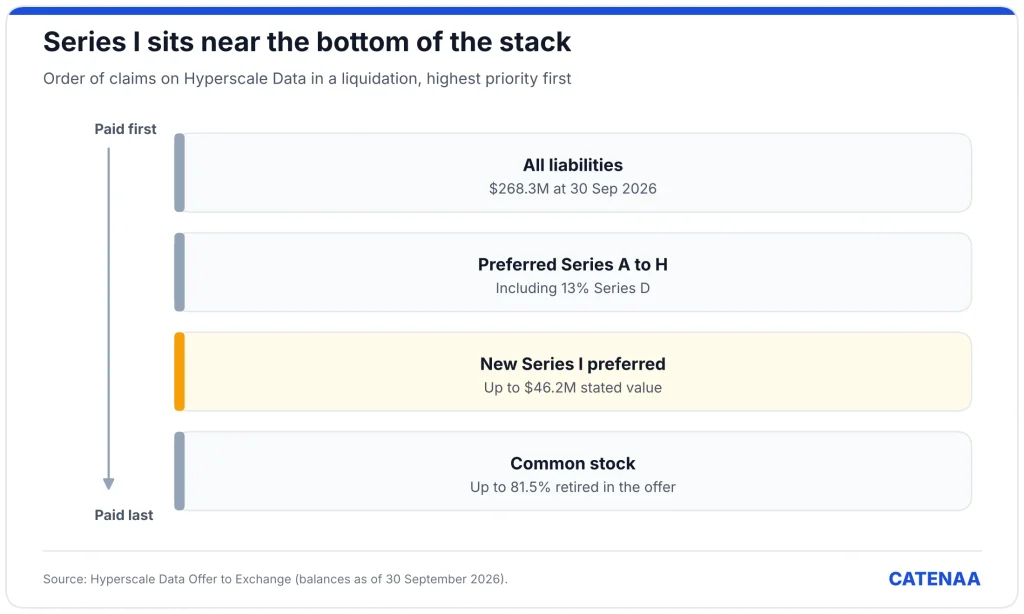
Series I ranks junior to all liabilities and every other preferred, and dividends only start to accrue after a year.
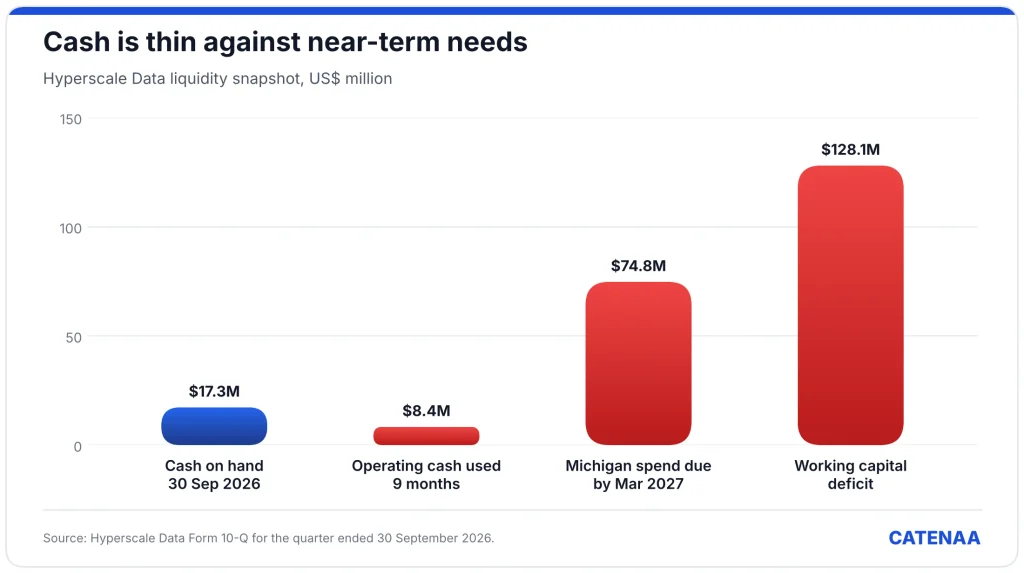
The company reported a $128.1 million working capital deficit and $74.8 million of near-term data center spending.
The Hyperscale Data exchange offer opened on November 20. The NYSE American company (GPUS) will swap up to 192.3 million common shares, its SEC tender filing shows. In return, holders get $2 in cash plus one new Series I preferred share for every 100 shares.
How the 71% premium works
Each preferred share carries a $24 stated value and a 12% yearly dividend that builds up if unpaid. Together, the unit values each common share at $0.26, the company’s press release says. That is 71% above the November 19 close of $0.1519. However, the premium rests on stated value, not a traded price. So far, no market exists for Series I shares.
Investors gave the deal a cold welcome. In fact, GPUS closed at $0.1291 on November 20, down 15%, Nasdaq data show. Against that price, the stated value implies a 101% premium. Yet the sell-off suggests the market doubts that value.
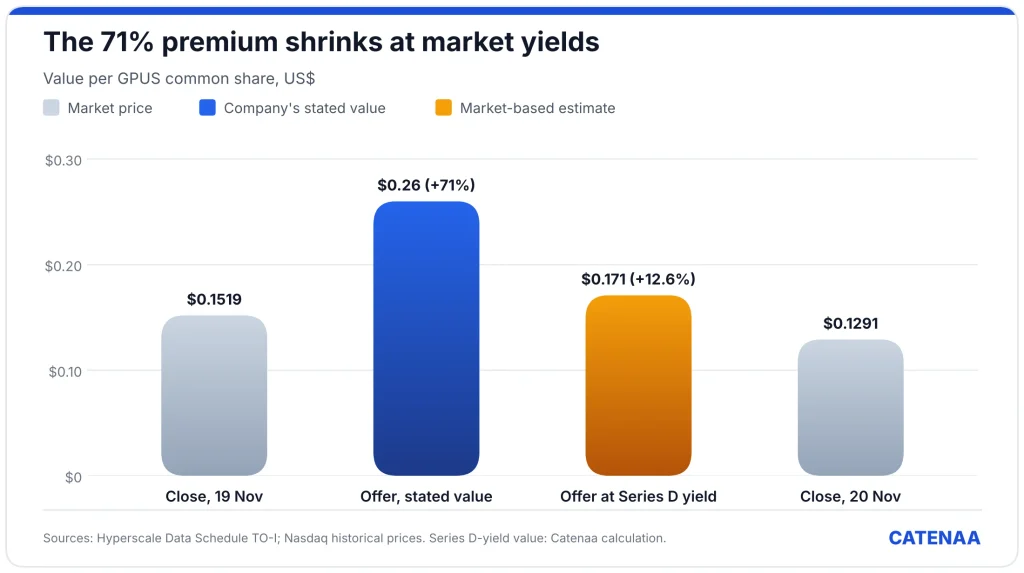
A market check on the Hyperscale Data exchange offer
Hyperscale already has a listed preferred that works as a yardstick. Its 13% Series D pays about $3.25 a share each year. It closed at $17.04 on November 19, Nasdaq records show. As a result, buyers demand a 19.1% yield on that stock. If Series I traded at the same yield, each share would fetch about $15.10. On that basis, the unit is worth about $0.171 per common share. That is a 12.6% premium, not 71%.
Moreover, Series I looks weaker than Series D. It ranks below every other preferred series and below all debts. Also, dividends only start to build up 12 months after issue. Then the first $0.24 monthly payment falls due at the end of the 13th month.
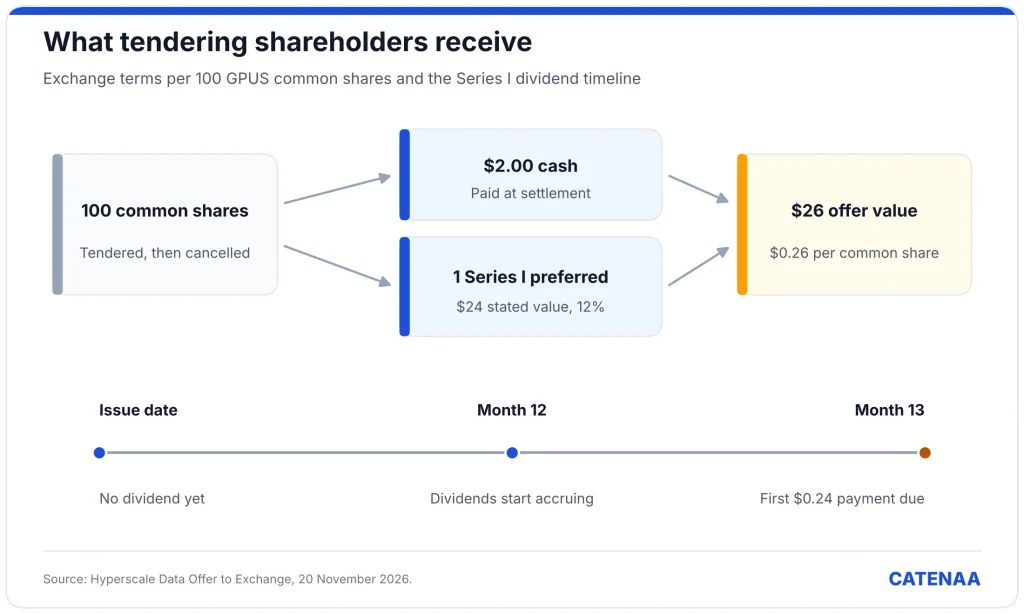
What changes in the capital structure
If fully taken up, the Hyperscale Data exchange offer retires 81.5% of the 236.0 million shares outstanding on November 16. It would also add $46.2 million of preferred stated value and pay $3.8 million in cash. After the first year, Series I dividends would cost about $5.5 million a year. That would lift the third-quarter preferred dividend run rate of $18.7 million by about 30%.
Control would shift too. Executive Chairman Milton Ault and his affiliates own about 67.9% of the stock, counting convertible holdings. Their stake could reach 94.2% if outside holders tender in full, the offer document states.
The deal still needs at least 100 million shares tendered before it can close. Until expiry, holders may also withdraw tendered shares at any time. The company will then retire and cancel every share it accepts.
Can the company carry the payments?
The latest quarterly report raises hard questions. Hyperscale lost $62.1 million in the nine months to September 30. Over that time, it used $8.4 million of cash in its operations. By September 30, it held just $17.3 million of unrestricted cash. Meanwhile, its short-term obligations exceeded its short-term assets by $128.1 million.
Furthermore, the company expects to pay $74.8 million for its Michigan data center by March 2027. Its own filing does not expect existing cash to cover these needs. Even so, the preferred terms offer little protection, with no operating rules and no debt limits. Listing is also uncertain, since the company may fall back to OTC trading.
What holders should weigh
The Hyperscale Data exchange offer expires at the end of December 18, New York time. Until then, holders must choose between a volatile common stake and a junior claim with delayed income. For some, the cash and future yield may still appeal. For others, the gap between stated and market value is the real catch.