

November 05, 2026 – The blue-chip index jumped 3.03% after Democrats took both chambers of Congress, while chip and AI infrastructure stocks slid and Treasury yields eased.

In Summary
The Dow closed at 53,356.12 on 4 November, up 1,569.40 points or 3.03%.
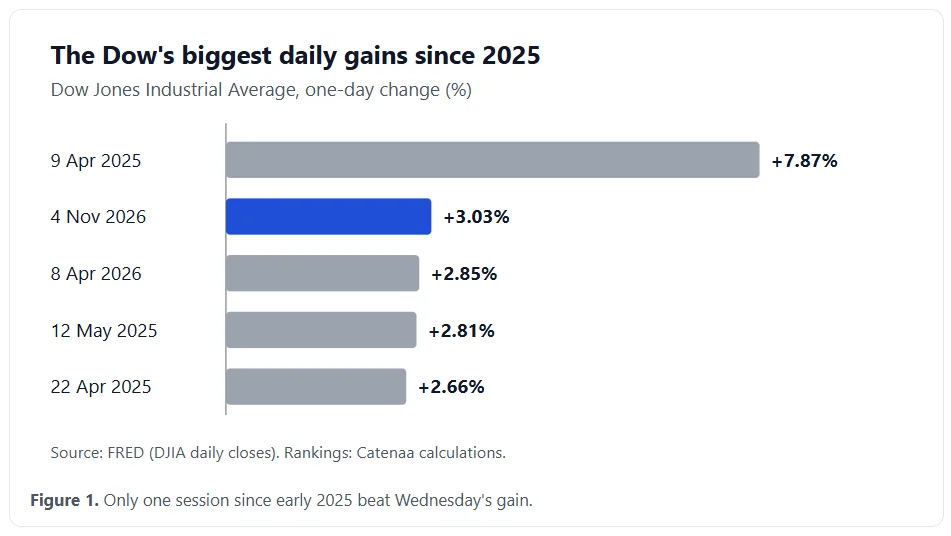
It was the index’s biggest one-day gain, in points and percent, since 9 April 2025.
Prediction markets settled in favor of Democratic control of both the House and the Senate.
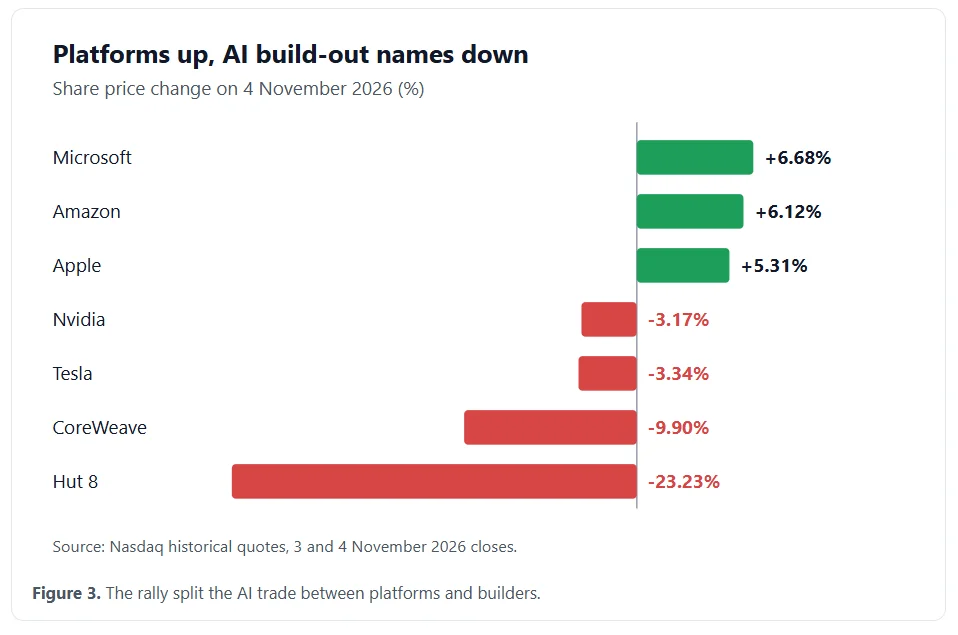
Microsoft, Amazon and Apple led, while Nvidia, CoreWeave and Hut 8 fell.
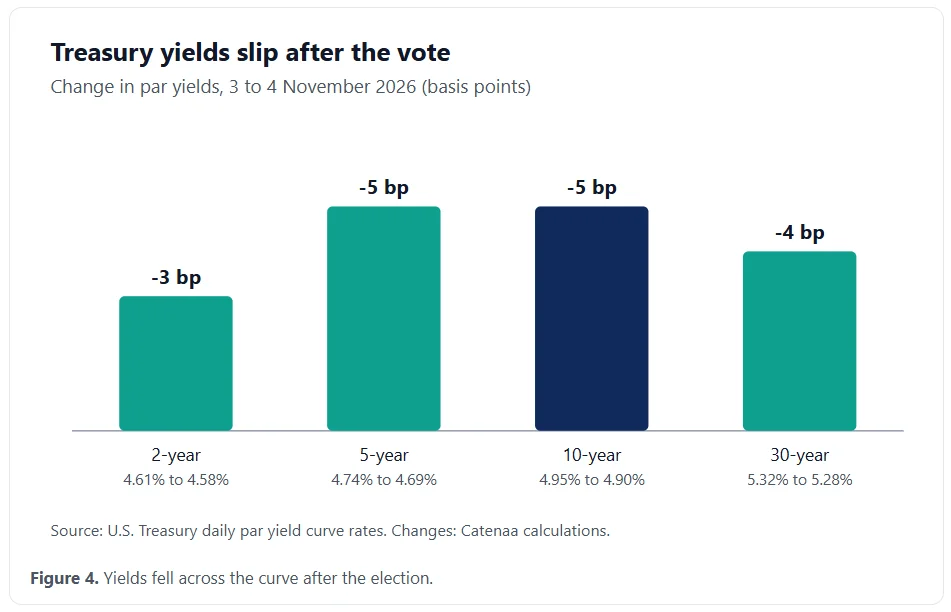
The 10-year Treasury yield eased 5 basis points to 4.90%.
The Dow Jones Industrial Average jumped 3.03% on Wednesday, its best day since April 2025. Wall Street’s blue-chip index gained 1,569.40 points to close at 53,356.12, FRED data shows. That Dow rally followed a midterm vote that handed Democrats control of both chambers of Congress.
Why the Dow rally stood out
Such a move is rare for a 30-stock index of this size. By points and by percentage, it was the Dow’s largest gain since 9 April 2025. That day, the index soared 7.87%. Wednesday’s move also lifted the index back above 53,000.
The gain leaves the Dow 1.8% below its record close of 54,349.12, set on 5 August. Moreover, the index is now up 11.0% for 2026, from 48,063.29 at the end of last year.
The election drove the move. Kalshi’s House control market settled in favor of Democrats early on 4 November, and its Senate market did the same. With a Republican in the White House, Washington now heads toward divided government from January. Each contract paid out $1 to holders who backed a Democratic win.
Divided power changes the policy math. Democrats can now set the agenda in both chambers, yet President Trump keeps his veto. As a result, sweeping new laws look less likely in the next Congress. Investors have often treated that kind of gridlock as a calming force.
Winners and losers in the Dow rally
Gains were uneven across benchmarks. The S&P 500 rose 1.58% to 7,688.62, leaving it 1.7% shy of its 6 October record. Meanwhile, the Nasdaq Composite added 1.44% to 25,736.51, according to Nasdaq data. However, the PHLX Semiconductor Index fell 3.13% to 10,268.65. That leaves the chip gauge 22.3% below its 6 October close.
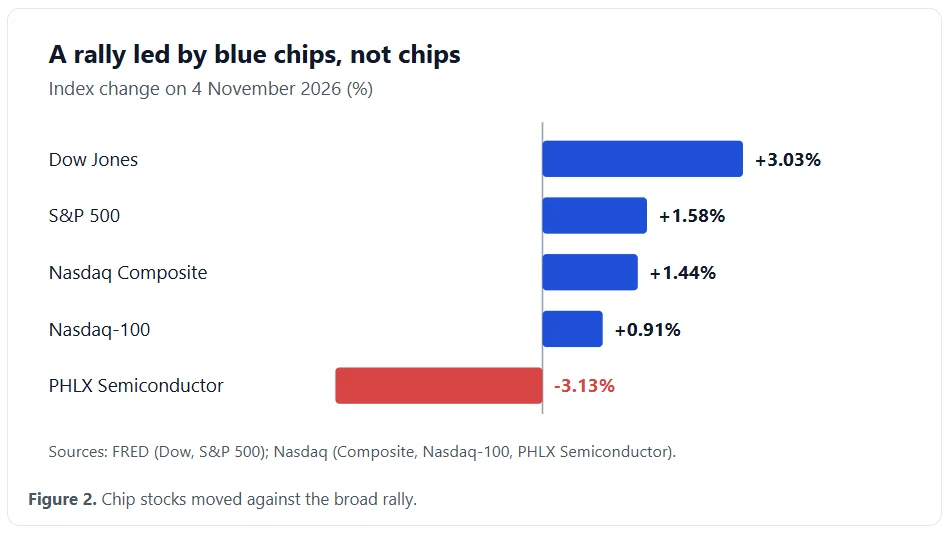
Zooming out, the picture for the year remains solid. The S&P 500 is up about 12.3% in 2026, from 6,845.50 at the end of 2025. Meanwhile, the Nasdaq-100 added 0.91% to 28,437.17, a much smaller gain than the Dow’s.
Large platform companies led the charge. Microsoft rose 6.68%, Amazon 6.12% and Apple 5.31%, closing at $349.51. By contrast, Nvidia slipped 3.17% and Tesla lost 3.34%.
Healthcare and banks joined in. Centene jumped 12.64%, and hospital operator HCA Healthcare gained 10.34%. JPMorgan Chase rose 4.18%, while Bank of America added 3.97%. Solar stocks also caught a bid, with First Solar up 4.63%.
AI infrastructure names fared worst. Hut 8 plunged 23.23%, while CoreWeave fell 9.90%. In short, investors rotated out of AI build-out trades and into large platform companies.
Bonds, gridlock and what comes next
Treasuries rallied as well. The 10-year yield fell 5 basis points to 4.90%, and the five-year yield dropped by the same amount to 4.69%. At the short end, the two-year yield eased to 4.58%. The 30-year yield slipped 4 basis points to 5.28%. Markets appear to expect gridlock to limit large new spending plans.
History offers useful context. After the 2018 midterms, which also split power in Washington, the S&P 500 gained 11.7% over the following year. Still, one cycle proves little, and this year’s backdrop includes high energy costs and a stretched AI trade.
Attention now turns to fresh data. Weekly jobless claims arrive on Thursday, and the October jobs report follows on Friday. Those releases will show whether the Dow rally has staying power. Steady jobs data and calm bond markets would give it the best chance.