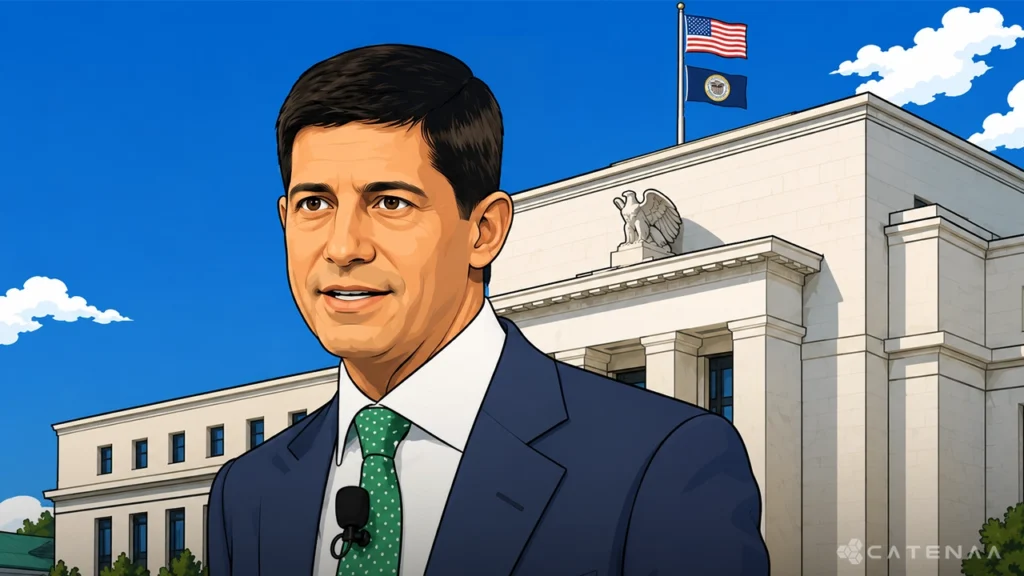


Catenaa, Friday, August 28, 2026- US Federal Reserve Chairman Kevin Warsh said that the US economy is at full employment, but inflation figures are more concerning.
Warsh made these remarks on Friday at a speech at Jackson Hole, Wyoming.
For more than two decades, the Fed’s sitting leader has signaled where interest rates are heading in their keynote address at the Federal Reserve Bank of Kansas City’s annual economic symposium.
Warsh’s break from tradition on Friday reinforces one of his biggest changes at the Fed: dialing back on communications to markets and the public about the Fed’s plans.
That, in turn, has left traders figuring out how to operate in a new era of US monetary policy, even as global pressures from government debt, the rise of AI and a war-driven inflation spike rattle financial markets.
“A quieter Fed, more purposeful in its communications, is better able to meet its objectives,” Warsh said Friday.
Meanwhile, inflation has moved higher, and some of Warsh’s colleagues are already calling for a raise in borrowing costs for the first time since July 2023.
While Warsh didn’t signal where rates are heading, or what would move the needle for him, his view that inflation is the greater problem is telling. But that might not provide enough clarity for markets.
Shortly after Warsh’s post-meeting news conference last month, in which he stayed quiet about interest rates, long-term bond yields surged in a potential sign that traders are concerned the Fed won’t do enough to tame stubbornly elevated inflation.
Rising government deficits and the increased supply of corporate bonds, among other factors, have pushed up bond yields in recent months. That means the federal government will continue to make massive interest payments that will only add to its $40 trillion pile of debt.
Warsh hasn’t provided what’s known as a “reaction function.” A reaction function is when a central bank explains “what it is watching, how it interprets the economy, how it weighs competing risks, and what developments would change its judgment,” the Brookings Institution explained in an analysis last month. Warsh has repeatedly refused to describe his reaction function when reporters ask.
This is different from “forward guidance,” which is a more explicit projection of the path for the Fed’s interest rate if the economy evolves as expected. In his Friday speech, Warsh defended his decision not to provide either.
“I wish our understanding of the economy were so precise as to provide a mechanical, tried-and-true answer,” Warsh said. “But our knowledge just doesn’t extend that far, at least not yet, and the factors most relevant to the proper conduct of monetary policy change over time.”
A CNBC survey of 31 economists, strategists and investors this week showed that 80% of respondents said Warsh should explain his economic views in more detail. Investors view the Jackson Hole event as Warsh’s best opportunity to do just that.
Fed officials are grappling with the current uptick in inflation, driven by tariffs, war, and companies’ massive spending on AI infrastructure on prices, and whether they should step in with interest rate hikes soon.
But the US jobs market has been in a lackluster, “low hire, low-fire” state during much of the past two years, complicating the Fed’s dual mandate of reining in price increases while buoying employment.
And those recent job gains were possibly even more tepid than previously thought, according to a new report released Friday.
The US economy likely added 79,000 fewer jobs than initially estimated between April 2025 and March 2026, according to the Bureau of Labor Statistics’ preliminary annual benchmark review of recent employment data.
If the estimates hold, job growth during that period would fall to 194,000 from 273,000.




