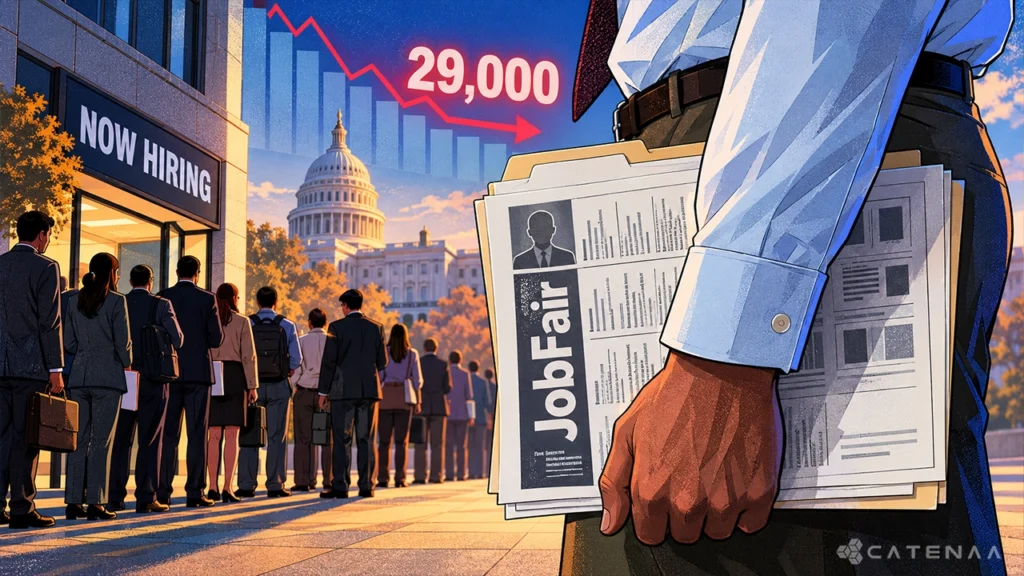


October 03, 2026 – Payroll gains slowed, revisions cut earlier months, and unemployment ticked higher. The data challenges the Fed’s upbeat view of the labor market.

In Summary
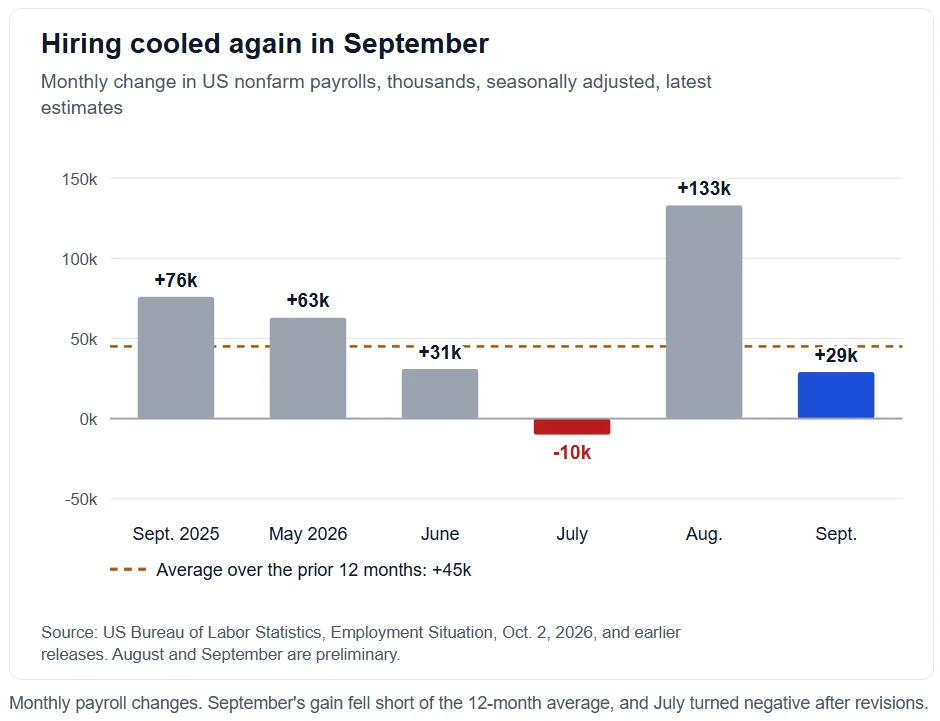
US employers added 29,000 jobs in September, below the 45,000 average of the prior 12 months.
The unemployment rate rose to 4.2%, above the Fed’s own 4.1% projection for the end of 2026.
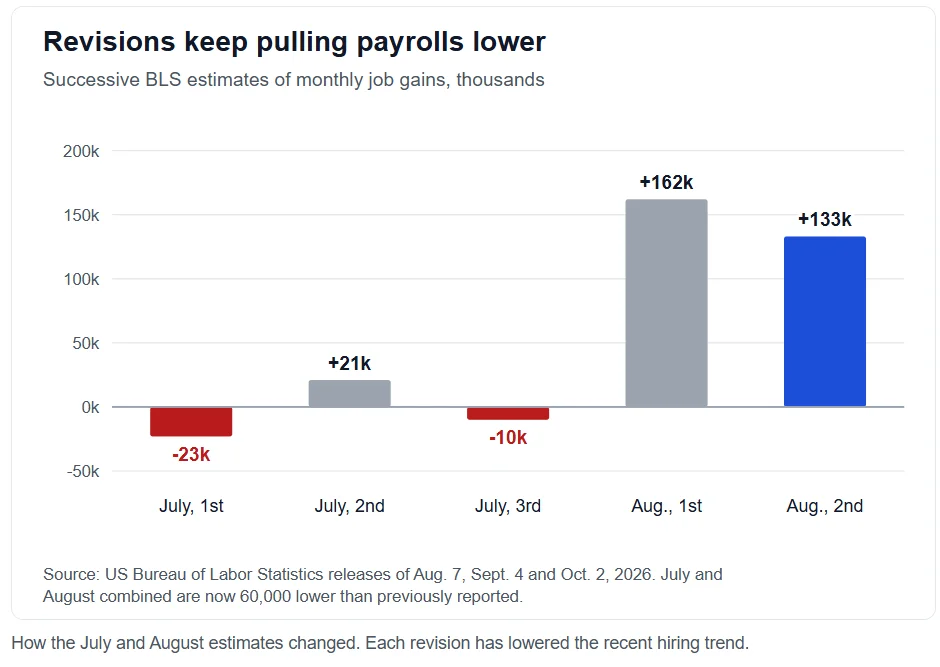
Revisions cut 60,000 jobs from July and August, and July now shows a loss of 10,000.
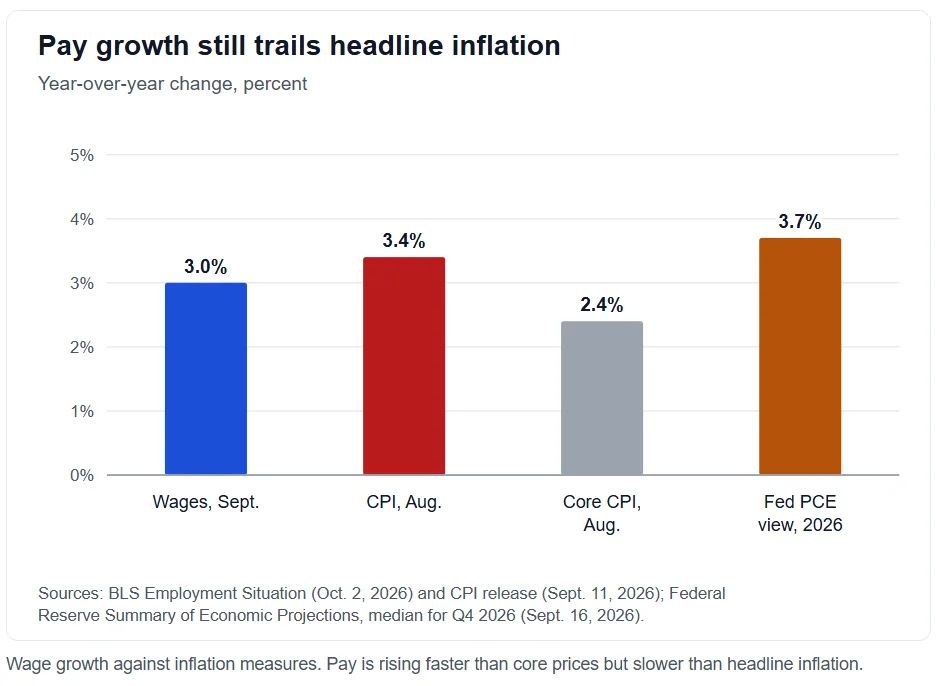
Wages rose 3.0% over the year, slower than August consumer inflation of 3.4%.
The September US jobs report showed hiring nearly stalled. Employers added just 29,000 jobs, the Bureau of Labor Statistics said on Friday. Meanwhile, the unemployment rate rose to 4.2% from 4.1% in August. The data lands two weeks after the Federal Reserve raised interest rates.
The headline gain trailed the 45,000 average of the prior 12 months. Revisions also cut 60,000 jobs from July and August combined. July now shows a decline of 10,000 jobs, and August stands at 133,000. In effect, the economy has added about 51,000 jobs a month over the past three months.
Private hiring looks a little firmer on that measure. Companies added an average of 54,000 jobs a month over the same three months. That compares with a three-month average of 38,000 a year earlier.
Inside the September US jobs report
Private employers did most of the hiring. They added 46,000 jobs, according to the BLS establishment table. Government payrolls fell by 17,000 after rising 44,000 in August. In addition, goods producers contributed 18,000, led by construction and manufacturing. Private service firms added 28,000.
Health care remained the main engine, but it slowed. The sector added 17,000 jobs, about half its 33,000 monthly average over the prior year. Within the sector, ambulatory services added 13,000, and hospitals added 12,000. By contrast, nursing and residential care facilities lost 9,000.
Elsewhere, results varied. Manufacturing added 9,000 and is up by 72,000 since a low in December 2025. Financial activities, however, shed 7,000 jobs, taking losses since May 2025 to 129,000. Most of that decline came from insurance carriers, which lost 90,000.
Construction added 11,000 jobs, close to its 10,000 monthly average over the prior year. Nonresidential specialty trade contractors drove most of that gain with 12,000 new roles. Within factories, plastics and rubber products and machinery each added 5,000.
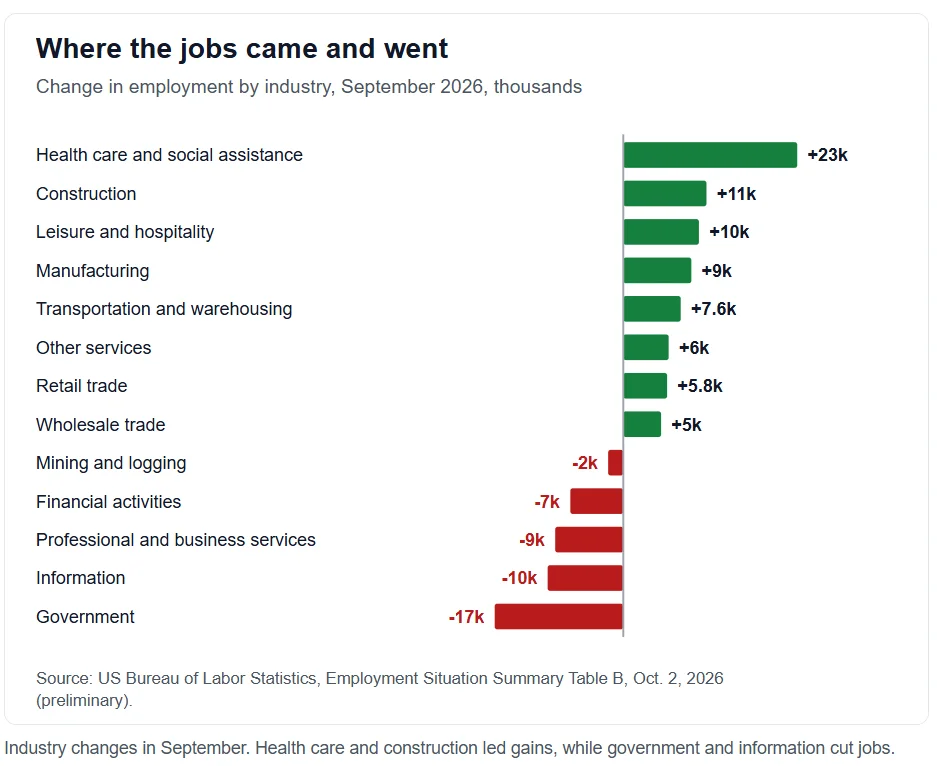
Meanwhile, professional and business services cut 9,000 jobs, including 10,900 in temporary help. Information also lost 10,000 jobs after an 18,000 drop in August. Leisure and hospitality added 10,000, a far smaller gain than in August.
Household survey shows slack building
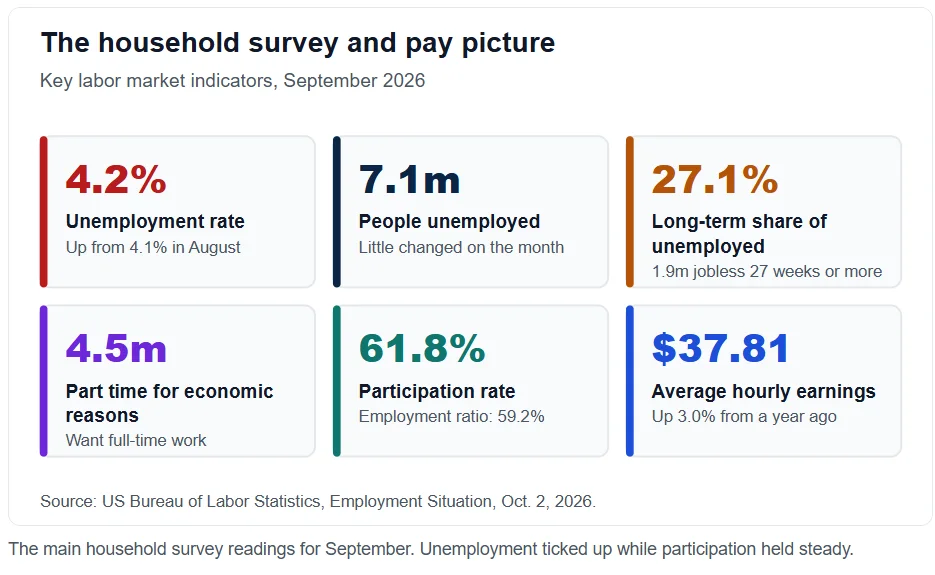
The household survey told a similar story. It counted 7.1 million unemployed people. About 1.9 million of them had looked for work for 27 weeks or longer, or 27.1% of the total. Also, 4.5 million people worked part time for economic reasons, such as cut hours or scarce full-time jobs.
Labor force participation stood at 61.8%, and the employment-population ratio at 59.2%. Both measures changed little in September, the BLS said. Notably, the jobless rate has stayed in a narrow range of 4.1% to 4.3% since March. That stability helps explain the Fed’s view that the jobless rate “has changed little.”
Wages lag inflation
Pay growth offered little comfort. Average hourly earnings rose 5 cents, or 0.1%, to $37.81. Over the year, wages climbed 3.0%. That trails August consumer inflation of 3.4%. On that basis, pay is lagging prices by about 0.4 percentage points, by Catenaa’s calculation.
The average workweek held at 34.4 hours. As a result, average weekly earnings edged up to $1,300.66, from $1,298.94 in August. That is about 3.6% above the $1,255.14 of a year earlier. A longer workweek, at 34.4 hours against 34.2, explains part of the gain.
Markets reacted quickly to the soft numbers. For example, bitcoin climbed above $87,000 after the release, as traders bet on easier policy. Lower odds of another rate increase tend to support risk assets.
What the US jobs report means for the Fed
The US jobs report complicates the Fed’s message. On Sept. 16, officials raised the target range to 3.75% to 4.00% in a 12-to-0 vote. Their statement said job gains “have kept pace with the workforce.” Yet September’s gain was the second weakest of the past five months.
The Fed’s own projections also look stretched. In September, the median official expected unemployment of 4.1% at the end of 2026. The rate already stands at 4.2%. Even so, the same projections pencilled in a funds rate of 4.1% by year-end, which implies another hike.

Policymakers meet next on Oct. 27 to 28. Before then, they will see September inflation data. If prices cool, Friday’s soft US jobs report could tip the debate toward a pause. Should inflation stay near 3.4%, however, officials who favor tighter policy may still push for one more increase.