

November 08, 2026 – Payrolls beat the year’s trend, unemployment fell to 4.1% and revisions added 84,000 jobs. Traders now see a December rate hike as the likely path.

In Summary
U.S. employers added 165,000 jobs in October, more than triple the prior 12-month average.
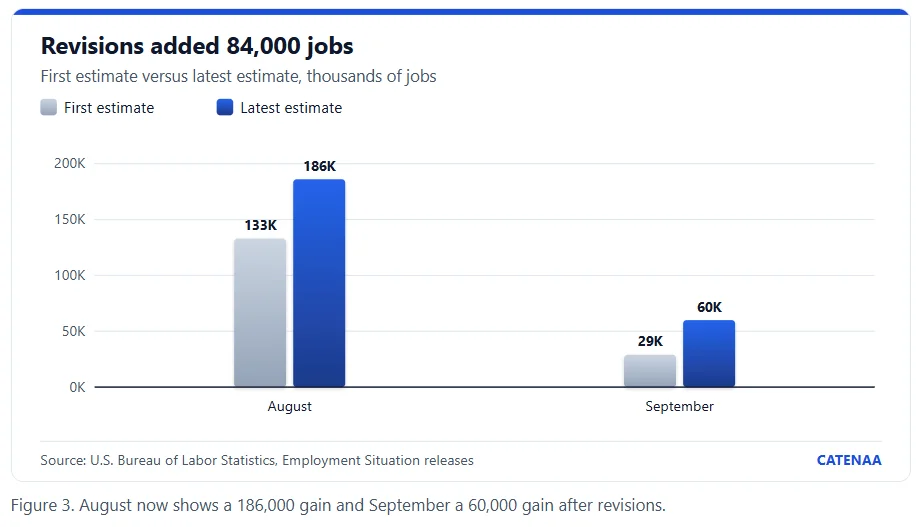
Unemployment fell to 4.1%, and revisions lifted August and September by 84,000 jobs.
Pay rose 3.1% over the year, still below September’s 3.7% inflation rate.
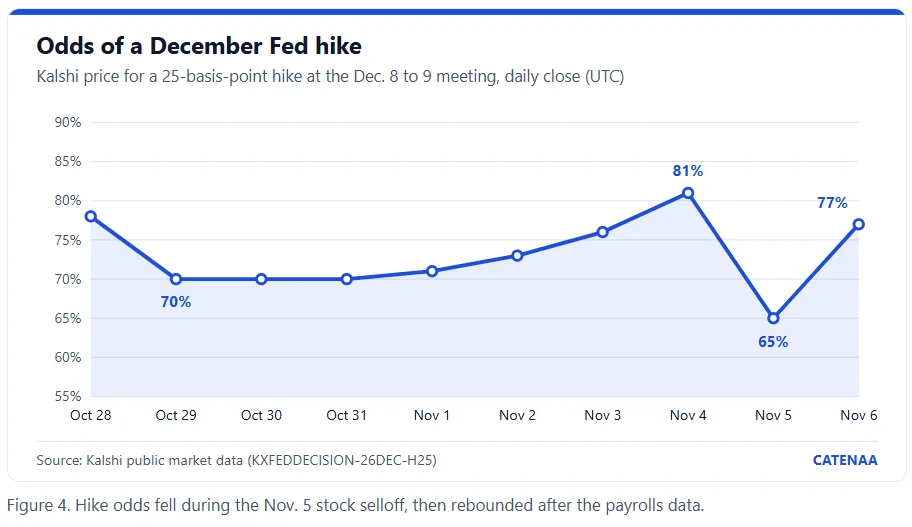
Kalshi odds of a December rate hike jumped to 77% from 65% after the release.
The October jobs report came in hot. U.S. employers added 165,000 jobs last month, the Bureau of Labor Statistics said on Nov. 6. That is more than triple the 48,000 monthly average of the prior 12 months, per Catenaa calculations.
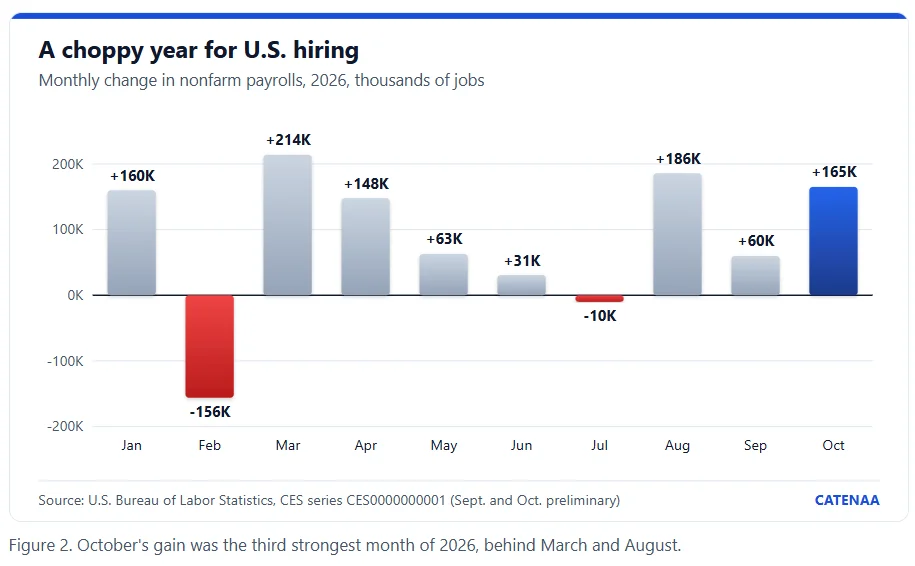
The unemployment rate also dipped to 4.1% from 4.2%. Meanwhile, revisions added 84,000 jobs to August and September combined. Taken together, the data push back against talk of a cooling labor market. They also break a soft summer run, when payrolls rose just 31,000 in June and fell 10,000 in July.
What the jobs report showed
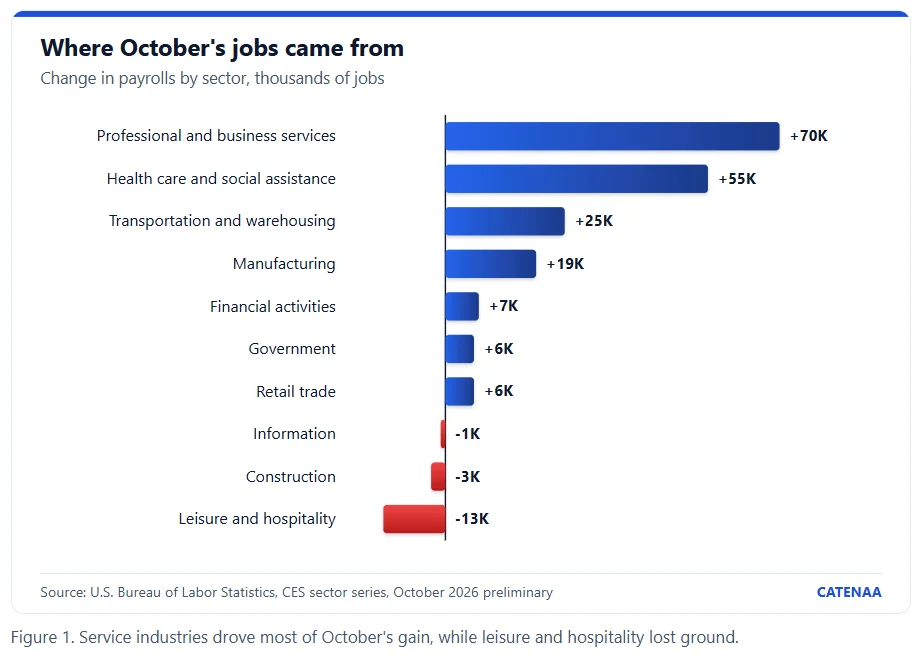
Hiring was broad but uneven. Professional and business services led with 70,000 new jobs. Health care and social assistance added 55,000, while transportation and warehousing gained 25,000. Together, those three groups supplied 150,000 jobs, or 91% of the total.
Factories added 19,000 jobs. On the other hand, leisure and hospitality shed 13,000. Construction and information were roughly flat. Elsewhere, financial activities gained 7,000, while government and retail trade each added 6,000.
The bigger picture still looks choppy. Payrolls swung from a 156,000 loss in February to a 214,000 gain in March. Through October, 2026 has averaged about 86,000 jobs a month.
Wages and inflation keep the Fed alert
Average hourly earnings rose 0.4% in October to $38.00. That left pay up 3.1% from a year earlier. However, consumer prices rose 3.7% in the year to September, according to the latest CPI report. As a result, real wages appear to be slipping.
Not every gauge improved, either. The broader U-6 underemployment rate rose to 7.9% from 7.6%. Labor force participation, by contrast, edged up to 61.9%, and the average workweek held at 34.4 hours.
Traders lift December hike odds after the jobs report
The Fed raised its target range to 3.75% to 4% in September and held it in October. Its final meeting of the year runs Dec. 8 to 9.
Traders moved fast after the release. On Kalshi, a quarter-point December hike closed Nov. 6 at 77 cents, up from 65 cents a day earlier. The contract still traded near 76 cents early on Nov. 8.
A hike would lift the range to 4% to 4.25%. Kalshi priced the chance of no change at about 22% on Nov. 8. Bets on a cut or a bigger hike drew only a few cents each.
Bond yields rose as well. The two-year yield climbed to 4.51% from 4.46%, while the 10-year rose to 4.86%, Treasury data show. Longer rates moved less, so the curve flattened slightly. The 30-year yield edged up to 5.26% from 5.25%.
Bitcoin, for its part, barely reacted. It closed Nov. 6 at $75,742 on Kraken, little changed from $75,980 a day earlier. Still, the token has struggled lately. It closed at $81,287 on Oct. 28 and has not closed above $81,000 since.
What comes next
The October inflation report lands on Tuesday, Nov. 10. In September, core prices, which exclude food and energy, rose 2.6% from a year earlier. That gap shows food and energy costs are doing much of the damage. Even so, another hot reading would make a December hike harder for the Fed to skip. After that, the November jobs report arrives on Dec. 4, just days before the meeting. Officials will also publish fresh economic projections at that gathering.
For now, the message is simple. Employers are still hiring, wages trail inflation, and markets expect the Fed to act again.