

September 26, 2026 – Business activity in the currency bloc grew at the fastest pace in almost three and a half years, led by German industry. Costs are rising again too.

In Summary
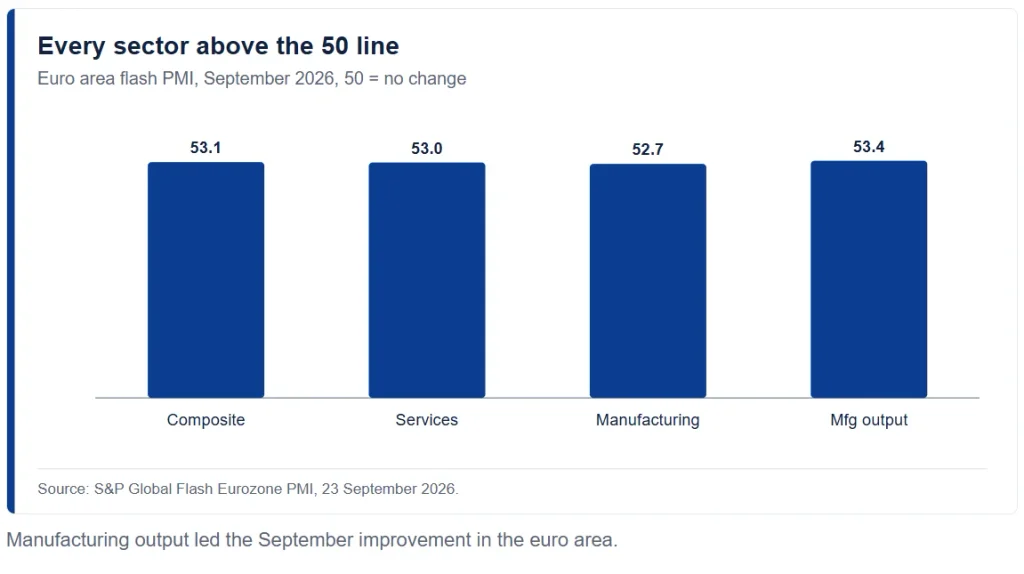
The euro area flash composite output index rose to 53.1 in September, the strongest in almost three and a half years.
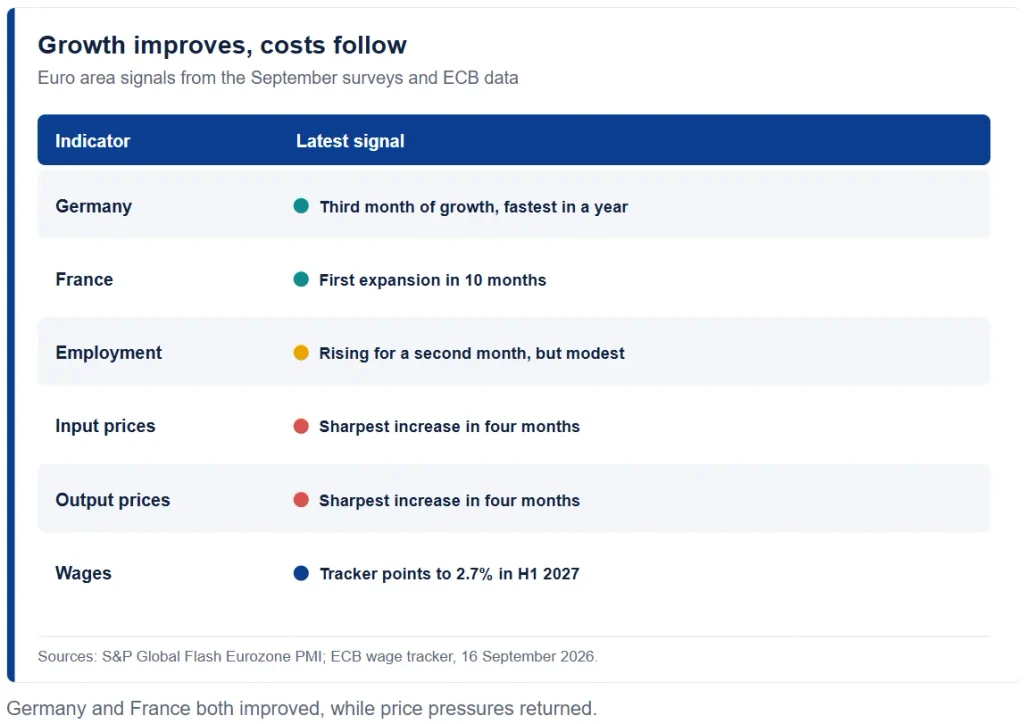
Manufacturing reached 52.7, with Germany growing fastest in just under a year and France expanding for the first time in 10 months.
Input and output prices rose at their sharpest rates in four months.
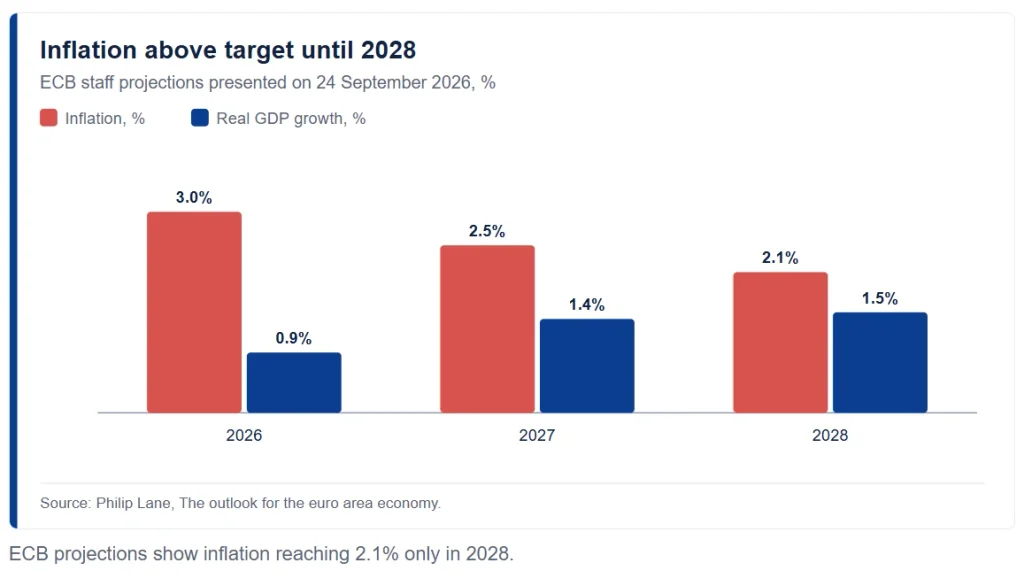
ECB projections put inflation at 3.0% in 2026, 2.5% in 2027 and 2.1% in 2028, with growth of 0.9% this year.
The UK composite slipped to 51.7, with cost inflation at a three-month high.
Europe’s economy is finally picking up speed. The euro area PMI composite output index rose to 53.1 in September, S&P Global’s flash survey shows. That was the strongest reading in almost three and a half years.
Factories led the way. The manufacturing PMI reached 52.7, while the manufacturing output index hit 53.4. Services activity came in at 53.0.
Germany did most of the heavy lifting. Its private sector grew for a third month, at the fastest pace in just under a year. France, meanwhile, expanded for the first time in 10 months.
What Is Driving the Euro Area PMI
Two forces stand out in the euro area PMI detail. Chris Williamson, chief business economist at S&P Global Market Intelligence, pointed to industry. Manufacturing is “enjoying its best growth spell for over four years, spurred by rising AI and defense spending,” he said.
Defence budgets and data centre investment both feed German industry. Machinery, electrical equipment and specialist components all benefit. Therefore, orders have improved even as consumer demand stays soft.
That mix carries a risk, however. Public spending drives much of the new work. If budgets tighten in 2027, the euro area PMI could give back these gains.
Jobs tell a more cautious story. Staffing rose for a second month, but only modestly. Manufacturers kept headcount flat, while services firms hired.
Prices Move the Wrong Way
Costs are rising again. Input prices and output prices both increased at their sharpest rates in four months, the survey found. Energy and wages remain the main drivers.
That complicates the inflation picture. Firms with stronger order books find it easier to raise prices. As a result, the pickup in growth may slow the retreat in inflation.
Williamson also flagged a cap on confidence. Job creation “remains subdued,” he said, because geopolitics still makes firms cautious. Hiring plans therefore lag the improvement in output.
The ECB Reads a Two-Speed Outlook
Policymakers see recovery, but not a boom. Philip Lane, the ECB’s chief economist, set out projections on 24 September. They show inflation at 3.0% this year, 2.5% in 2027 and 2.1% in 2028.
Growth looks modest by comparison. The projections put real GDP growth at 0.9% in 2026, then 1.4% and 1.5%. So the September survey runs ahead of the official forecast.
Wages support the cautious view. The ECB’s wage tracker points to negotiated pay growth of 2.7% in the first half of 2027. That figure implies a modest uptick rather than a wage spiral.
Households Still Feel the Squeeze
Consumers remain the weak link. The ECB’s Consumer Expectations Survey tracks perceived and expected inflation each month. Those readings shape spending decisions across the bloc.
Retail demand has lagged industry all year. Households face high living costs and uncertain job prospects. Consequently, services growth depends heavily on business spending. A stronger labour market would change that balance quickly.
Geopolitics adds another layer. Energy prices, trade rules and defence commitments all shift quickly. Firms therefore hesitate to add permanent staff.
Britain Moves the Other Way
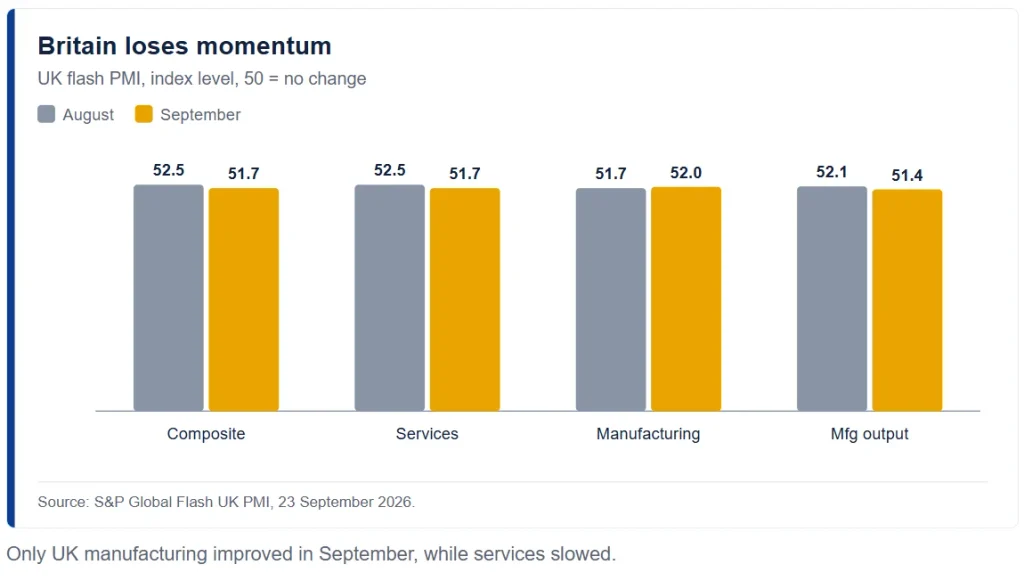
The contrast with the United Kingdom is sharp. The UK composite index fell to 51.7 in September from 52.5. Services slipped to 51.7, while manufacturing edged up to 52.0.
British firms also reported faster cost increases. Input price inflation hit its highest since June, with fuel, energy and metals cited. Output prices rose at the quickest pace since June as well.
Williamson called it “a worrying combination” of sluggish growth and rising price pressures. That mix leaves the Bank of England with an awkward choice. Cutting rates would risk inflation, while holding them would slow demand further.
What the Euro Area PMI Means Next
Three points matter for investors. First, the euro area recovery now rests on manufacturing rather than consumers. That makes it sensitive to global demand and defence budgets.
Second, price pressures have stopped falling. If input costs keep rising, the path back to 2% inflation lengthens. The ECB will weigh that against soft wage growth.
Third, the gap with the United States remains wide. American business activity grew at a 62-month high in September, as our US flash PMI report explains. Currency and bond markets will keep pricing that divergence.
For now, though, Europe can point to real improvement. A third month of German growth and a French turnaround both matter. The next test comes with the final PMI readings and the October inflation prints. Until then, expect policymakers to sound patient rather than pleased.