

November 29, 2026 – Euro area households now expect prices to rise almost six times faster than their pay over the next year.

In Summary
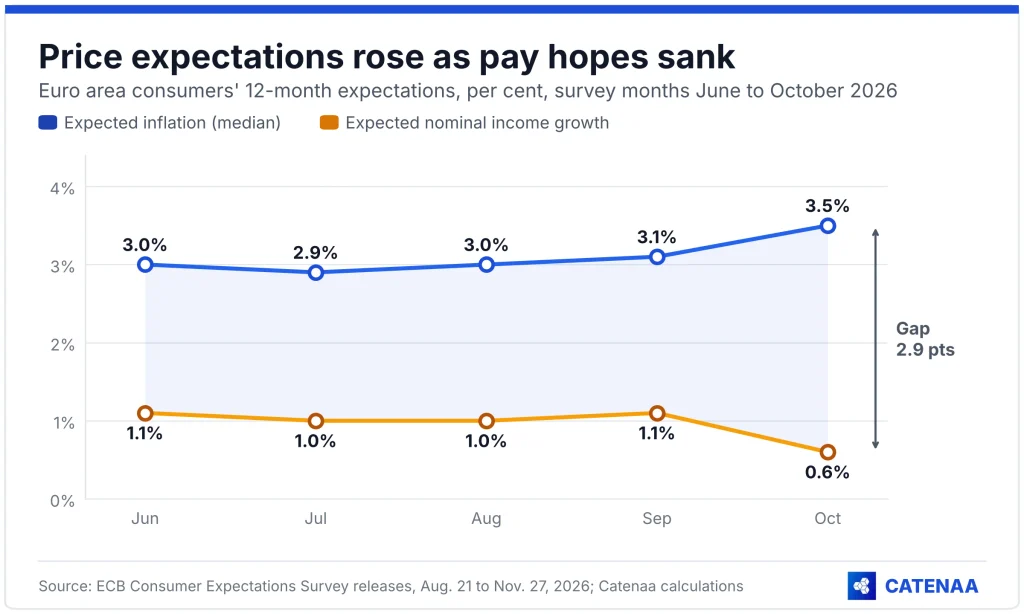
Euro area consumers expect 3.5% inflation over the next 12 months, up from 3.1% in September.
Expected nominal income growth fell to 0.6% from 1.1%, leaving a 2.9-point gap with inflation.
Both the bottom and top income quintiles cut income expectations by 0.7 and 0.8 points.
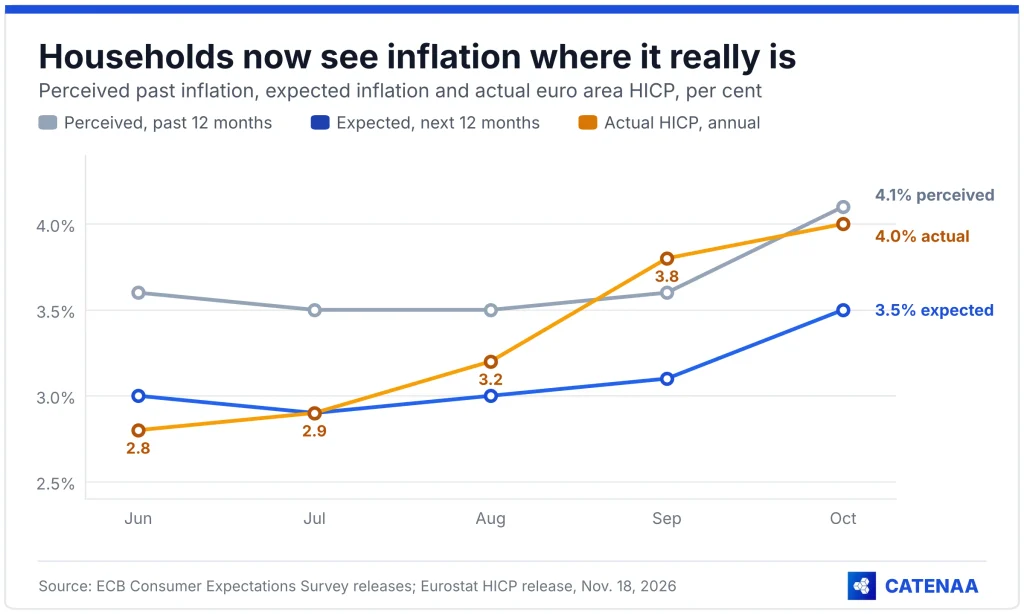
Perceived inflation hit 4.1%, close to October’s actual HICP rate of 4.0%.
The latest ECB consumer survey shows households bracing for a squeeze on real income. Consumers now expect prices to rise 3.5% over the next year, up from 3.1%. Meanwhile, they expect nominal income to grow just 0.6%, down from 1.1%, the ECB said on Nov. 27.
ECB consumer survey shows inflation fears rising
The October survey ran from Oct. 1 to Nov. 2 and covers about 19,000 adults in 11 countries. Perceived inflation over the past year rose to 4.1% from 3.6%. That is the highest reading since July 2024.
Longer horizons moved less. Three-year expectations edged up to 3.0%, while five-year expectations held at 2.5% for a third month. Even so, 2.5% matches the highest level since the series began in August 2022.
Households are not imagining the pressure. Euro area inflation reached 4.0% in October, up from 3.8% in September, Eurostat reported. Energy added 1.89 percentage points, and services added 1.55 points.
A 2.9-point gap opens
Set side by side, the two expectations point to falling real pay. Expected inflation of 3.5% minus expected income growth of 0.6% leaves a gap of 2.9 points. In June, that gap stood at 1.9 points, based on the July survey release.
However, the figures need care. The inflation numbers are medians, while the ECB reports income growth as a winsorised mean, a type of average. So the gap is a rough signal, not a forecast for any single household.
Rich and poor both cut income hopes
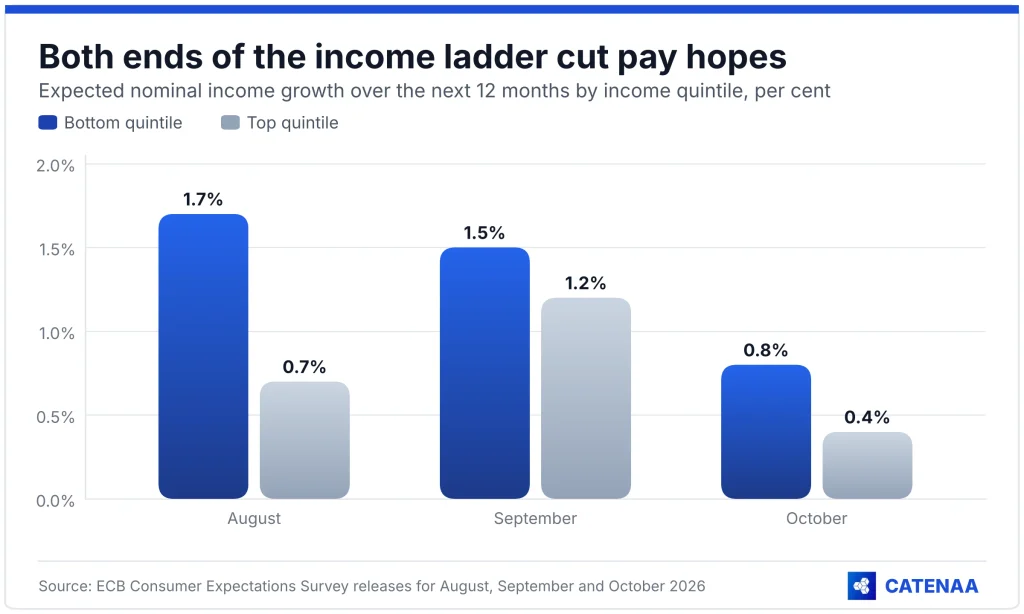
The drop hit both ends of the income ladder. The bottom fifth of households lowered expected income growth by 0.7 points to 0.8%. Meanwhile, the top fifth cut theirs by 0.8 points to 0.4%.
The gap between the two groups has moved around. In August, the bottom fifth expected 1.7% income growth and the top fifth 0.7%, the ECB reported. By September, those figures were 1.5% and 1.2%, according to the September release.
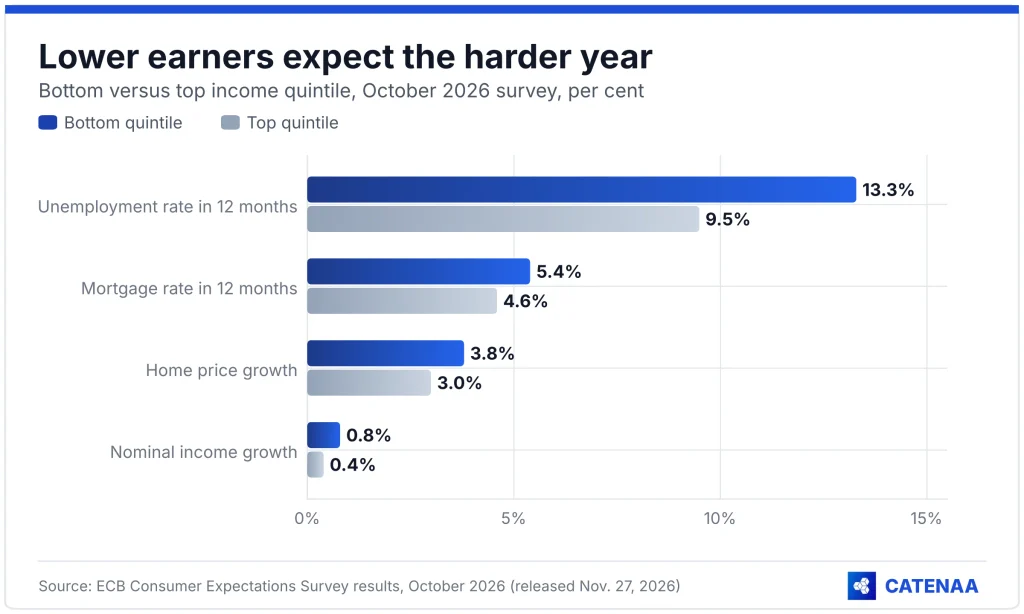
Lower earners remain more exposed, though. They expect unemployment to reach 13.3% in a year, compared with 9.5% for the top fifth. They also expect higher mortgage rates, at 5.4% versus 4.6%.
Spending plans outpace income
Consumers still expect nominal spending to grow 3.7%, unchanged from September. That is far above expected income growth of 0.6%. Therefore, many households may need to draw on savings or buy less.
Credit may not fill the gap. The net share of households expecting tighter credit rose to its highest since October 2023. Moreover, they still expect mortgage rates of 4.9% in a year.
Jobs and growth send mixed signals
Other parts of the ECB consumer survey were less gloomy. Expected economic growth improved to -1.3% from -1.5%. Consumers also expect unemployment of 11.0% in a year, down from 11.3%.
However, quarterly data showed softer job hopes. Unemployed people put their chance of finding work within three months at 29.6%, down from 30.8% in July. In addition, expected home price growth slowed to 3.3% from 3.5%.
For policymakers, five-year expectations of 2.5% sit above the ECB’s 2% target. Still, the bank notes that survey results do not reflect the views of its decision-makers.
What comes next
The ECB will publish November results on Jan. 7, 2027. That next ECB consumer survey will show whether the squeeze eased or deepened. Until then, analysts can test it with the survey’s country microdata, which go down to the household level. For now, the aggregate data point one way: households expect prices to outpace pay.