

November 19, 2026 – US corporate bond yields jumped over the past year, mostly because Treasury yields rose. The refinancing shock is mild for top-rated firms but severe for the weakest borrowers.

In Summary
Investment-grade bond yields rose from 4.88% to 5.95% in a year; high-yield yields rose from 6.86% to 8.31%.
Treasury yields drove most of the move, since the investment-grade spread rose only to 0.92 points.
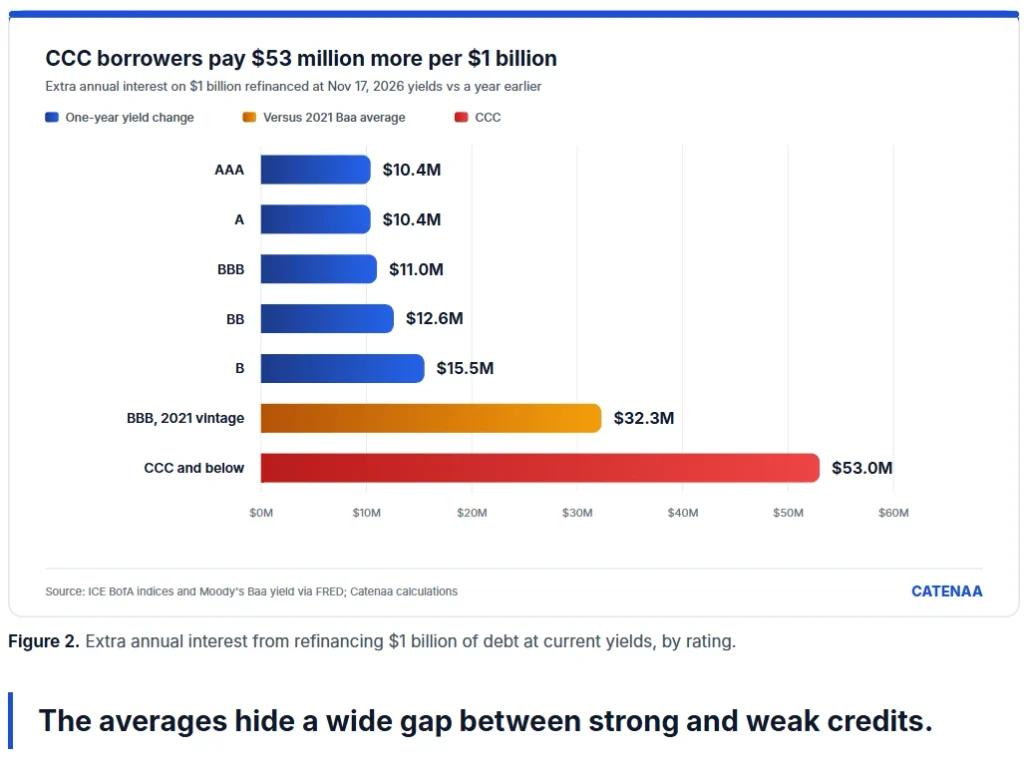
CCC yields jumped 530 basis points to 18.04%, adding about $53 million a year per $1 billion refinanced.
Triple-B debt issued at 2021 yields faces about 323 basis points of extra cost.
The Fed says coverage for non-investment-grade public firms remains weak by historical standards.
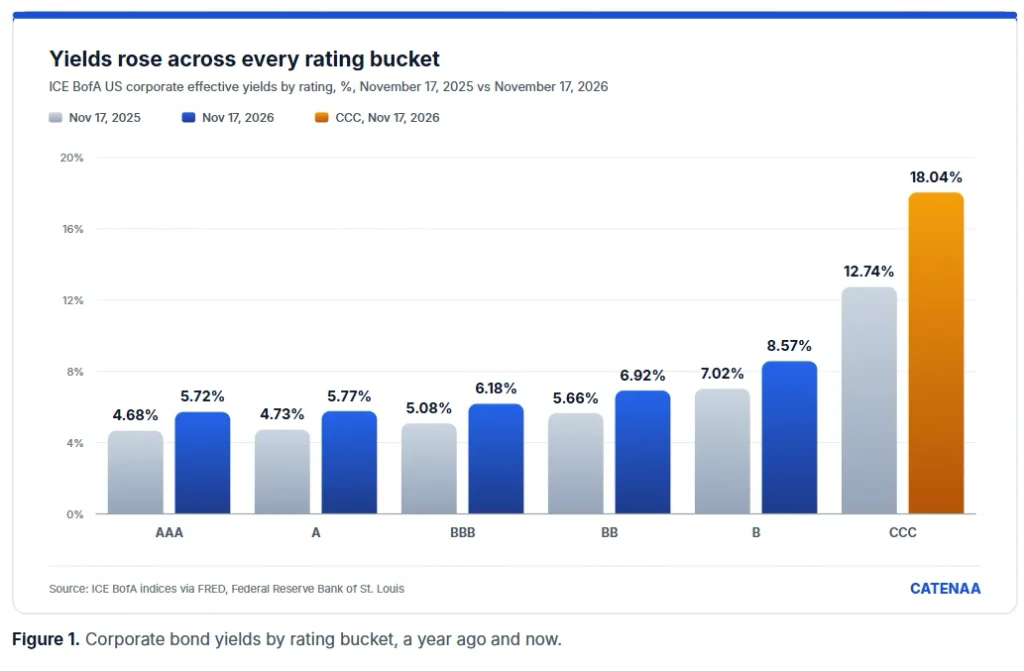
America’s companies face a sharper refinancing shock than a year ago. The average investment-grade bond now yields 5.95%, up from 4.88% in November 2025. Meanwhile, the average high-yield bond yields 8.31%, against 6.86% a year earlier.
Those are index readings for November 17. They show what a borrower would roughly pay to roll over debt today. However, the averages hide a wide gap between strong and weak credits. Also, the refinancing shock arrives only as debt matures, so it spreads over several years.
Treasuries, not credit fear, drove the jump
Indeed, most of the rise came from government bond yields, not wider risk premiums. The investment-grade spread over Treasuries stood at 0.92 points, up only from 0.84 a year ago. By contrast, the 10-year Treasury yield reached 5.07% on November 18. High-yield spreads widened a little more, to 3.43 points from 3.13.
The Federal Reserve made the same point in its November Financial Stability Report. It said higher yields on high-yield and triple-B bonds largely reflect higher Treasury yields. The report also noted that spreads remain at the low end of their historical range.
Who faces the biggest refinancing shock
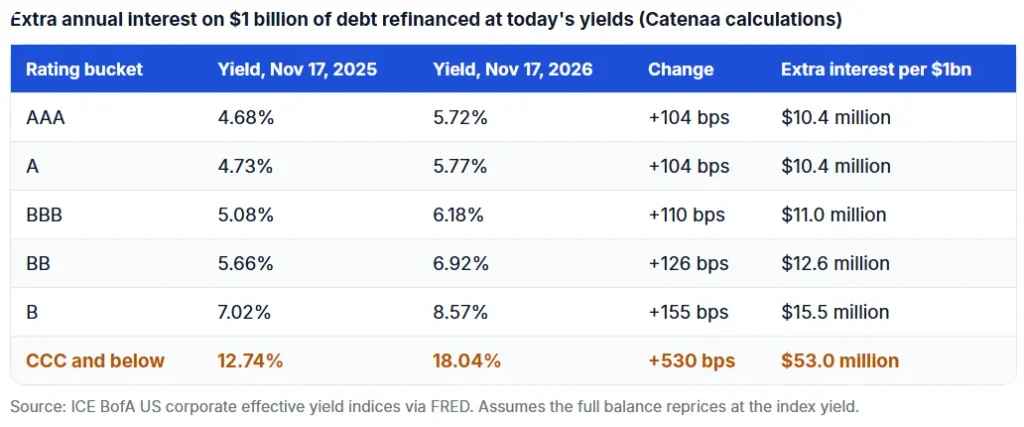
Notably, the pain rises fast as credit quality falls. Yields on AAA bonds climbed 104 basis points in a year. For B-rated debt, the increase was 155 basis points. Yet CCC yields jumped 530 basis points, to 18.04%. In other words, the weakest issuers face a move five times larger than AAA issuers.
Our model, shown in the table below, turns those moves into dollars. Refinancing $1 billion of B-rated debt now costs about $15.5 million more each year. For a CCC borrower, the bill rises by about $53 million.
The 2021 vintage feels it most
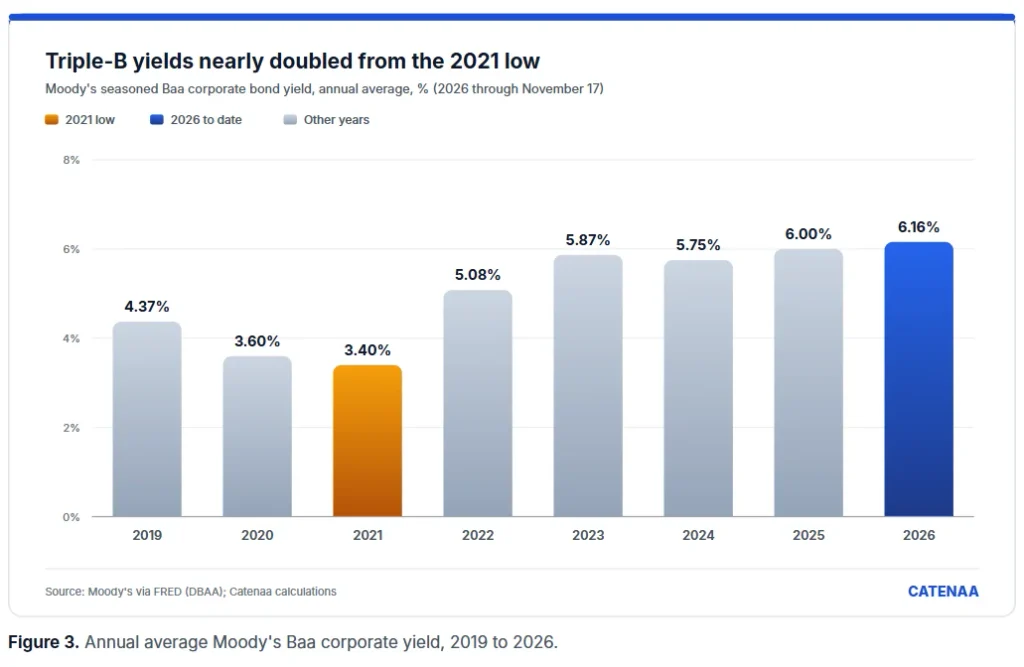
Still, one-year changes understate the hit for older debt. Moody’s seasoned Baa yield averaged 3.40% in 2021, but it stood at 6.63% on November 17. So a triple-B issuer rolling a 2021 bond today pays about 323 basis points more. On $1 billion, that adds roughly $32.3 million a year. As a result, the true refinancing shock for older debt is about three times the one-year change.
Coverage ratios show where it bites
Interest coverage measures earnings before interest and taxes against interest costs. The Fed reported that coverage for non-investment-grade public firms remained weak by historical standards. In contrast, investment-grade firms kept robust coverage.
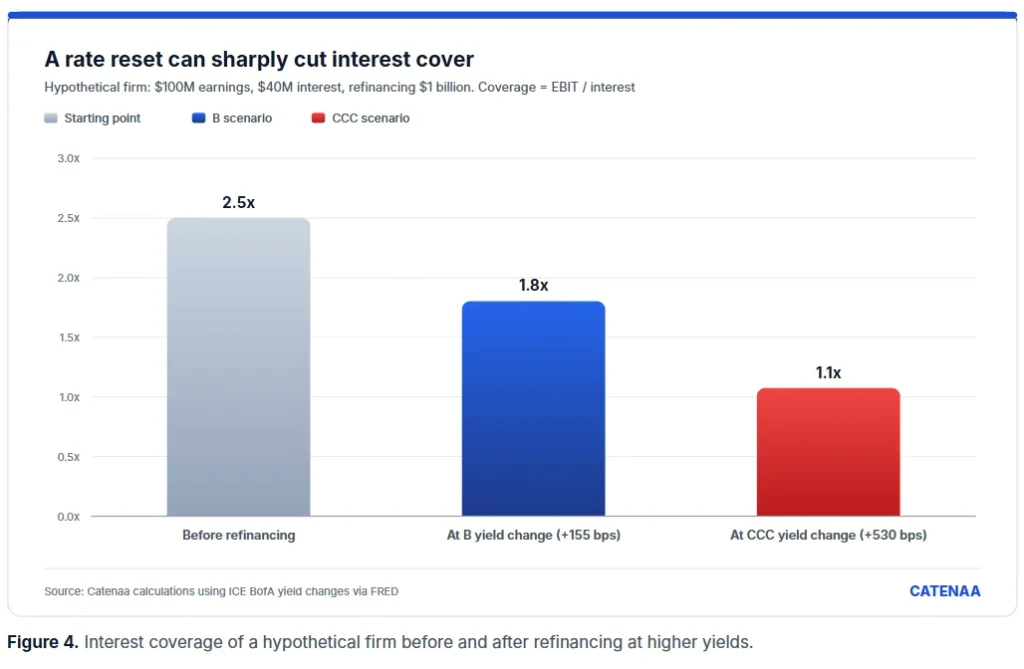
Consider a hypothetical B-rated firm with $100 million in operating earnings and $40 million in interest. Its coverage ratio is 2.5 times. If it refinances $1 billion at 155 basis points more, coverage falls to about 1.8 times. Thus a modest rate move can push a weak borrower close to the point where earnings barely cover interest.
How large is the exposure
The Fed’s data put investment-grade corporate bonds at $8.6 trillion in the second quarter. Furthermore, that stock grew 7.8% in the year to June. High-yield and unrated bonds totalled $1.7 trillion. Leveraged loans added $1.6 trillion, and private credit reached $1.5 trillion. Much of that riskier debt floats, so higher rates pass through quickly.
What to watch
Overall, spreads remain the swing factor. If they widen from today’s low levels, weaker borrowers would face a double hit. Meanwhile, the Fed held its policy range at 3.75% to 4% in October, so floating-rate costs stay high for now. Therefore, watch CCC yields and coverage ratios for early signs of stress.