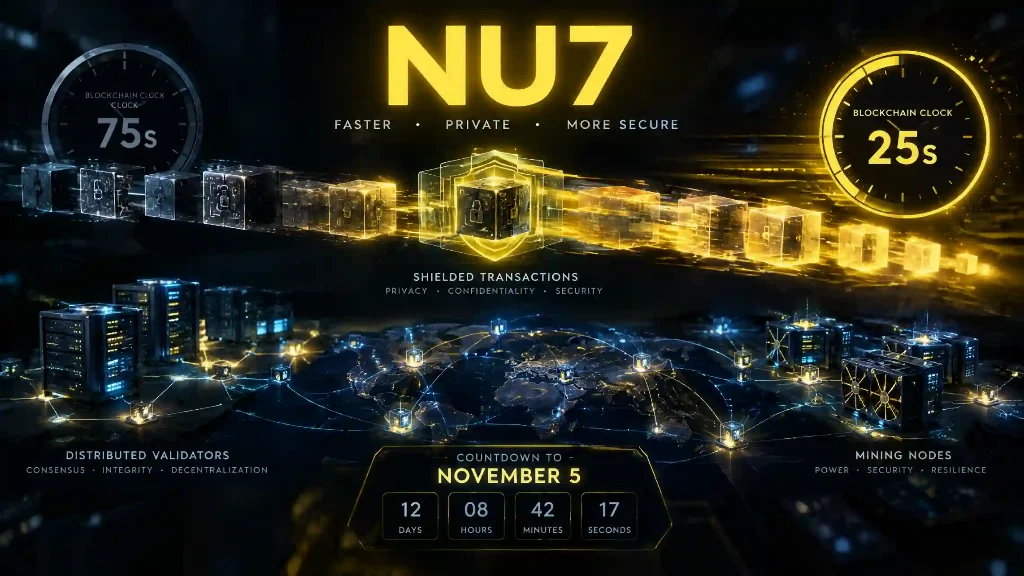


Catenaa, Monday, September 28, 2026-Zcash developers are targeting November 5 for the NU7 network upgrade, which would reduce the blockchain’s target block spacing from 75 seconds to 25 seconds and significantly shorten transaction confirmation times.
The upgrade is scheduled to reach the Zcash testnet on October 6 before developers make a final decision on mainnet activation on October 20.
That final checkpoint will allow engineering teams to evaluate how NU7 performs under testnet conditions before committing to the November activation.
Code for the upgrade is expected to be completed by September 30.
The 25-second block target is defined in ZIP 218, a Zcash Improvement Proposal designed to reduce transaction latency while increasing the network’s processing capacity.
It would produce roughly three times as many blocks over the same period compared with the current 75-second target.
For users waiting for a transaction to receive its first confirmation, the expected average delay could therefore fall from about 75 seconds to 25 seconds.
The change is particularly aimed at situations where one or two confirmations are sufficient, including payments, exchange deposits and cross-chain transactions.
The proposal also increases the network’s available consensus bandwidth.
With blocks arriving three times more frequently, Zcash could process substantially more transaction activity without simply increasing the maximum size of each block.
ZIP 218 estimates that the change, combined with new limits on shielded transaction activity within individual blocks, could raise Orchard transaction throughput from about 2.9 transactions per second to roughly 6.6.
The faster schedule does not mean three times as much ZEC will be created.
Mining rewards per block will be adjusted downward to compensate for the increased number of blocks.
That is designed to keep overall ZEC issuance over time aligned with the existing monetary schedule.
Reducing block times also creates technical challenges.
Nodes must receive, validate and distribute blocks quickly enough to avoid excessive competing chains when miners produce blocks close together.
Shorter intervals leave less time for blocks to propagate across geographically distributed nodes before the next block is found.
Developers therefore tested the proposed configuration across distributed Zebra nodes before advancing the upgrade.
ZIP 218 cites testing involving 99 geographically distributed nodes running with the proposed 25-second target.
The experiment recorded stale-block and fork rates within levels developers considered acceptable for deployment.
NU7 will also modify Zcash’s difficulty-adjustment system to account for the faster block schedule.
The averaging window used by the proof-of-work difficulty algorithm is expected to increase substantially so that the network continues smoothing mining difficulty over a similar real-world period.
Without that adjustment, faster blocks could shorten the time window used by the algorithm and potentially make the network more sensitive to abrupt changes in hash rate.
The November upgrade will include more than faster blocks.
Zcash developers say NU7 is also expected to disable version 4 transactions and introduce changes to the network’s sustainability mechanism.
Those changes follow community discussions over how Zcash issuance and funding should evolve while preserving scheduled halvings.
Developers have said new transaction formats will not be introduced with NU7.
That means ordinary wallet users are not expected to face major changes to how they send and receive ZEC.
Full-node operators, indexers, block explorers and other infrastructure providers may require updates because they interact more directly with network consensus rules.
The November 5 date remains a target rather than an irreversible activation date.
The most important checkpoint comes October 20, when developers expect to decide the final mainnet activation height based on experience gathered after the October 6 testnet rollout.
Any serious problem discovered during testing could still result in a delay.
That staged approach is common for major blockchain consensus upgrades because problems are easier to address before activation than after thousands of nodes begin enforcing new rules.
NU7 represents one of the more significant changes to Zcash’s underlying network timing since the Blossom upgrade in December 2019.
Blossom reduced the target block time from 150 seconds to 75 seconds while adjusting block rewards to preserve the currency’s issuance schedule.
NU7 would repeat that approach on a larger scale by cutting the interval by another two-thirds.
Zcash launched in 2016 as a privacy-focused cryptocurrency using zero-knowledge cryptography to allow users to conduct shielded transactions.
Its Orchard and Sapling systems allow transaction information to be protected while still enabling the blockchain to verify that transfers are valid.
That privacy architecture also means network designers must consider the processing and synchronization demands placed on wallets handling shielded transaction data.
ZIP 218 therefore introduces limits on the number of actions certain shielded pools can place into individual blocks.
Developers say those limits are intended to keep worst-case wallet synchronization requirements manageable even as blocks become more frequent.
The proposal estimates that maximum daily shielded synchronization bandwidth for light clients could decline despite the threefold increase in block frequency.
If the November activation proceeds, the most visible difference for ordinary users should be speed.
Transactions will not become instantaneous, and applications can still require multiple confirmations depending on their own security policies.
However, each confirmation should arrive considerably sooner under normal network conditions.
For exchanges and payment applications, that could make Zcash more practical for transactions where users currently experience long waits relative to newer blockchains.
The upgrade will not alter Zcash’s fundamental privacy model or transform the network into a different consensus system.
It remains a proof-of-work blockchain.
Instead, NU7 changes how quickly that existing system advances.
The October testnet launch will now provide the first major real-world test of whether Zcash can sustain that faster rhythm before developers make their final call on November 5.