

November 22, 2026 – On-chain records show how one exposed key turned 5.2 million tokens into $13.51 million. Holders now rely on a promise.

In Summary
XMR1 fell from about $494 to $1 in 29 minutes on November 20, according to Hyperliquid fill data.
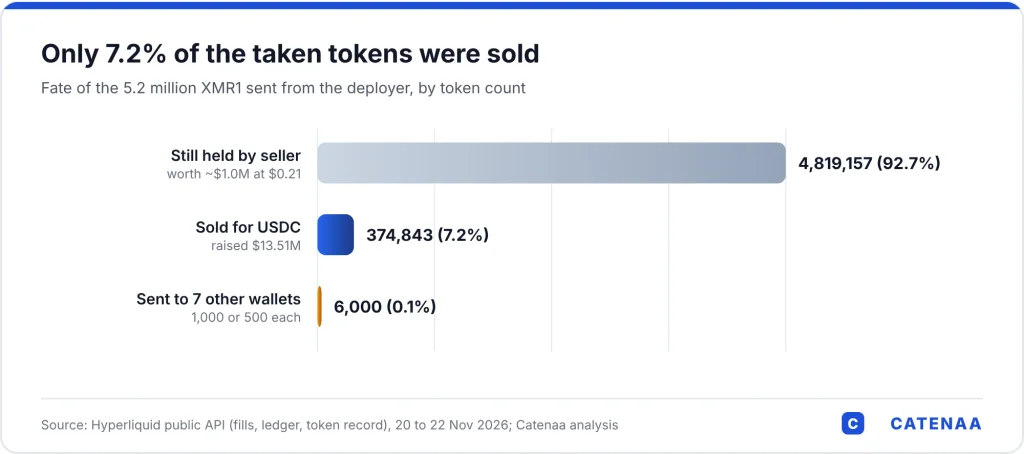
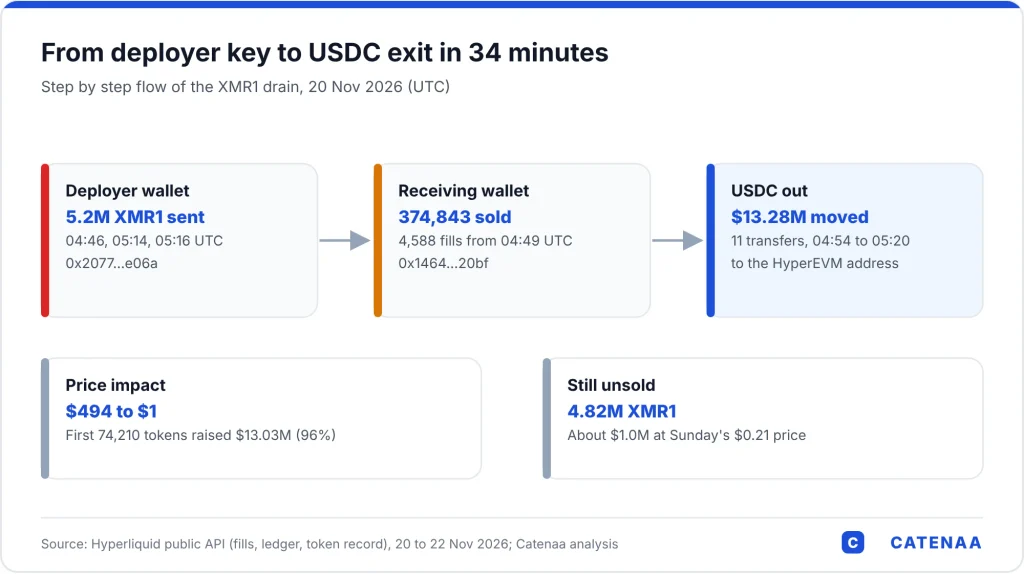
The receiving wallet sold 374,843 tokens for $13.51 million and still holds 4.82 million XMR1.
The first 74,210 tokens sold raised 96% of the cash, which shows how thin the order book was.
The attack did not touch the Monero blockchain. Wagyu’s bridge is offline and no refund schedule exists yet.
Wrapped Monero XMR1 lost more than 99.8% of its value on Friday, November 20. Swap service Wagyu issues the token on Hyperliquid as a stand-in for Monero. Importantly, the attack did not touch the Monero blockchain itself. Native XMR closed Friday at $455.28 on Kraken, down 8.5% on the day.
Before the attack, XMR1 tracked native Monero closely. On Thursday, it closed at $507, about 1.9% above Monero’s Kraken close of $497.56. That small premium showed that traders trusted the 1:1 redemption promise. By Sunday, the premium had turned into a discount of more than 99.9%.
How the wrapped Monero XMR1 drain unfolded
Public Hyperliquid ledger records show each step. At 04:46 UTC, the deployer address sent 100,000 XMR1 to a fresh wallet. That wallet had test-traded a fraction of a token about an hour earlier. Heavy selling then began at 04:49 UTC, with the first fills near $494. Next, at 05:14 and 05:16 UTC, the deployer sent a further 5.1 million tokens. By 05:18 UTC, the price had hit $1.
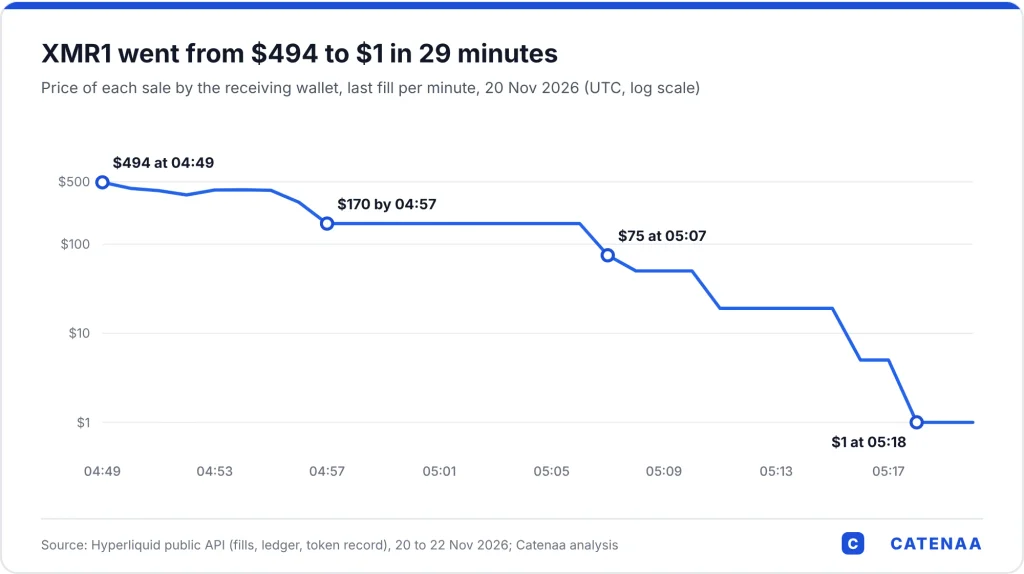
Figure 1. XMR1 sale prices by minute on 20 November 2026, 04:49 to 05:20 UTC.
Catenaa traced 4,588 sell fills from the receiving wallet. In total, it sold 374,843 XMR1 for $13.51 million in USDC. That works out to an average of $36.05 per token. Strikingly, the first 74,210 tokens raised $13.03 million, or 96% of the cash. After that, few real bids remained. Meanwhile, the wallet sent $13.28 million of USDC to the HyperEVM transfer address within 26 minutes.
Notional value versus real loss
Headline figures can overstate the damage. At Thursday’s close of $507, the 5.2 million tokens carried a notional value of $2.64 billion. Yet thin liquidity capped the real cash out at 0.51% of that figure. Moreover, the wallet still holds 4.82 million XMR1. At Sunday’s price of $0.21, that balance is worth about $1 million.
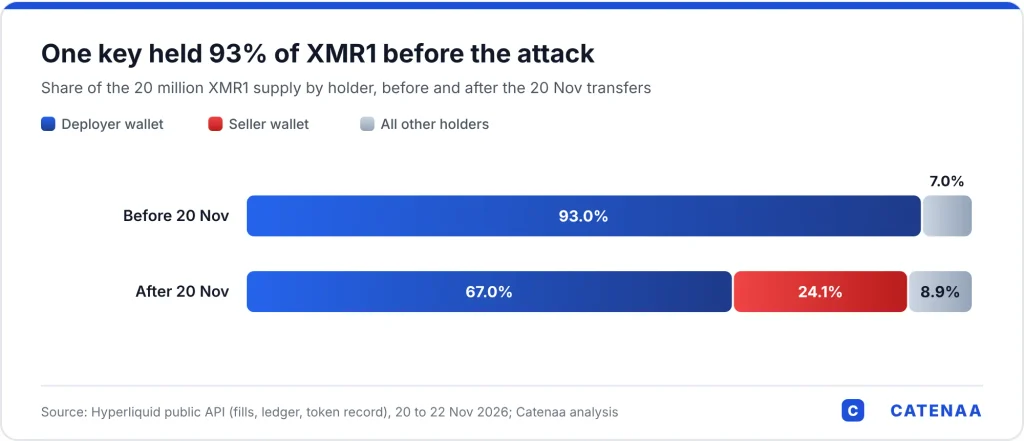
The token’s design concentrated the risk. According to Hyperliquid’s token record, all 20 million XMR1 went to the deployer at launch in December 2025. Before Friday, that address still held about 18.6 million tokens, or 93% of supply. Consequently, one key controlled nearly every token not yet in users’ hands.
Redemption rights and the refund pledge
Wagyu’s bridge page says holders can redeem each XMR1 for native XMR at 1:1, minus a withdrawal fee. That right only holds if Monero reserves cover every token in users’ hands. However, public data cannot confirm those reserves, because Monero hides balances by design. For now, the Wagyu site says the service is temporarily unavailable.
In a post on X, founder PerpetualCow blamed a breach at Icelandic host 1984.hosting. He said a deployment key on a server he had deleted remained reachable. The founder also pledged to refund affected users personally. Catenaa could not verify that key path, and Wagyu has not published a refund schedule.
Separately, the host and national response team CERT-IS issued a joint statement on November 20. It described a serious, sophisticated attack and a temporary halt to all services. Notably, the statement did not name Wagyu or any other client.
What holders should watch next
Three questions now decide what XMR1 is worth. First, will Wagyu publish proof of its Monero reserves? Second, will the 4.82 million tokens in the seller’s wallet reach the market? Finally, who pays if reserves fall short? Until Wagyu answers, XMR1 trades as a claim on a promise rather than on Monero.