

October 03, 2026 – Tether’s stablecoin left Bitcoin for faster chains. A new protocol and a Tether-backed startup now aim to bring it home.

In Summary
Utexo expects to start issuing USDT on Bitcoin through the RGB protocol this month.
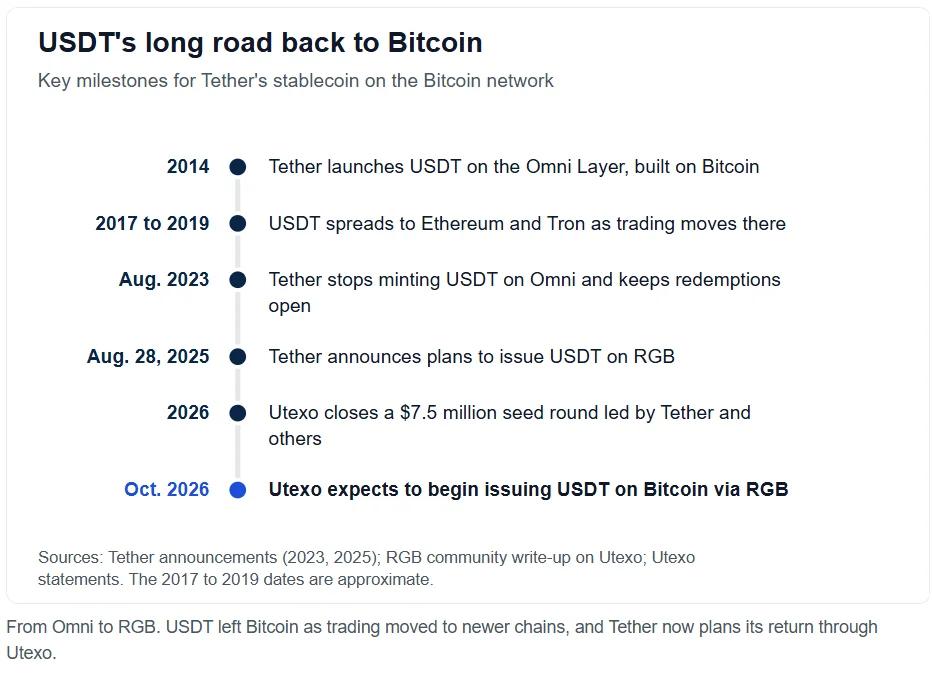
Tether first issued USDT on Bitcoin’s Omni Layer in 2014 and stopped minting there in 2023.
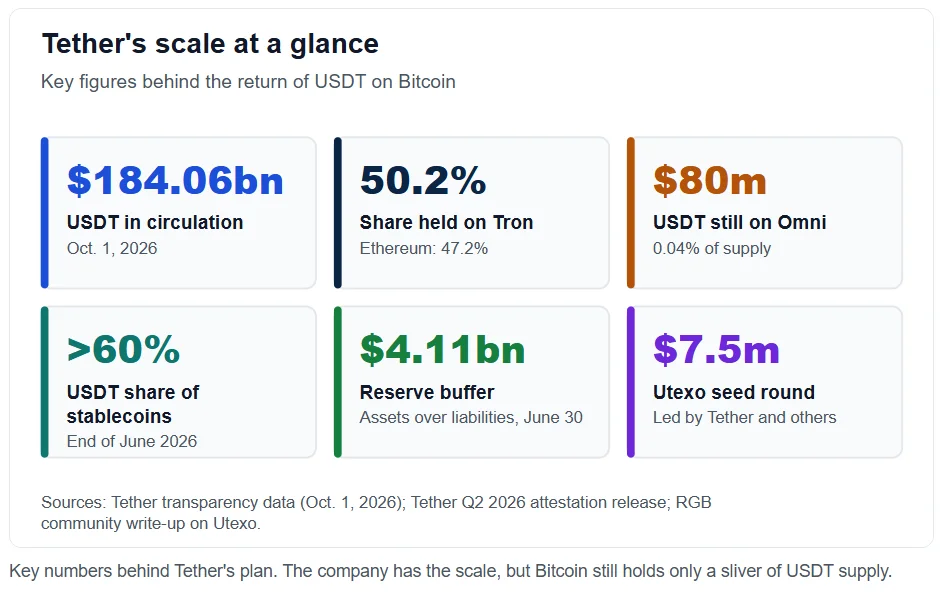
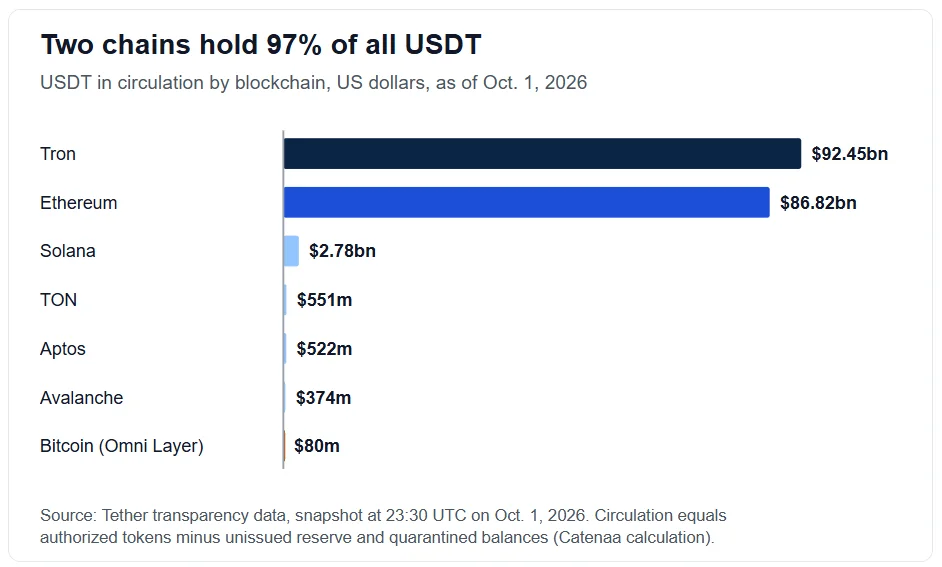
Tron and Ethereum now hold 97.4% of the $184.06 billion of USDT in circulation.
RGB keeps transfer data off-chain, and Utexo plans to add Lightning support later.
USDT on Bitcoin could return this month, 12 years after Tether first issued its stablecoin on the network. Utexo, a Tether-backed startup with a commercial license to issue USDT on Bitcoin, will handle the launch through RGB. In late September, co-founder Viktor Ihnatiuk said the token would be “live on Bitcoin next month.” The move would bring the world’s largest stablecoin back to where it began.
The timing carries symbolic weight. Tether first launched USDT in 2014 on the Omni Layer, which runs on top of Bitcoin. In August 2023, however, Tether stopped minting on Omni as activity moved to other chains. It kept redemptions open for at least 12 months after the halt. Today, only about $80 million of USDT remains there, according to Tether’s transparency data.
Why USDT on Bitcoin faded
Tether’s own explanation was blunt. The company said Omni “faced challenges” as exchanges favored other transport layers. As a result, Ethereum and Tron absorbed nearly all of the supply. Together, those two chains now hold about 97.4% of the $184.06 billion of USDT in circulation.
Tron leads with roughly $92.5 billion, or 50.2% of the total. Ethereum follows with about $86.8 billion. Solana sits a distant third at $2.8 billion. By contrast, the legacy share of USDT on Bitcoin is a rounding error at 0.04%.
How RGB changes the model
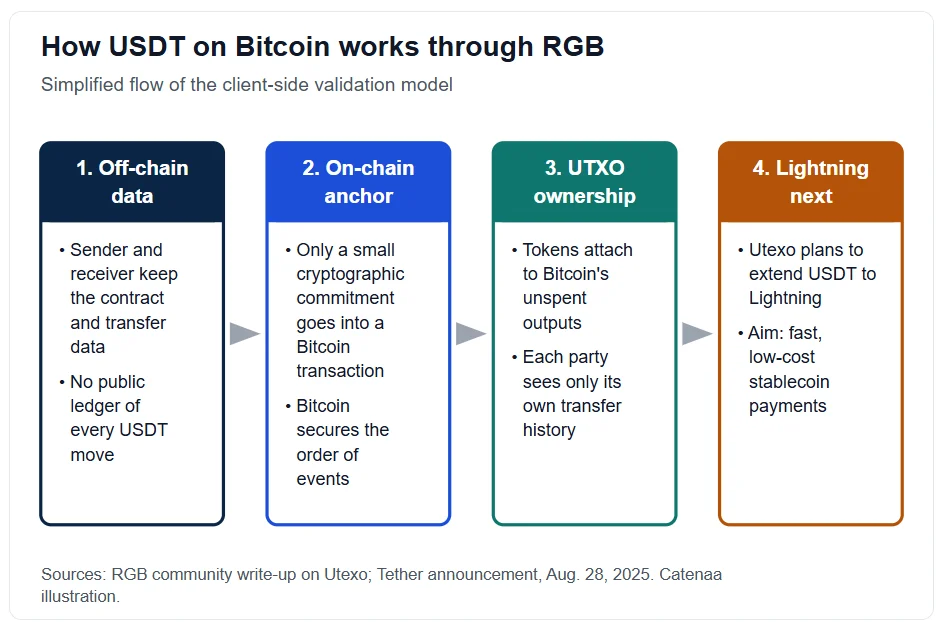
RGB takes a different route from smart contract chains. Under its client-side validation design, contract and transaction data never touch the Bitcoin blockchain directly. Only a small cryptographic commitment goes on-chain. Each party therefore sees only the history tied to its own transfer, not every other holder’s.
Supporters say that design fixes the problems that once drove the token away. Ihnatiuk made that case at a Lightning summit in May, arguing that RGB and Lightning together solve them. In practice, most activity never hits the main chain, which keeps fees and data loads low.
The approach also differs from wrapped tokens. Holders would own USDT issued natively on Bitcoin, not a bridged copy from another chain. That removes a bridge from the chain of trust. Even so, every holder would still rely on Tether’s reserves.
Tether first announced the plan in August 2025, soon after RGB reached mainnet with its 0.11.1 release. “Bitcoin deserves a stablecoin that feels truly native, lightweight, private, and scalable,” CEO Paolo Ardoino said at the time. Tether also said users could hold USDT and bitcoin in the same wallet. It added that people could even send and receive value offline.
Utexo takes the lead role
Utexo will handle the rollout. The startup closed a $7.5 million seed round led by Tether, Big Brain Holdings and Portal Ventures. Franklin Templeton, Maven 11 and Fulgur Ventures also took part. Rather than build a consumer app, the firm sells to wallets, exchanges and custodians.
Utexo has outlined three early uses: private transfers, direct swaps between bitcoin and USDT, and lending. Later, Utexo plans to extend USDT on Bitcoin to the Lightning Network for faster payments.
Compliance will also work differently. On Ethereum, Tether can freeze tokens held at a given address. With RGB, by contrast, Utexo cannot freeze UTXOs directly, Ihnatiuk said. Instead, it plans to share a blacklist of tainted outputs with exchanges and service providers. Those outputs would then become unredeemable.
What the return means for Tether
The scale behind the project is large. Tether’s second-quarter attestation showed about $184.6 billion of USDT issued at the end of June. That gave the token over 60% of the stablecoin market. Moreover, reserves exceeded liabilities by about $4.11 billion, and quarterly net operating profit reached about $1.50 billion.
Growth, however, has slowed. Issuance rose by only about $446 million in the second quarter, even as the wider stablecoin market shrank. A native home for USDT on Bitcoin could open a new pool of demand among long-term Bitcoin holders. Those users have so far had little reason to touch Tron or Ethereum.
Still, success is far from certain. Tron and Ethereum benefit from deep liquidity, mature apps, and years of exchange support. Wallets and exchanges will need to add RGB support before most users notice any change. Even then, traders tend to stay where liquidity already sits.
If adoption does follow, the payoff could be meaningful. Bitcoin holders could move dollars without leaving the network they trust most. For Tether, that would close a loop that opened on Omni in 2014.