

Uniswap Labs has proposed activating protocol fees on Circle’s Arc blockchain and feeding the revenue into its expanding UNI burn system.
Catenaa, Monday, September 28, 2026- Uniswap Labs has proposed activating protocol fees across Uniswap v2, v3 and v4 on Circle’s newly launched Arc blockchain, extending fee collection and UNI token burns to another network.
The proposal entered a five-day governance temperature check on September 18 and remains open through September 23.
It has not yet been approved or executed.
If the preliminary Snapshot vote succeeds, Uniswap governance will move to an on-chain vote before any Arc protocol fees are activated.
Arc launched its public mainnet on September 16, two days before the proposal was published.
Uniswap v2, v3, v4 and UniswapX were available on the network from launch.
Circle developed Arc as a Layer 1 blockchain aimed particularly at financial markets, payments and programmable financial applications.
The network launched with more than 100 institutional and ecosystem builders and a validator group that includes major financial and payment companies.
Uniswap’s proposal would bring Arc into a protocol-fee system already operating across Ethereum and 11 additional chains.
Those networks include Arbitrum, Base, OP Mainnet, World Chain, X Layer, Soneium, Zora, Celo, BNB Chain, Polygon and Robinhood Chain.
Protocol fees allow a portion of trading fees generated through Uniswap pools to be directed toward the protocol rather than entirely to liquidity providers.
Uniswap’s newer system links those accumulated fees to UNI destruction.
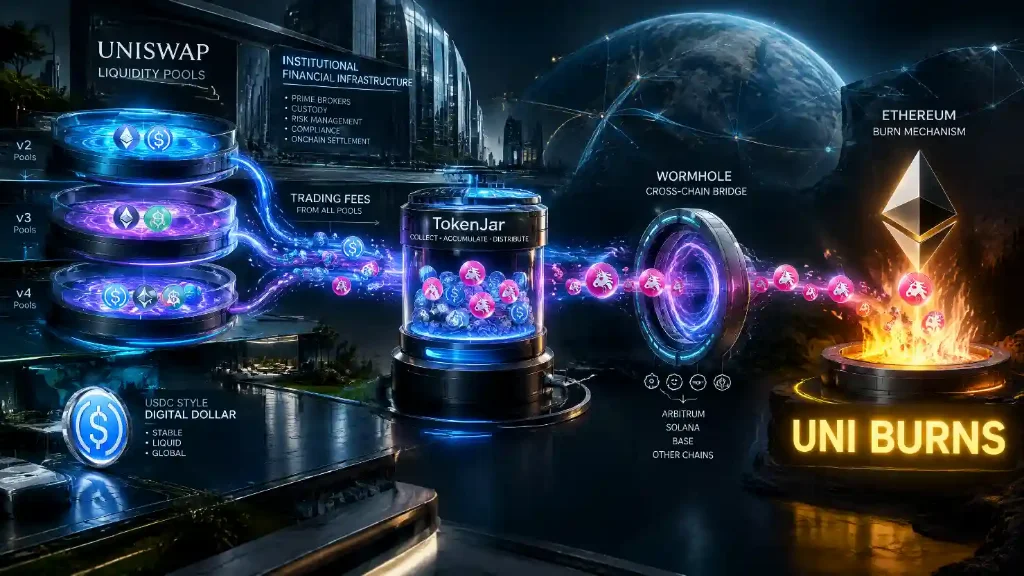
Under the Arc proposal, fees generated by v2, v3 and v4 pools would accumulate in TokenJar smart contracts.
Independent searchers would then be able to claim the assets inside those contracts by providing UNI.
That UNI ultimately gets removed from circulation through Uniswap’s burn infrastructure.
The mechanism creates a connection between trading activity on Uniswap and the circulating supply of its governance token.
Arc introduces an additional complication because the canonical UNI token exists on Ethereum.
UNI used on Arc is therefore represented through Wormhole’s Native Token Transfer system.
Under that system, canonical UNI can be locked on Ethereum while a corresponding synthetic version is created on Arc.
When a searcher uses synthetic UNI on Arc to obtain accumulated protocol fees, the Arc-side UNI is burned.
A Wormhole message then travels back to Ethereum, where the corresponding canonical UNI is sent to the burn address.
The architecture is not entirely new.
Uniswap already uses the same basic Wormhole-based burn route on Polygon and BNB Chain.
That gives governance an operating model to extend rather than requiring an entirely new cross-chain fee system for Arc.
Governance instructions would also originate on Ethereum.
Uniswap’s Ethereum timelock would send instructions through a Wormhole message sender, with a corresponding receiver on Arc executing approved governance actions.
That structure allows UNI governance to retain control of protocol fee settings even though trading takes place on another blockchain.
The proposal covers v2, v3 and v4 fee collection.
UniswapX is already deployed on Arc but is not included in the protocol-fee activation described in the temperature check.
The v2 factory, v3 factory and v4 PoolManager contracts are already deployed on Arc.
Some of the specific fee infrastructure contracts, however, were still listed as pending when Uniswap Labs published the proposal.
These include the TokenJar, v3 and v4 fee adapters, the v4 fee policy and parts of the Wormhole release infrastructure.
Uniswap Labs said those addresses would be added before the final on-chain vote.
That makes the current Snapshot primarily a decision on whether governance wants to expand the fee system to Arc.
The executable proposal will contain the completed contract configuration needed to implement it.
Uniswap’s protocol-fee rollout has accelerated since fees were first activated on Ethereum mainnet in late December 2025.
Rather than treating fee activation as a single network-wide decision, governance has gradually extended the system to additional chains.
The process was streamlined under Uniswap’s UNIfication governance changes.
Fee-parameter proposals can bypass the longer request-for-comment stage and proceed directly to a five-day Snapshot vote followed by an on-chain governance proposal.
The Arc proposal uses that expedited route.
If approved, it would signal that new Uniswap deployments can increasingly be brought into the fee-and-burn system soon after their host networks launch.
Arc presents an unusual case because Circle has positioned the network primarily around financial institutions and stablecoin-based economic activity rather than general-purpose crypto speculation.
USDC is deeply integrated into Arc’s architecture, while Circle has promoted the network for real-time money movement, tokenized assets and AI-driven financial transactions.
Uniswap’s presence from the first day of public mainnet gives the decentralized exchange an early position in any liquidity that develops around those activities.
Protocol fees would allow the Uniswap system to capture part of that trading activity if Arc develops meaningful volume.
The proposal does not guarantee that Arc itself will generate large fee revenue.
The blockchain is less than a week into its public mainnet operation, making future trading volume difficult to establish.
The economic impact on UNI will depend on several factors, including Uniswap trading activity, the amount of protocol fees collected and the amount of UNI required by searchers to release those fees.
Token burning permanently reduces supply but does not guarantee an increase in UNI’s market price.
Price remains dependent on broader supply, demand and cryptocurrency market conditions.
The governance proposal is therefore more significant as part of Uniswap’s evolving economic structure than as evidence of immediate revenue from Arc.
For years, one of the central debates surrounding Uniswap was whether trading activity should directly create economic value for the protocol and UNI holders.
The expanding fee system increasingly answers that question through token burns.
Instead of distributing protocol revenue directly to UNI holders, accumulated fees create demand for UNI from parties competing to claim those assets.
The UNI used in that process is then removed from circulation.
Arc would become the latest blockchain connected to that mechanism.
The immediate decision remains with UNI governance.
The Snapshot temperature check closes September 23.
A successful preliminary vote would not turn fees on automatically.
An on-chain proposal would still have to pass and execute before the v2, v3 and v4 deployments on Arc begin collecting protocol fees.
Until then, Arc remains a proposed expansion of Uniswap’s fee-and-burn network rather than an active part of it.