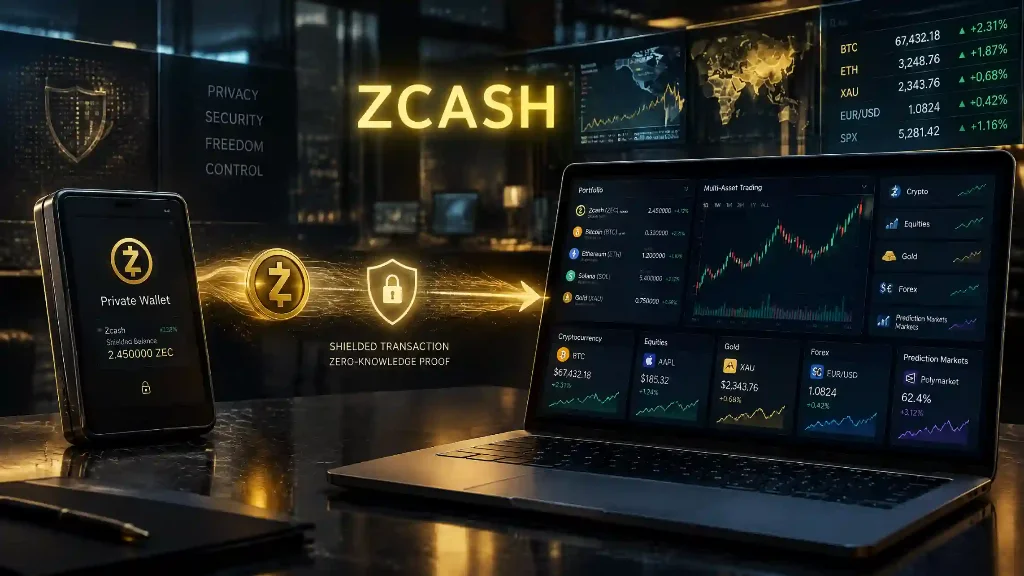


Catenaa, Saturday, September 26, 2026- TrueCurrent has added Zcash to its on-ramping system, allowing ZEC holders to access crypto and markets tied to equities, gold, foreign exchange and predictions from a self-custodial balance.
The New York-based decentralized trading platform said the integration went live September 21 and allows retail users to trade without commissions.
TrueCurrent said Zcash is the first of several additional assets it plans to support through the same on-ramping model.
The integration targets a long-standing problem for holders of privacy-focused cryptocurrencies.
Users who keep ZEC in self-custody have often had to transfer assets to a centralized exchange before converting them into another cryptocurrency or gaining access to other markets.
That process temporarily moves control of the assets to an intermediary.
TrueCurrent said its system removes that step by allowing ZEC to enter its trading environment while maintaining a self-custodial structure.
The platform operates through a single balance from which users can access different markets.
TrueCurrent currently advertises cryptocurrency markets alongside products linked to equities, commodities, foreign exchange and prediction markets.
The company said a ZEC holder can move from on-ramping to trading within about a minute.
That speed claim comes from TrueCurrent and was not accompanied by independent performance data in the announcement.
The addition is notable because Zcash was designed around financial privacy rather than the fully transparent transaction model used by Bitcoin and many other blockchains.
Zcash supports shielded transactions that use zero-knowledge cryptography to conceal information that would otherwise appear publicly on a blockchain.
Users can also make transparent transactions, meaning the privacy level depends on the address and transaction type being used.
The distinction becomes important when ZEC moves between wallets, exchanges and trading platforms.
Centralized exchanges generally take custody of deposited cryptocurrency and associate accounts with customer records.
A self-custodial system instead allows users to retain control of the keys governing their assets while interacting with trading infrastructure.
TrueCurrent is positioning the Zcash integration around that difference.
The company said privacy-focused assets should not require users to surrender custody simply to access other markets.
TrueCurrent itself operates as a decentralized trading platform built around blockchain settlement and self-custodial accounts.
Its broader offering includes Bitcoin, Ethereum, Solana and other cryptocurrencies, along with markets tracking traditional financial assets.
The platform also advertises market and trading tools aimed at users accustomed to conventional exchanges.
Its mobile application describes trading as commission-free and says network costs are subsidized by the platform.
Commission-free trading does not necessarily mean trading is without cost.
Users can still face spreads, price movements, funding costs or other expenses depending on the market and type of position involved.
TrueCurrent’s Zcash announcement did not detail spreads or other costs specifically associated with converting or deploying ZEC through the new on-ramp.
It also did not disclose trading volume expected from Zcash users or the amount of ZEC already moved through the system.
The launch nevertheless expands the number of ways Zcash holders can move from a privacy-focused cryptocurrency into a broader trading environment.
That could become more relevant as self-custody services try to offer functionality traditionally associated with centralized exchanges.
The competition is increasingly moving beyond basic cryptocurrency swaps.
Decentralized platforms are adding markets linked to equities, foreign exchange, commodities and real-world events while trying to preserve blockchain-based settlement and user control of funds.
For privacy assets such as Zcash, that model addresses a particular tension.
The cryptocurrency was created to give users the option of keeping financial activity private, yet moving those assets into broader markets has often required using custodial services.
TrueCurrent is betting that ZEC holders will value a route that keeps self-custody at the center of the trading process.
Zcash is only the first test of that strategy.
If TrueCurrent follows through on plans to add more assets through the same system, the ZEC integration could become part of a wider effort to connect self-custodied crypto holdings directly with multi-asset trading markets.