

November 24, 2026 – Sharplink spent $10 million to retire 2.06 million shares at about 0.70 times their ether backing. The trade is accretive, but cash limits its scale.

In Summary
Sharplink repurchased 2,060,801 shares on November 19 and 20 at a weighted average of $4.8525, about $10.0 million.
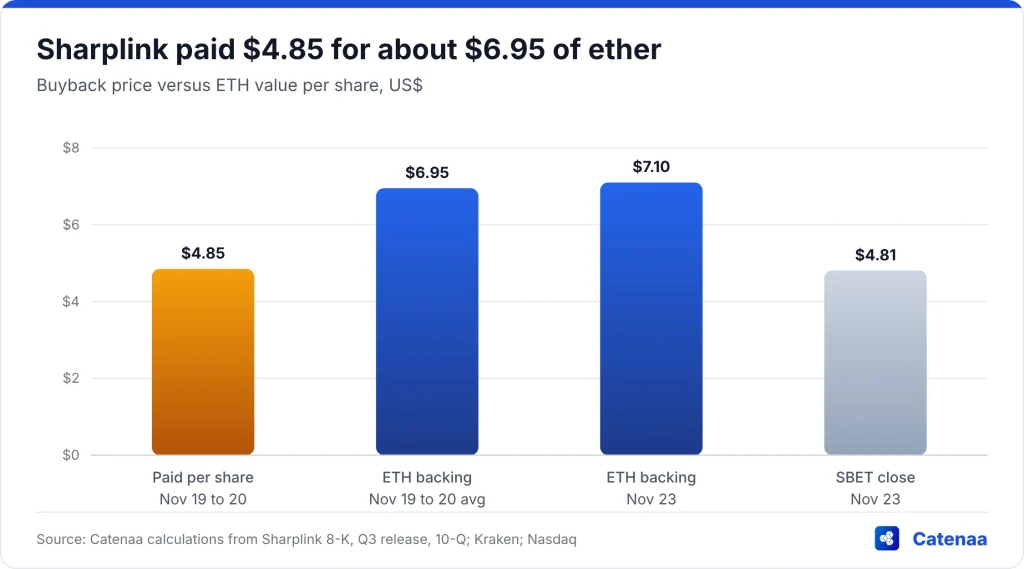
With 895,117 ETH, each share carried about $6.95 of ether on the buyback days, so the company paid roughly 0.70x.
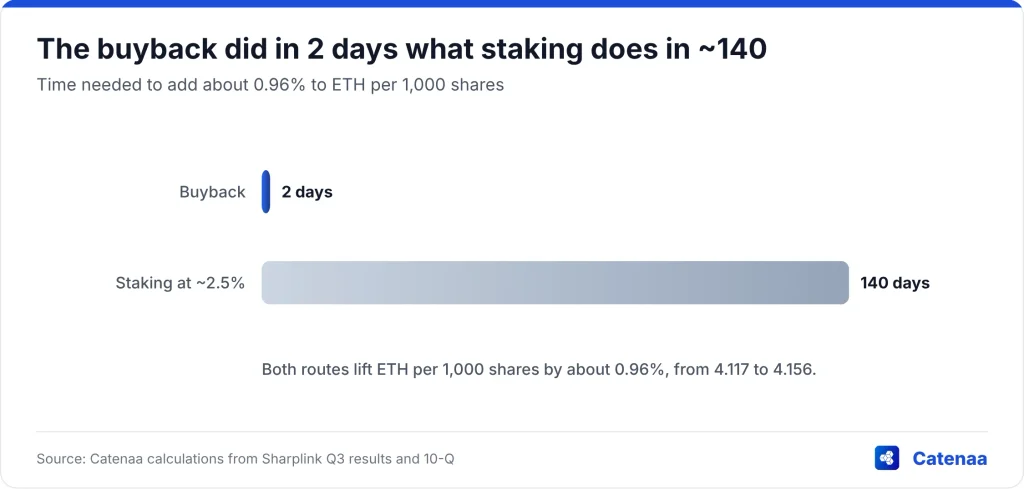
The buyback lifted ETH per 1,000 shares by about 0.96%, a gain staking would need around 4.6 months to match.
Cash of $47.9 million at September 30 limits scale; larger buybacks would likely require selling ETH.
The Sharplink buyback adds a new lever to the company’s ether treasury. In a November 23 SEC filing, Sharplink said it repurchased 2,060,801 shares on November 19 and 20. The weighted average price was $4.8525, for a total of about $10.0 million.
In the press release attached to that filing, Chief Executive Joseph Chalom said he believes the market undervalues the stock. He also tied the move to the goal of raising ETH per share. However, a buyback alone does not prove that view. So the numbers below put it to the test.
How Deep Is the Discount?
Sharplink held 895,117 ETH as of November 2, according to its third-quarter results release. Its 10-Q lists 217,346,200 common shares as of November 3. It also shows 80,000 pre-funded warrants at September 30. Together, that equals about 4.117 ETH per 1,000 shares before the buyback.
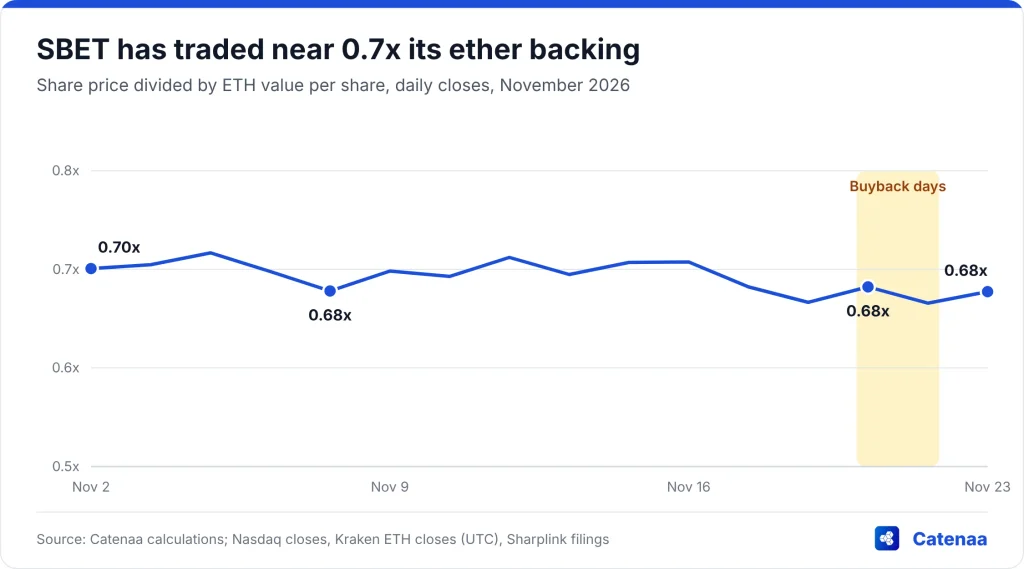
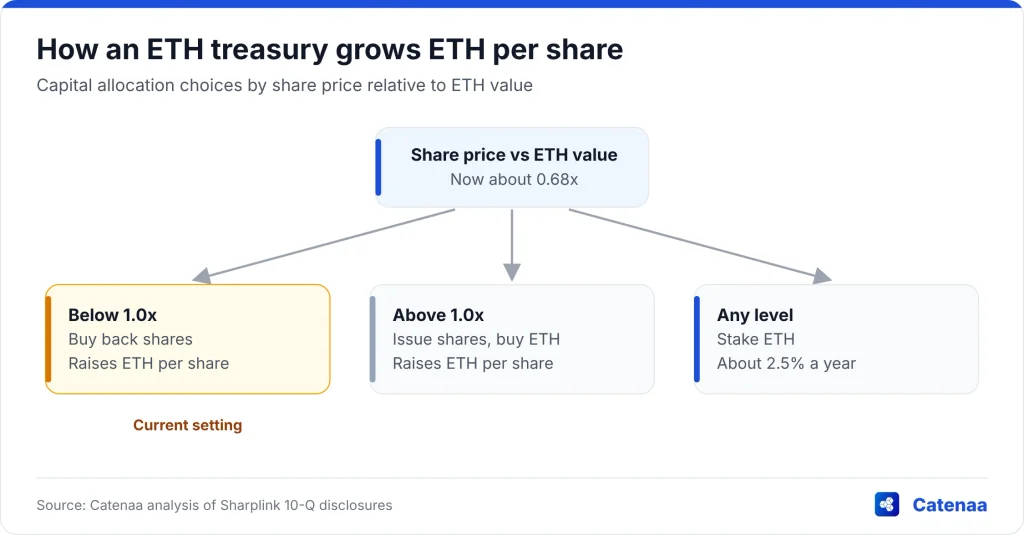
Ether closed at $1,708.64 on November 23, based on Kraken daily prices. At that price, each share now carries about $7.10 of ETH. Meanwhile, SBET closed at $4.81, according to Nasdaq data. So the stock trades near 0.68 times its ETH value, a discount of about 32%. Ether fell about 24% between November 2 and 23, yet that ratio held between 0.67 and 0.72. At ether prices on November 19 and 20, the ETH backing was about $6.95 per share. Thus, the company paid roughly 0.70 times that value.
What the Sharplink Buyback Bought
Retiring 2.06 million shares lifts ETH per 1,000 shares to about 4.156. That is a gain of roughly 0.96%, by Catenaa’s estimate. In effect, Sharplink paid $4.85 for a claim on close to $7 of ether.
By comparison, staking moves more slowly. Third-quarter staking revenue reached $13.1 million, up 27% from a year earlier. Annualized, that equals about 2.5% of the $2.1 billion in crypto assets reported at September 30. At that pace, staking would need around four to five months to add the same 1% per share.
The Limits of the Trade
Even so, cash is finite. Sharplink reported $47.9 million in cash at September 30. The $10 million buyback equals about one fifth of that balance. Furthermore, third-quarter SG&A of $11.0 million nearly matched staking revenue. Unrealized gains drove third-quarter net income of $751.4 million, so earnings say little about cash. As a result, day-to-day operations leave little spare cash for larger buybacks.
The 10-Q also shows this is not the first buyback of 2026. Earlier in the year, Sharplink bought 2,132,773 shares for $10.0 million. About $1.46 billion of its $1.5 billion authorization remained at September 30. The program has no expiry date and does not oblige further purchases.
Two risks stand out. First, the discount can widen if ether or investor demand falls. Second, bigger buybacks would likely require selling ETH. That step would shrink the stack that earns staking income.
What to Watch Next
The math favours buybacks while the discount stays near 30%. If the shares recover toward ETH value, that edge fades quickly. Conversely, a wider gap would make each dollar of repurchases more accretive.
Notably, the 10-Q warns that ETH per share ignores liabilities, expenses and potential dilution. Investors should track three figures in future filings. These are ETH per 1,000 shares, the price-to-ETH ratio and cash on hand. Together, they will show whether repurchases keep adding value or simply shrink the treasury. For now, the Sharplink buyback looks accretive on paper, but its scale remains small against an 895,117 ETH stack.