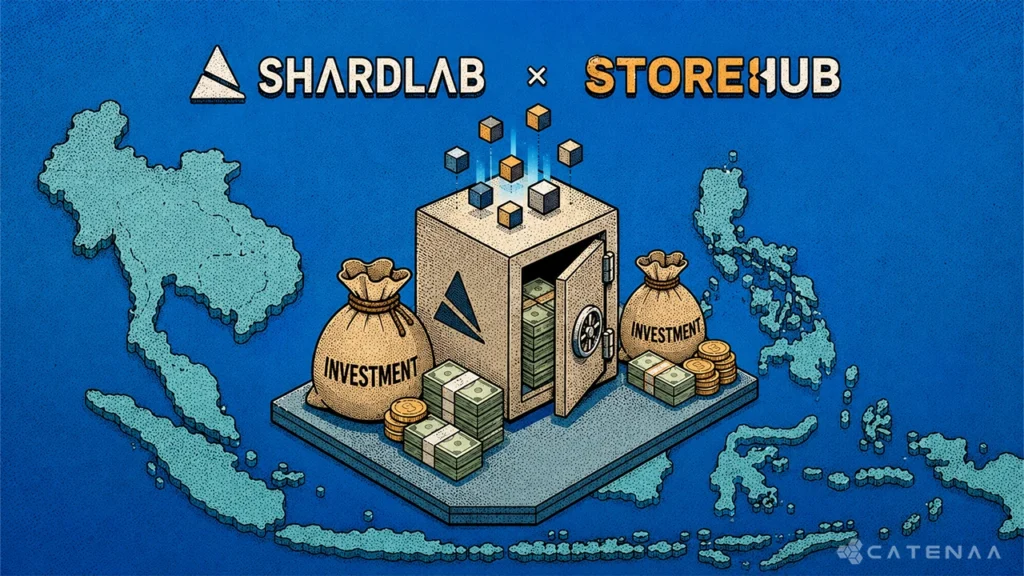


Catenaa, Tuesday, September 01, 2026- ShardLab has invested in Southeast Asian commerce platform StoreHub and agreed to form a joint venture to develop new payment and consumer rewards products across the region.
The companies did not disclose the size of the investment or financial terms of the joint venture.
StoreHub operates payment, point-of-sale, loyalty and ordering systems across Malaysia, the Philippines, Thailand and Japan.
The Kuala Lumpur-based company said its network serves more than 20,000 merchant locations and processes over 200 million transactions annually, representing about $3.5 billion in yearly transaction value.
Those figures were supplied in the companies’ Chainwire announcement and were not independently verified.
The partnership gives ShardLab access to an existing network of merchants rather than limiting new financial technology products to experimental pilots.
ShardLab said the joint venture will examine payment and rewards models that can be tested with consumers and businesses already using StoreHub’s infrastructure.
Specific products have not yet been announced.
The companies said new services will be disclosed as they are developed and launched.
That distinction is important because the partnership remains an infrastructure and product-development initiative rather than the launch of a new cryptocurrency payment service.
StoreHub CEO Wai Hong Fong said any products developed through the partnership would be judged primarily on whether they help merchants increase sales.
ShardLab CEO Hojin Kim said StoreHub’s merchant network provides a route to move technologies previously tested in smaller environments into commercial use.
ShardLab is the innovation arm of Asian Web3 investment firm Hashed.
It was established through a strategic partnership between Hashed and SCBX, the parent group of Thailand’s Siam Commercial Bank.
ShardLab works on products involving financial services and emerging technologies, including blockchain-based payment and reward systems.
The StoreHub investment connects that development work to a large point-of-sale and merchant network.
Hashed, meanwhile, invests across blockchain, artificial intelligence and digital technology companies.
Its involvement gives the partnership a connection to both Web3 venture capital and established Asian financial institutions.
Southeast Asia has become an active testing ground for new payment systems.
The region combines high mobile-phone usage with rapidly expanding digital commerce and large populations that have historically had uneven access to conventional banking services.
Digital wallets, QR payments and financial technology applications have gained widespread adoption across several markets.
That makes merchant infrastructure increasingly valuable.
A new payment technology may work technically, but adoption depends on whether businesses can use it without creating additional complexity at checkout.
StoreHub already operates inside the systems merchants use for payments, ordering and loyalty.
The joint venture could allow ShardLab to test new technologies without requiring retailers to replace their existing operating systems.
Consumer rewards are another focus of the partnership.
Traditional loyalty programs often operate separately across individual merchants, airlines, banks and payment companies.
Blockchain and other programmable technologies have created opportunities to make rewards more transferable or usable across different services.
However, many Web3 loyalty projects have struggled to move beyond small pilot programs because they lack large numbers of participating merchants.
StoreHub’s network could provide the partnership with a broader environment for testing whether new reward structures offer practical benefits to businesses and consumers.
The companies have not said whether any future reward product will involve cryptocurrencies, blockchain tokens or conventional loyalty points.
That leaves the final technical model open.
StoreHub was founded as a commerce technology company serving small and midsize retailers and food and beverage businesses.
Its systems combine point-of-sale functions with payments, customer loyalty, online ordering and business-management tools.
That makes the company more than a payment processor.
Its technology sits at the point where merchants manage transactions and customer relationships.
For ShardLab, access to that layer could be particularly useful when developing financial products intended to operate invisibly behind existing merchant systems.
The strategy resembles a wider trend in digital finance.
Blockchain companies increasingly seek to integrate their technology into payment infrastructure consumers and merchants already use rather than requiring them to adopt entirely new systems.
StoreHub is also increasing its use of artificial intelligence within its business-management products.
Fong said the company is rebuilding parts of its platform around AI to help smaller businesses operate with capabilities normally associated with much larger teams.
The AI effort is separate from the joint venture’s payment and rewards work but illustrates StoreHub’s broader push toward automated commerce infrastructure.
For smaller retailers, tools that combine payments, ordering, customer management and automated business functions can reduce the number of separate technology providers they need.
The partnership with ShardLab could add another financial technology layer to that model.
The companies said they intend to test products with real merchants before expanding those that demonstrate commercial value.
That could help distinguish the project from blockchain initiatives built around technology before establishing a clear customer use case.
Merchant adoption will ultimately depend on practical factors such as transaction costs, settlement speed, ease of integration and whether rewards increase customer retention or spending.
Consumers are likely to care less about which technology operates underneath the product than whether it makes payments or rewards easier to use.
That creates a straightforward test for the joint venture.
New technology will need to outperform or complement payment and loyalty systems merchants already have.
StoreHub’s presence across several Asian markets also gives the partnership a potential route for expansion if early products succeed.
Malaysia, Thailand and the Philippines have different banking systems, payment regulations and consumer habits.
Japan adds another market with a highly developed payments sector.
A product that can operate across those environments could demonstrate whether newer financial infrastructure can scale beyond a single national market.
For ShardLab, the investment therefore provides more than access to StoreHub itself.
It offers a commercial testing network across several distinct Asian economies.
For StoreHub, the partnership brings access to ShardLab and Hashed’s work in blockchain, digital payments and emerging financial technologies.
The companies have yet to reveal what they will build.
But the structure of the partnership shows where much of the next phase of digital finance may be heading: away from isolated experiments and toward technology embedded directly into the systems merchants already use every day.