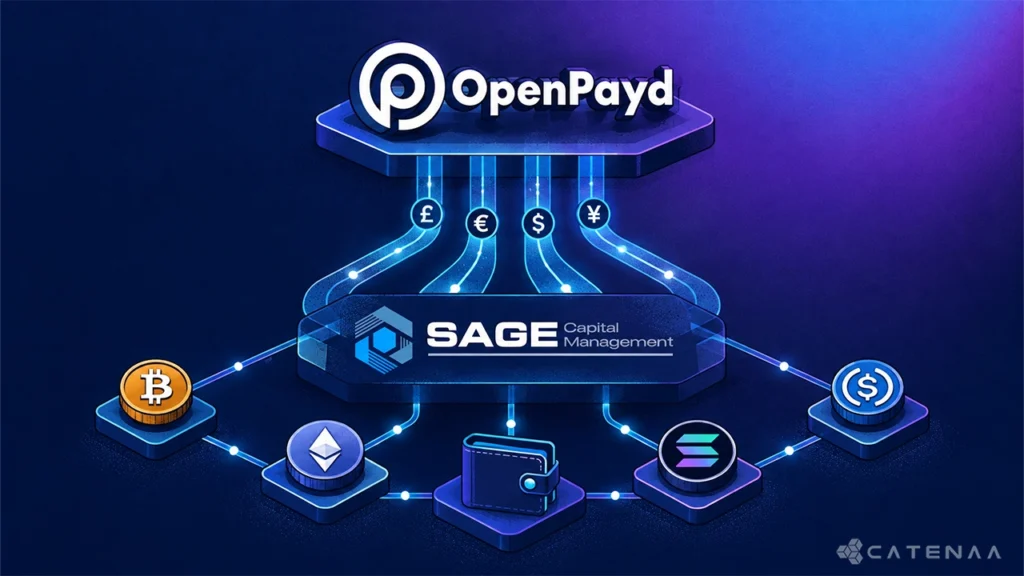


Catenaa, Monday, September 14, 2026-Sage Capital Management has selected OpenPayd to expand fiat payment and settlement access for institutional digital-asset clients, adding U.S. dollar, euro and British pound capabilities across several banking networks.
The integration is already live and gives Sage Capital clients access to U.S. dollar payments through SWIFT, euro transfers through SEPA and British pound payments through Faster Payments and SWIFT.
OpenPayd will also allow Sage Capital to issue virtual International Bank Account Numbers, or vIBANs, for individual clients.
Those accounts can help institutions identify incoming and outgoing payments and reconcile transfers more precisely.
The arrangement targets hedge funds, asset managers, trading firms, brokers, corporate treasuries and digital-asset treasury companies using Sage Capital’s infrastructure.
Sage Capital said the additional payment routes will give those clients more flexibility when funding trading activity or settling transactions with liquidity providers.
The development addresses one of the persistent operational challenges facing institutional digital-asset businesses: moving money efficiently between traditional banking systems and crypto markets.
Institutions often need to send fiat currency to trading venues or liquidity providers before acquiring digital assets, then move proceeds back into conventional accounts.
Sage Capital’s integration with OpenPayd adds several routes for those transfers rather than depending on a single currency or payment system.
For U.S. dollar transactions, Sage Capital now has an account with SWIFT connectivity that can be used for fiat on-ramping and off-ramping.
Euro payments can move through SEPA, while British pound transfers can use Faster Payments or SWIFT.
The company said those rails can support both client collections and settlements with liquidity providers.
OpenPayd Chief Commercial Officer Lux Thiagarajah said institutional digital-asset trading depends on reliable movement of fiat funds on both sides of transactions.
He said access to multiple payment networks can give institutions more choice in how they enter digital-asset markets and settle with counterparties.
Sage Capital Chief Executive Nathan Sage said the OpenPayd partnership strengthens the company’s existing banking infrastructure while expanding access to global payment networks.
He said the firm wants clients to move between fiat currencies and digital assets while also managing payments and foreign exchange from the same operating environment.
No financial terms for the agreement were disclosed.
The integration builds on Sage Capital’s banking offering launched earlier this year.
That service gave institutional clients named multicurrency accounts held in their own legal entity, according to the company.
Sage Capital also offers physical and virtual corporate debit cards connected to those accounts.
The company is attempting to bring banking, liquidity access, collateralized lending and technology into a single institutional platform.
The OpenPayd integration extends the banking side of that model by adding more payment routes and client-specific account infrastructure.
Virtual IBANs could be particularly useful for firms handling large numbers of transfers because each client can be assigned a distinct account identifier.
That structure can make reconciliation easier by reducing the need to manually determine which customer or transaction an incoming payment belongs to.
For institutional trading firms, payment speed can also affect the ability to respond to market movements.
Delays in moving fiat funds may prevent a trader from deploying capital quickly or meeting settlement obligations with a counterparty.
Multiple payment routes can reduce dependence on one network, particularly when different currencies or banking regions are involved.
The partnership also reflects the growing overlap between traditional payment infrastructure and digital-asset markets.
Crypto firms initially relied heavily on specialist banking relationships and individual exchange accounts to move fiat currency.
Infrastructure companies are increasingly offering APIs that connect account services, foreign exchange and domestic or international payment networks with digital-asset platforms.
OpenPayd positions itself in that market as financial infrastructure connecting traditional currencies and digital assets.
Its services include embedded accounts, foreign exchange, domestic and international payments, open banking and stablecoin on- and off-ramps.
The company says its customers include eToro, Kraken, OKX and B2C2.
OpenPayd also says it processes more than $300 billion in annual payment volume for more than 1,200 businesses.
Sage Capital has operated since 2015 and focuses on financial infrastructure for professional digital-asset firms.
Its model combines banking access, trading connectivity, lending and technology through a single platform.
The OpenPayd agreement extends that structure further into traditional payments at a time when institutional crypto firms are placing greater emphasis on settlement speed and access to multiple fiat currencies.
The use of SWIFT, SEPA and Faster Payments also gives Sage Capital clients access to payment networks commonly used by institutional counterparties outside crypto markets.
That may allow firms to manage fiat settlements without creating separate workflows for each currency corridor.
For digital-asset treasury companies, such infrastructure can also support movements between corporate cash accounts, trading counterparties and crypto holdings.
The same applies to hedge funds and market makers that may need to shift funds frequently between exchanges, brokers and liquidity providers.
Sage Capital’s latest integration therefore centers less on direct cryptocurrency trading and more on the infrastructure required before and after a trade.
As institutional participation in digital assets expands, fiat settlement remains one of the areas where crypto-native systems still depend heavily on traditional financial networks.
OpenPayd’s addition gives Sage Capital another layer connecting those two systems.