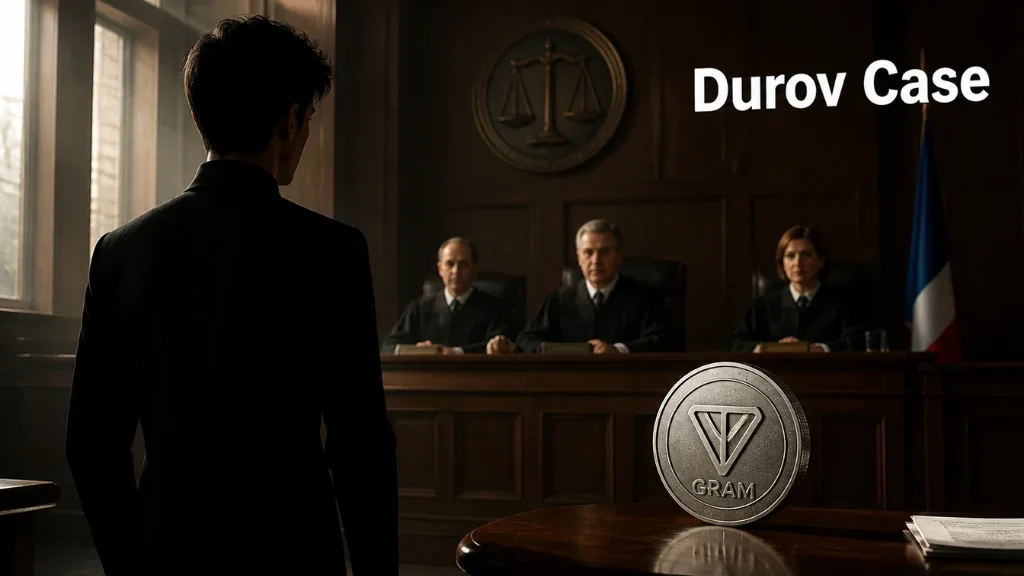


Catenaa, Thursday, August 06, 2026- Fresh terrorism-related charges brought by Russian authorities against Telegram founder Pavel Durov have renewed legal and regulatory uncertainty surrounding the Telegram ecosystem, placing renewed pressure on the GRAM cryptocurrency as investors reassess founder-related risks.
Russia’s Federal Security Service (FSB) has accused Durov of facilitating terrorist activities by allegedly failing to remove content that authorities claim was used by extremist organizations and Ukrainian intelligence services. Russian authorities have also reportedly placed Durov on an international wanted list.
The allegations mark a notable escalation from previous legal actions involving Telegram, shifting attention from content moderation disputes toward national security accusations.
GRAM declined following reports of the charges, although the market reaction remained considerably smaller than the sharp selloff that followed Durov’s arrest by French authorities in 2024.
Analysts suggest investors may already have incorporated a degree of founder-related legal risk into the token’s valuation after multiple investigations involving Telegram over the past two years.
Nevertheless, the latest developments reinforce concerns that legal proceedings involving high-profile founders can materially affect digital asset ecosystems closely associated with their leadership.
Beyond immediate price movements, the case raises broader questions for cryptocurrency exchanges, payment providers and financial institutions operating under anti-money laundering and counter-terrorist financing regulations.
If additional jurisdictions respond to Russia’s allegations, regulated service providers could face increased compliance scrutiny when supporting assets linked to the Telegram ecosystem.
Such uncertainty often weighs more heavily on institutional participation than on retail trading activity.
Telegram has evolved far beyond a messaging application into one of the largest digital ecosystems supporting blockchain applications, digital payments and decentralized services.
Its blockchain initiatives have attracted developers, investors and payment providers seeking to leverage the platform’s extensive global user base.
That growing integration means legal challenges involving Telegram’s leadership increasingly carry implications for associated digital assets and infrastructure projects.
The case also highlights the growing intersection between geopolitics and cryptocurrency markets.
As blockchain platforms become more integrated into global communications and financial systems, legal actions involving their founders increasingly influence investor sentiment alongside traditional market fundamentals.
Market participants will likely monitor whether additional governments or regulators take action in response to the Russian allegations.
While GRAM’s immediate decline has been relatively modest, the renewed legal pressure on Pavel Durov introduces another layer of uncertainty for the Telegram-linked ecosystem.
Whether the episode develops into a broader regulatory challenge will depend on international legal responses, exchange compliance decisions and Telegram’s ability to maintain confidence among users and institutional partners.
Pavel Durov founded Telegram after leaving Russia and has become one of the technology industry’s most prominent advocates of digital privacy and encrypted communications. Telegram has grown into one of the world’s largest messaging platforms while simultaneously expanding into blockchain infrastructure and digital asset services. The GRAM token is closely associated with that broader ecosystem, making developments involving Telegram’s founder closely watched by cryptocurrency markets.