


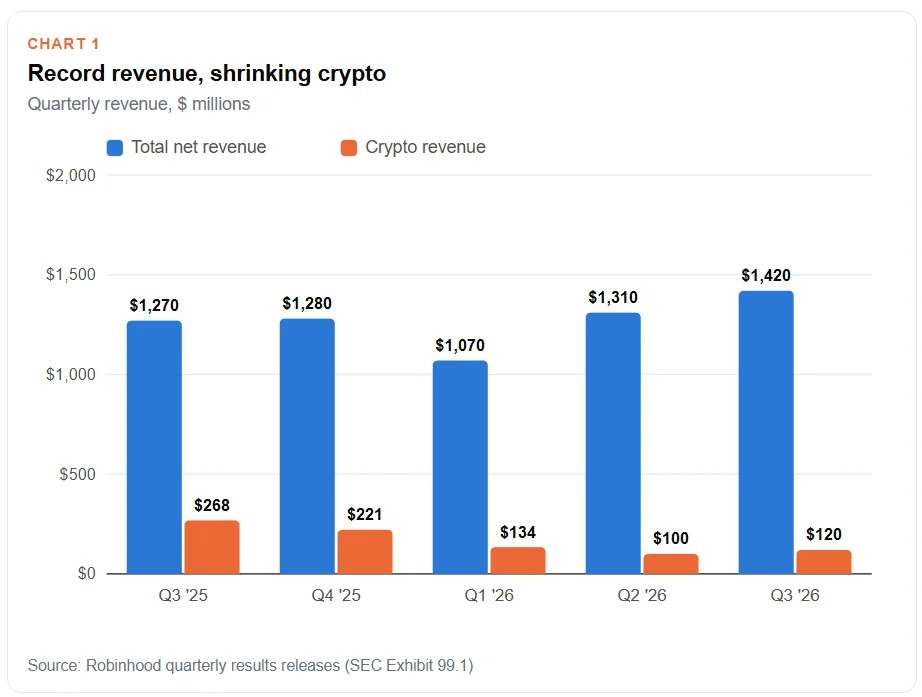
October 31, 2026 – Robinhood posted record third-quarter revenue of $1.42 billion. Crypto, once its growth engine, shrank to less than a tenth of sales. The stock fell 3.3% the next day.

In Summary
Robinhood crypto revenue dropped 55% year over year to $120 million in the third quarter.
Total net revenue still rose 12% to a record $1.42 billion, led by options and prediction markets.
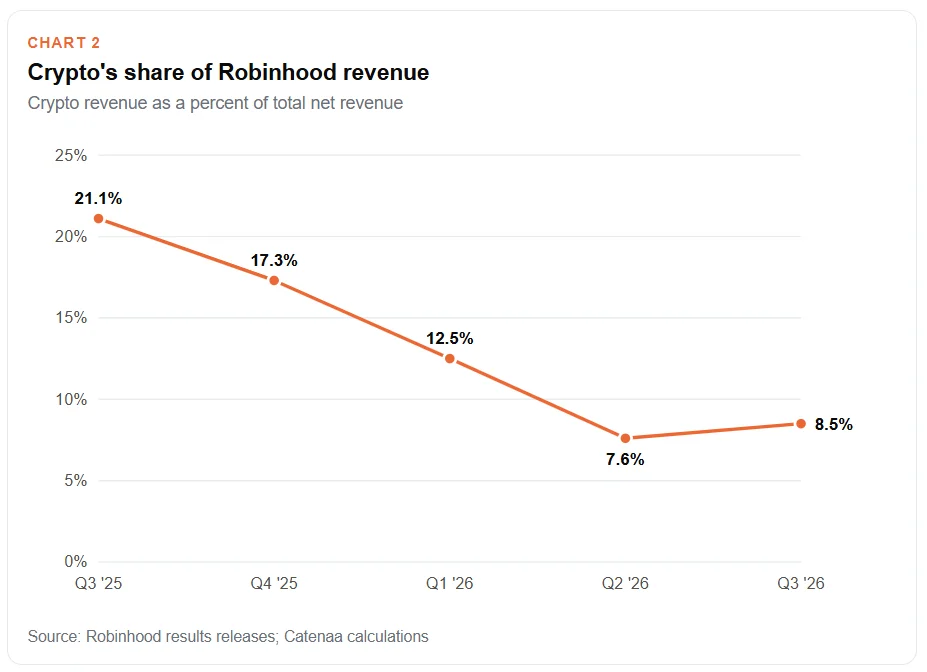
Crypto’s share of revenue fell to about 8.5%, from roughly 21% a year earlier (Catenaa calculation).
Shares closed at $91.43 on Oct. 28, down 3.3%, as EPS fell 16% to $0.51.
Robinhood crypto revenue sank in the third quarter, even as the broker set a new sales record. Crypto revenue fell 55% from a year earlier to $120 million, according to the company’s Q3 2026 results. Total net revenue, by contrast, rose 12% to $1.42 billion.
Investors focused on profit. Net income fell 14% to $476 million, and diluted earnings per share dropped 16% to $0.51. The results included $67 million of unrealized losses, mainly tied to its venture fund. Adjusted EPS, a new non-GAAP measure, fell 3% to $0.60.
On Oct. 28, the day after the release, HOOD shares closed at $91.43, down 3.3%. The stock now trades about 39% below its 52-week high of $150.47.
Why Robinhood crypto revenue shrank
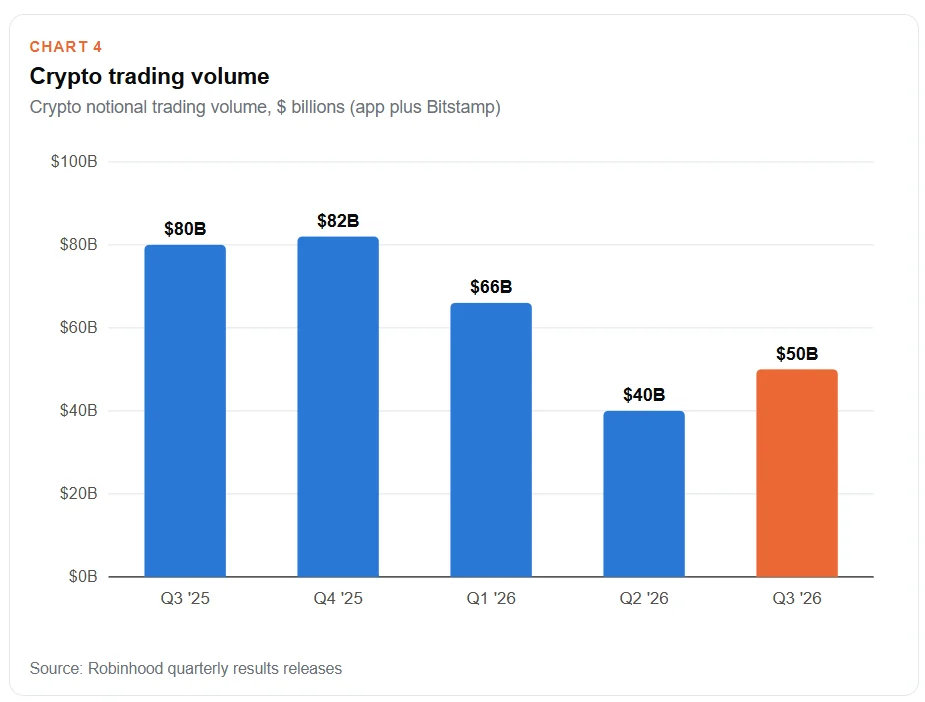
Trading activity explains most of the decline. Crypto notional volume fell 38% year over year to $50 billion. Within that, volume on the Robinhood app dropped 48% to $21 billion. Bitstamp volume fell 28% to $29 billion.
Prices played a role too. Bitcoin closed near $81,287 on Oct. 28, based on Kraken data. That is about 35% below its October 2025 peak of roughly $124,767.
However, the trend has started to turn. Bitcoin rose about 27% from late July to late October. Likewise, crypto revenue climbed 20% from the second quarter’s $100 million, per Robinhood’s Q2 2026 release.
Options and prediction markets fill the gap
Other business lines more than offset the crypto slump. Options revenue rose 31% to $399 million. Equities revenue jumped 41% to $121 million. Meanwhile, event contracts revenue grew more than sixfold to $173 million. Customers traded a record 16.4 billion event contracts, over seven times the year-ago level. Options contracts traded also hit a record 905 million.
Net interest revenue slipped 9% to $415 million, mostly because of lower securities lending and lower short-term rates. On the other hand, other revenues rose 61% to $142 million. Costs grew faster than sales, though. Total operating expenses rose 16% to $739 million, partly due to higher credit card loss provisions.
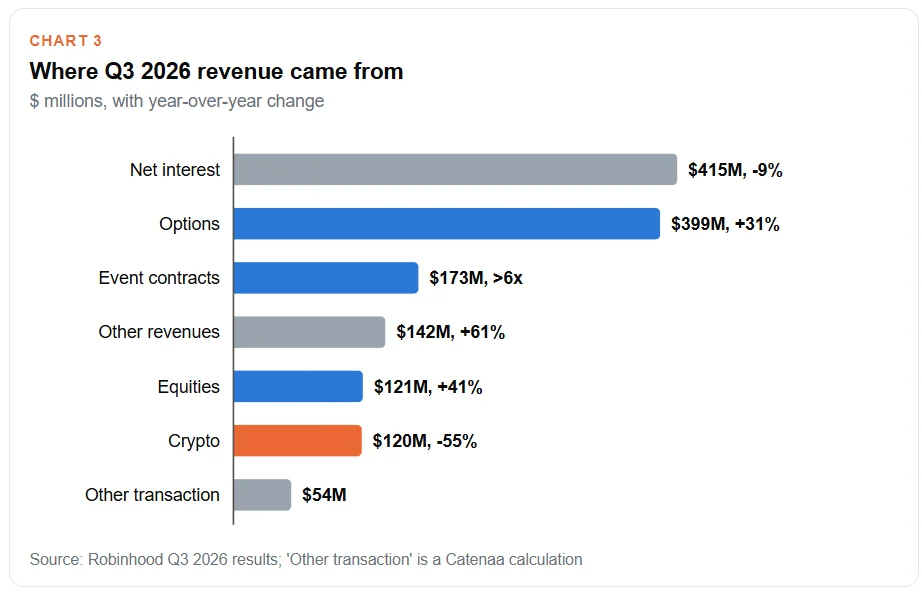
That shift changes Robinhood’s profile. In the third quarter of 2025, crypto brought in $268 million, or about 21% of revenue. Now it accounts for roughly 8.5%, based on Catenaa calculations.
Customers keep adding money
The platform itself keeps growing. Funded customers rose 7% to 28.7 million, and total platform assets climbed 19% to $396 billion. Net deposits reached $15.7 billion for the quarter, and average revenue per user rose 5% to $200.
Furthermore, Gold subscribers jumped 34% to a record 5.2 million. CFO Shiv Verma said October net deposits had already topped $13 billion month to date. That figure includes $6 billion from the Dell family’s contribution to Trump Accounts.
What it means for crypto traders
Robinhood still bets on crypto infrastructure. The company said Robinhood Chain generated over $80 billion in DEX volume in its first quarter on mainnet. It also launched crypto trading in the U.K. during the quarter.
For now, though, Robinhood crypto revenue depends on a market recovery. If bitcoin’s autumn rebound holds, the fourth quarter could look better. Follow more on Catenaa’s crypto markets desk.