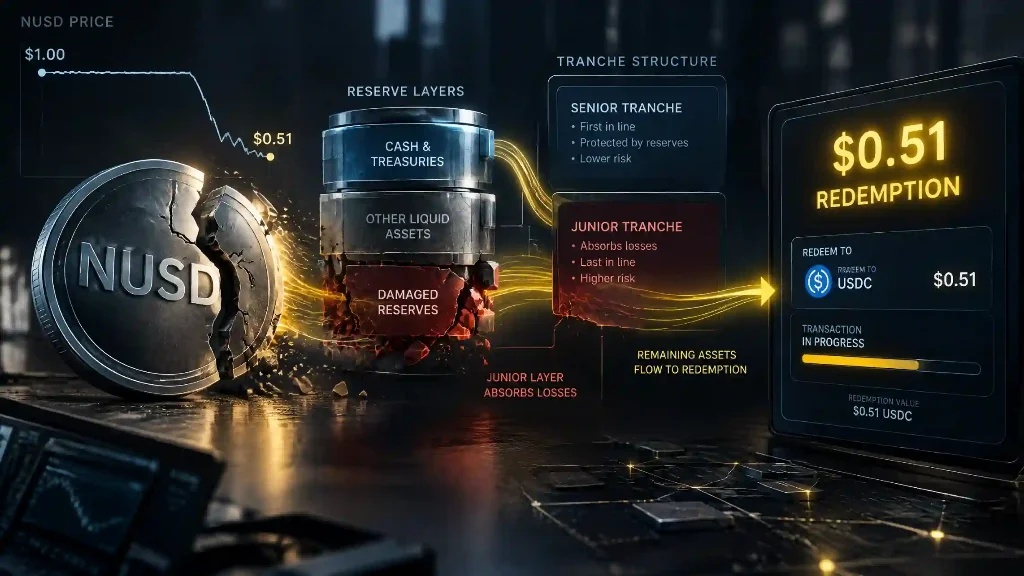


Catenaa, September 22, 2026 – Neutrl has opened an early redemption program for NUSD and sNUSD holders, allowing eligible users to recover USDC at an on-chain reference rate currently equivalent to about 51 cents per NUSD.
The redemption program follows a liquidity crisis that caused Neutrl to pause normal operations in August.
Neutrl said the redemption rate is fixed according to previously disclosed liquid reserves.
The protocol itself did not announce a 51% recovery figure.
Structured-yield protocol Strata subsequently examined the deployed redemption contract and reported that its `redemptionRate()` function returned a value equivalent to 0.51.
That makes the figure an observable on-chain redemption rate rather than a new $0.51 target price for NUSD.
NUSD was designed as a synthetic dollar intended to maintain value around $1.
A redemption at about $0.51 therefore represents a substantial loss for holders who acquired the token near its intended dollar value.
Neutrl also allows holders of sNUSD, its yield-bearing staked version, to submit redemption requests.
Users must connect the wallet holding their NUSD or sNUSD and sign an on-chain message proving control of the address.
The portal then shows the applicable redemption terms before a request is submitted.
Successful redemptions are paid in USDC.
The corresponding NUSD or sNUSD is burned, permanently removing the redeemed tokens from circulation.
Neutrl said the program is expected to remain available until November 14, although the timetable remains subject to its terms and conditions.
The operation is being conducted by Caverna Auctus Inc., the company behind Neutrl.
Neutrl said the redemption contract underwent a third-party security review but did not identify the auditor in its public September 17 announcement.
The crisis began in August when Neutrl suspended minting, redemptions and other protocol functions after identifying a problem involving one of its strategy positions.
The company described the issue as affecting the liquidity of part of its reserves rather than resulting from a smart-contract exploit or hack.
By August 28, Neutrl said it had approximately $27 million in readily available liquid assets.
Additional strategy positions remained illiquid.
At the time, the company said it could not determine when those positions would be recovered, how much could ultimately be recovered or their eventual recovery value.
That uncertainty is central to the current 51-cent redemption rate.
The program gives holders access to the liquid portion of the available assets rather than requiring them to wait indefinitely for the remaining positions to be unwound.
Neutrl has not said that accepting the current redemption represents the final economic recovery from all remaining assets.
Nor has it publicly guaranteed that holders who wait will eventually receive more.
The distinction makes the current program an early liquidity mechanism rather than restoration of NUSD’s original dollar redemption value.
The Neutrl problem has also affected products built on top of NUSD.
Strata operates a structured market based on sNUSD that divides exposure between senior and junior tranches.
The senior product is known as srNUSD, while jrNUSD provides the junior layer.
Under Strata’s structure, the junior tranche is designed to absorb losses before the senior tranche.
At an NUSD valuation of 0.51, Strata said the losses are large enough to write the jrNUSD tranche down to zero.
Remaining value is instead allocated toward the senior srNUSD tranche under the product’s loss waterfall.
That sequence is important.
The loss did not originate in Strata’s junior tranche.
Neutrl’s reserve and strategy problem reduced the value available behind NUSD, and Strata’s junior tranche subsequently absorbed that loss as its structure was designed to do.
Strata describes risk tranching as a system in which junior capital accepts greater downside exposure in return for potentially higher yields.
Senior investors receive priority protection while junior investors act as first-loss capital.
The Neutrl episode shows what that distinction means when an underlying asset suffers a severe impairment.
Tranching can redistribute losses among different investors.
It cannot eliminate losses in the underlying collateral.
The situation also highlights the difference between a stablecoin’s target value and the assets actually available for redemption.
A token may continue to reference $1 in its design while the amount recoverable from its reserves has fallen substantially below that figure.
For holders, redemption value becomes more important than the nominal peg once normal convertibility breaks down.
Neutrl’s model relied on market-neutral strategies including OTC arbitrage, basis trading and other yield-generating positions.
Such strategies are intended to generate returns while reducing directional exposure to cryptocurrency prices.
They can still carry counterparty, liquidity and execution risks.
A position that cannot be liquidated when redemptions arrive can create problems even if its eventual economic value has not fallen to zero.
That appears to be the central issue Neutrl has described so far.
The company has disclosed the amount immediately available but has not provided enough information to establish the final value of the remaining illiquid positions.
The current 0.51 contract rate should therefore not be read as proof that Neutrl’s entire remaining portfolio is worth exactly 51 cents on the dollar.
It represents the rate currently available through the redemption mechanism.
That rate could matter significantly for holders deciding between obtaining liquidity now and waiting for further information about Neutrl’s remaining assets.
Neither outcome is certain.
For now, however, the redemption contract has converted a month of uncertainty into a measurable number.
NUSD holders who use the program can recover roughly half of the token’s original dollar reference value in USDC.
The remaining question is whether further recovery from Neutrl’s illiquid positions will eventually produce additional value, and for whom.