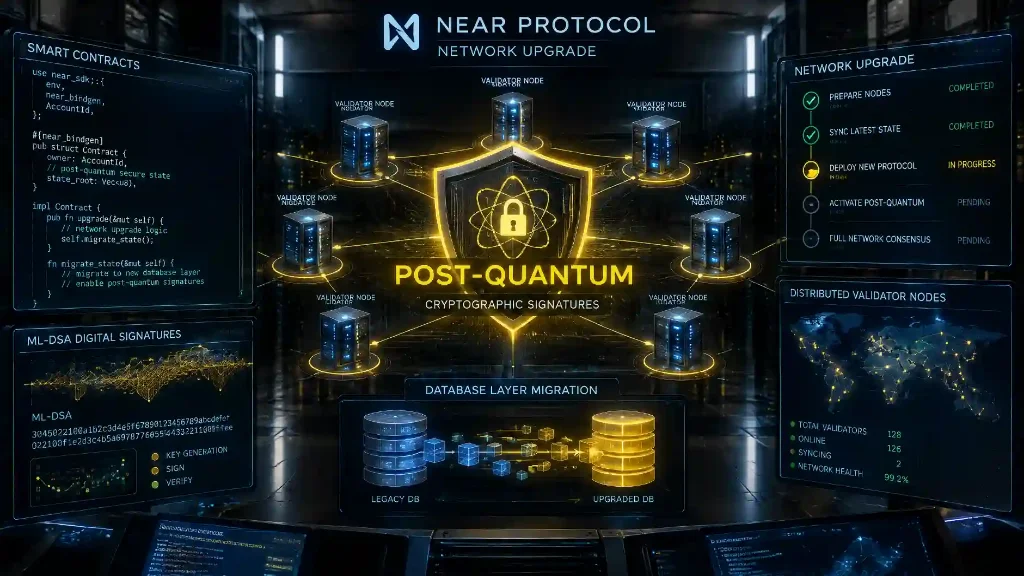


Catenaa, Monday, September 28, 2026- NEAR developers are testing a major nearcore 2.14.0 upgrade that removes contract gas rewards, adds post-quantum signature verification and changes the network database.
The first release candidate, `nearcore 2.14.0-rc.1`, was published September 16.
Developers followed it one day later with `2.14.0-rc.2`, which is now the latest candidate in the series.
The second candidate adds a further code change on top of rc.1 rather than replacing the larger protocol package introduced with the earlier build.
Both remain pre-release software.
That distinction matters because the changes are still moving through testing before a final stable release is promoted for broader deployment.
The 2.14.0 upgrade includes several changes affecting NEAR’s execution environment, validators and smart-contract developers.
One of the most significant removes the existing contract gas-reward mechanism.
NEAR currently returns part of the gas burned by a function call to the smart contract receiving that call.
Under 2.14.0, the `burnt_gas_reward` parameter falls from 30% to zero.
That means contracts will no longer receive a portion of burned gas as a developer reward when users call them.
The change follows a NEAR governance proposal to eliminate the developer gas rebate.
Supporters of removing the rebate have argued that the mechanism is no longer necessary as the ecosystem and network economics have evolved.
The release also adds a native function allowing smart contracts to verify ML-DSA-65 digital signatures.
ML-DSA is a post-quantum signature standard designed to resist attacks from sufficiently powerful quantum computers.
The new `ml_dsa_verify` function allows NEAR contracts to check ML-DSA-65 signatures directly on-chain.
That does not make the entire NEAR blockchain quantum-proof.
NEAR continues to use existing cryptographic systems elsewhere in its protocol and account infrastructure.
The addition instead gives developers a standardized cryptographic tool they can use inside applications where post-quantum verification is required.
Contracts will be able to provide an ML-DSA-65 signature, message and public key to the host function.
The network then returns whether the signature is valid.
Native verification can be more efficient than requiring each developer to reproduce complex cryptographic verification logic inside a smart contract.
The feature could become increasingly relevant as blockchain developers prepare for future migration away from cryptographic systems vulnerable to quantum attacks.
Quantum computers capable of breaking widely deployed public-key cryptography do not currently exist.
However, blockchain networks face a particular planning problem because assets and contracts may remain active for years.
Adding post-quantum capabilities before they are urgently required can give developers more time to test migration strategies.
NEAR’s upgrade also introduces new limits intended to prevent individual transactions or receipts from placing excessive demands on the network.
The combined size of resolved promise inputs will be capped at 4,194,944 bytes.
A receipt exceeding that limit will fail rather than continuing into execution.
Promises are used extensively in NEAR’s asynchronous smart-contract model.
A contract can initiate another call and later receive the result through a callback.
Without explicit limits, unusually large inputs could consume excessive state or processing resources.
The release also applies storage-proof limits more broadly across actions contained within a receipt.
Those changes are intended to place clearer boundaries around resource consumption.
Another protocol change addresses unreliable chunk producers.
NEAR divides network processing across shards, with chunk producers responsible for generating portions of blockchain data.
Under the new rules, a producer repeatedly failing to generate assigned chunks can lose new assignments before the end of an epoch.
Previously, a poorly performing producer could retain assignments until the next epoch boundary.
The revised mechanism can reassign work earlier to healthier producers when performance falls below specified thresholds.
The upgrade also introduces new SHA-3 cryptographic host functions for smart contracts.
Developers will be able to calculate SHA3-256, SHA3-384 and SHA3-512 digests through native functions.
NEAR is also stabilizing what it calls universal accounts.
The system is intended to unify implicit and deterministically created accounts while using a post-quantum-safe account derivation method.
The database changes are equally important for operators running NEAR infrastructure.
Nearcore 2.14.0 raises the database version from 49 to 50.
The migration creates a new database column used to store information about chunk producers.
Nodes running in normal read-write mode can migrate the database automatically when the upgraded software starts.
Operators using a read-only database configuration must take an additional step.
They need to start the database once in read-write mode so the new column can be created before returning to read-only operation.
The release also changes state snapshot behavior.
Nearcore will now create a state snapshot every epoch rather than allowing operators to disable snapshots through the previous configuration option.
State snapshots are important for decentralized state synchronization because they allow nodes to serve blockchain state data to peers.
For validators and infrastructure providers, these changes make 2.14.0 more significant than a routine maintenance release.
A protocol upgrade changes rules that participating nodes must eventually agree on.
A database upgrade can also require local data structures to migrate before a node operates normally.
Release candidates allow operators and developers to test those changes before they reach the stable software used widely on the network.
The appearance of rc.2 shortly after rc.1 shows that process is still active.
NEAR’s developers have not presented the candidate builds as a signal that ordinary users need to take immediate action.
The software primarily affects validators, node operators, infrastructure providers and developers building applications on NEAR.
For users, many changes will remain largely invisible if the final upgrade proceeds smoothly.
The more visible long-term effects could come from applications adopting the new cryptographic functions.
Post-quantum verification could allow developers to experiment with wallets, authentication systems and contracts designed around newer signature standards.
The removal of gas rewards could also influence how contract developers think about revenue and incentives.
Nearcore is the reference software implementation used to run the NEAR Protocol.
Changes introduced there can eventually alter how nodes execute transactions, store network state and enforce consensus rules.
The 2.14.0 series therefore combines several different objectives in one release.
It tightens network limits, changes developer economics, improves chunk-production resilience and expands cryptographic capabilities.
Its post-quantum features are likely to attract the most attention.
But for node operators, the protocol and database migrations may be the more immediate concern.
For now, 2.14.0 remains in release-candidate testing.
The final stable version will determine which of those changes ultimately move from testing into production.