

Catenaa, Friday, September 25, 2026- Bitcoin could receive more support than gold if investors reduce hedging around exchange-traded funds, according to JPMorgan analysts examining institutional positioning in the two assets.
Strategists led by Nikolaos Panigirtzoglou said both bitcoin and gold ETFs attracted money after the Federal Reserve’s July meeting as investors returned to the so-called debasement trade.
That strategy treats scarce assets such as bitcoin and gold as protection against declining purchasing power and concerns over government debt and monetary policy.
The trade has weakened over the past week as inflation-adjusted bond yields increased and the US Senate failed to advance the CLARITY Act.
JPMorgan said gold ETF demand has recovered more strongly than demand for bitcoin funds.
Gold ETFs have now regained all the money withdrawn earlier this year, while bitcoin ETFs have recovered about half of their previous outflows.
Recent bitcoin ETF demand has also eased.
JPMorgan sees an important difference, however, in how investors are positioned around the two markets.
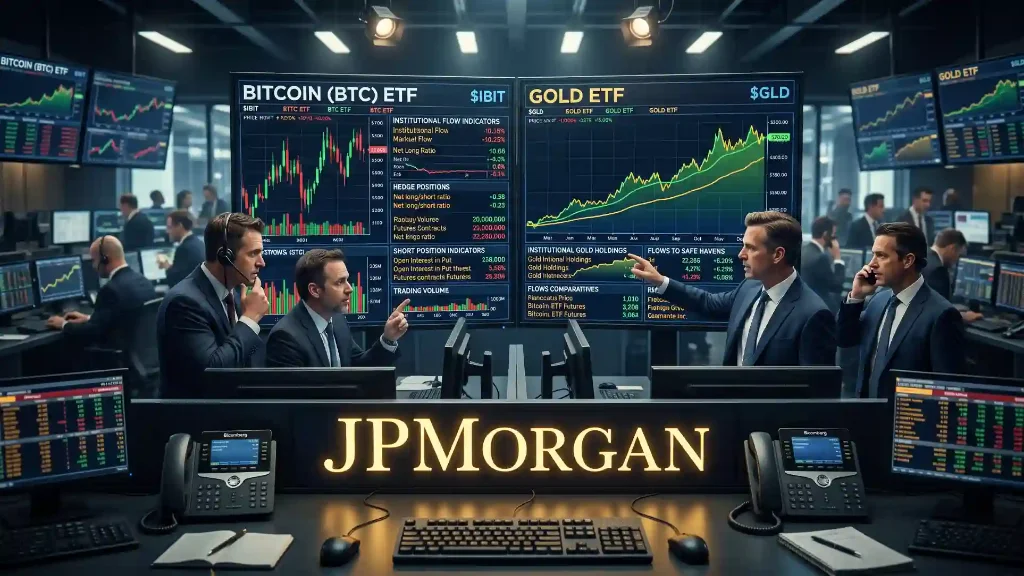
Short interest in BlackRock’s iShares Bitcoin Trust, or IBIT, remains close to its highest level of 2026, according to the analysts.
Short interest in SPDR Gold Shares, known as GLD, remains below its historical average.
That suggests investors are still using more defensive positions around bitcoin than around gold.
Options markets show a similar pattern.
IBIT has a higher put-to-call open interest ratio than GLD, indicating greater demand for protection against declines in the bitcoin fund.
Institutional exposure remains elevated in futures markets for both assets, suggesting professional investors have continued participating despite the recent weakening of ETF demand.
JPMorgan said the unusually high level of hedging around IBIT could become supportive for bitcoin if investors become less cautious and begin closing those positions.
Reducing short positions can itself create buying pressure as traders purchase shares to close bearish trades.
The analysis does not amount to a bitcoin price forecast.
Other factors, including interest rates, inflation expectations, regulatory developments and broader risk appetite, could still determine how bitcoin and gold perform.
The difference identified by JPMorgan is primarily one of positioning.
Gold has already recovered much of its earlier ETF demand, while bitcoin still carries heavier defensive positioning.
If that caution eases, JPMorgan believes bitcoin has more room than gold to benefit from the unwinding of those hedges.